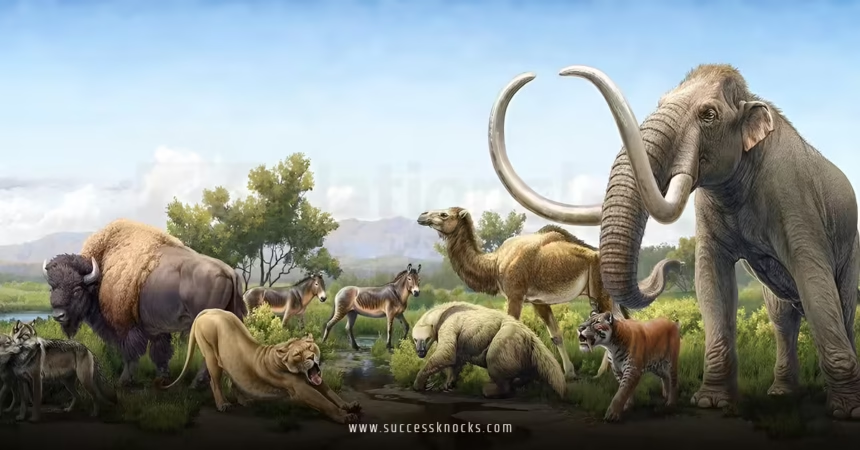
Ancient predators of North America once dominated landscapes that would be unrecognizable today, featuring massive cats, giant bears, and bone-crushing wolves that made modern wildlife look tame by comparison. These Pleistocene powerhouses shaped ecosystems for millions of years before climate change and human arrival triggered the most dramatic extinction event since the dinosaurs disappeared.
Quick Overview:
- North America hosted over 50 species of large predators during the Pleistocene epoch
- Sabertooth cats, giant bears, and dire wolves were apex predators for over 2 million years
- Most ancient predators specialized in hunting megafauna that no longer exists
- Climate change between 15,000-10,000 years ago eliminated 75% of large predator species
- Only the most adaptable predators like grey wolves and mountain lions survived
Let’s explore the incredible predatory dynasty that once ruled this continent—and discover why most of them didn’t make it to see modern America.
The Pleistocene Predator Paradise
Imagine stepping into North America 20,000 years ago. You’d encounter a continent teeming with predators that would make today’s grizzly bears look like house cats.
This wasn’t some primitive wilderness—it was a sophisticated ecosystem where massive predators had evolved intricate hunting strategies over millions of years. The Pleistocene epoch (2.6 million to 11,700 years ago) represented the golden age of North American predators.
Why so many giants? The answer lies in abundant prey. Massive ground sloths, giant beavers the size of black bears, cave bears, woolly mammoths, and American cheetahs created an ecosystem that could support an incredible diversity of specialized hunters.
The Megafauna Buffet
Ancient predators of North America evolved alongside prey animals that dwarf anything alive today:
- Woolly mammoths weighing up to 6 tons
- Giant ground sloths reaching 20 feet tall
- American lions 25% larger than African lions
- Short-faced bears standing 12 feet on hind legs
- Giant beavers with 6-inch cutting teeth
This megafauna abundance created ecological niches for highly specialized predators. Each species carved out specific hunting strategies, prey preferences, and territorial ranges that minimized competition.
The Sabertooth Dynasty: Smilodon fatalis
No discussion of ancient predators of North America would be complete without sabertooth cats—the poster children of Ice Age predation.
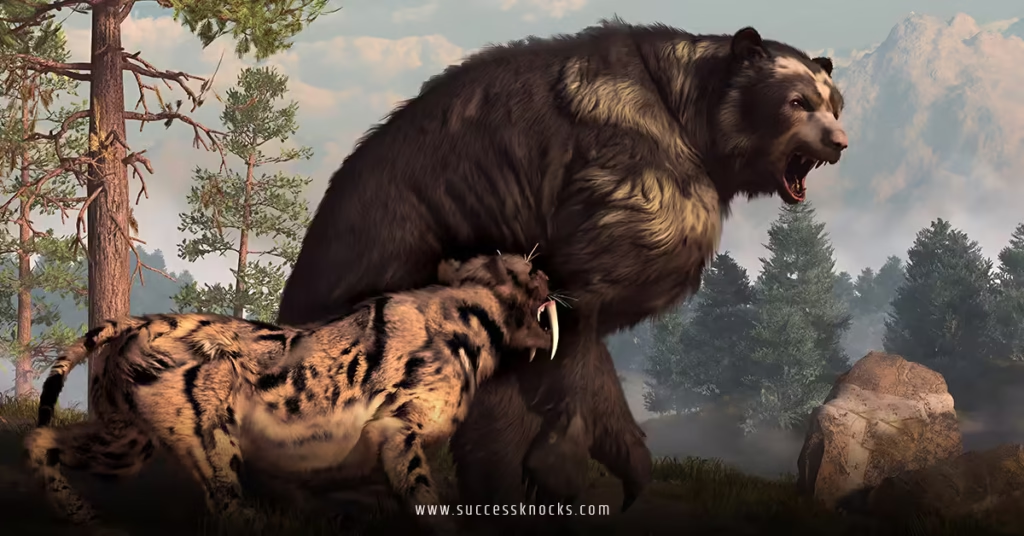
Smilodon fatalis wasn’t built for speed chases. These 400-pound muscle machines perfected ambush hunting with those iconic 7-inch canine teeth. Picture a leopard that spent two years exclusively doing powerlifting, then add sabers.
Sabertooth Hunting Strategy
Sabertooth cats employed precision rather than brute force. Those elongated canines were surgical instruments designed for specific killing techniques:
- Ambush positioning – Hide near water sources or migration routes
- Wrestling takedown – Use massive forelimb muscles to pin large prey
- Precision bite – Insert sabers between neck vertebrae for instant kill
- Group feeding – Share massive carcasses with pride members
Fossil evidence from the La Brea Tar Pits shows sabertooth cats lived in social groups, sharing kills and caring for injured pack members. Their teeth show wear patterns consistent with bone processing—they weren’t just killers, but sophisticated scavengers.
Why Sabertooth Cats Failed
Sabertooth specialization became their downfall. When megafauna populations crashed around 11,000 years ago, these precision hunters couldn’t adapt to smaller, faster prey. Their massive canines became liabilities when hunting deer-sized animals that required pursuit rather than ambush.
The Giant Bear Monopoly: Arctodus simus
Short-faced bears (Arctodus simus) were the ultimate ancient predators of North America—and the stuff of nightmares.
Standing 12 feet tall and weighing up to 1,800 pounds, these bears weren’t just big—they were built for speed. Long legs gave them a 40-mph sprint capability that could run down horses. Imagine a grizzly bear crossed with a greyhound, then supersized.
Short-Faced Bear Dominance
Short-faced bears occupied the apex predator niche across most of North America for over 800,000 years. Their hunting strategy combined size, speed, and intelligence in ways that modern bears can’t match:
Physical Advantages:
- 50% longer legs than modern grizzlies
- Massive skull with bone-crushing bite force
- Enhanced sense of smell for locating carcasses from miles away
- Intimidation factor that scared off other predators
Behavioral Intelligence:
- Kleptoparasitism—stealing kills from other predators
- Seasonal migration following prey herds
- Flexible diet including meat, fish, and vegetation
- Tool use for accessing difficult food sources
The Smithsonian Institution houses extensive short-faced bear remains that demonstrate their continent-wide distribution and ecological impact.
The Bone-Crushing Specialists: Dire Wolves
Among ancient predators of North America, dire wolves represent one of the most successful species—and one of the most mysterious extinctions.
These weren’t oversized grey wolves. Dire wolves (Aenocyon dirus) evolved as specialist bone processors with jaws that could crack mammoth femurs. Their hunting strategy focused on accessing nutrient-rich marrow that other predators couldn’t reach.
The dire wolf vs grey wolf comparison reveals fascinating insights about predator survival strategies. While dire wolves optimized for strength, grey wolves evolved flexibility—a choice that determined which species survived the Pleistocene extinction.
Dire Wolf Pack Dynamics
Recent research suggests dire wolves operated in larger packs than modern wolves, possibly 15-20 individuals coordinating to bring down massive prey. Their bone-crushing specialization allowed entire packs to feed from single mammoth carcasses for weeks.
Fossil evidence shows dire wolves with healed fractures and missing teeth—signs of pack care for injured members. This social cooperation extended their hunting effectiveness across the continent for nearly 250,000 years.
The Speed Demon: American Cheetah
North America once hosted its own cheetah species (Miracinonyx trumani) that could outrun anything alive today. These ancient predators of North America evolved to chase pronghorn antelope—which explains why modern pronghorns can run 70 mph despite having no current predators that fast.
American cheetahs combined Old World cheetah speed with New World cat climbing ability. They could pursue prey up cliffs and through forests in ways their African cousins never mastered.
Unique Adaptations
- Retractable claws for tree climbing (unlike African cheetahs)
- Larger body size for tackling bigger prey
- Enhanced lung capacity for sustained high-speed pursuit
- Flexible spine allowing 25-foot leaping bounds
American cheetahs disappeared around 12,000 years ago, leaving pronghorn antelope with speed capabilities they no longer need—a evolutionary “ghost of predation past.”
The Aquatic Assassin: Giant Otter
Ancient predators of North America weren’t limited to land. Giant otters (Enhydriodon) dominated freshwater ecosystems with 6-foot bodies and bone-crushing jaws.
These weren’t cute river otters. Giant otters were semi-aquatic predators that hunted fish, turtles, and small mammals with the efficiency of crocodiles. Their powerful jaws could crack turtle shells and process large fish that modern otters can’t handle.
Fossil sites across the Great Lakes region show giant otter remains alongside evidence of sophisticated den systems and territorial marking. They controlled freshwater ecosystems for over 5 million years before climate change altered their aquatic habitats.
The Terror Bird Legacy: Titanis walleri
While terror birds originated in South America, Titanis walleri represents the only species that successfully invaded North America during the Great American Biotic Interchange 3 million years ago.
Standing 8 feet tall with massive hooked beaks, terror birds were flightless predators that dominated through speed and crushing power. Their hunting strategy involved running down prey at 40+ mph, then using their massive beaks like axes.
Titanis survived in North America for nearly 2 million years before disappearing around 1.8 million years ago—possibly outcompeted by more adaptable mammalian predators.
Why Most Ancient Predators of North America Went Extinct
The Pleistocene extinction wasn’t a single event—it was a 5,000-year ecological collapse that eliminated 75% of large predator species.
Climate Change Cascade
Rising temperatures around 15,000 years ago triggered massive environmental shifts:
- Grassland conversion – Open grasslands became dense forests
- Prey population crashes – Megafauna couldn’t adapt to new plant communities
- Habitat fragmentation – Large predators lost territory connectivity
- Competition intensification – Remaining prey became highly contested resources
Human Hunting Pressure
Archaeological evidence suggests human arrival around 15,000 years ago coincided with accelerated megafauna extinctions. Early humans didn’t just compete for prey—they actively hunted the largest, most vulnerable species that ancient predators depended on.
Specialization Trap
Most ancient predators of North America had evolved such specific hunting strategies that they couldn’t pivot when their preferred prey disappeared. Sabertooth cats couldn’t chase deer. Short-faced bears couldn’t survive on smaller food sources. Dire wolves couldn’t process smaller bones efficiently.
The Survivors: Why Some Predators Made It
Not all ancient predators of North America went extinct. The survivors share common traits that modern conservation biologists recognize as key to species resilience.
Behavioral Flexibility
Grey wolves survived because they could hunt anything from mice to moose. Their pack strategies adapted to different prey sizes and habitat types.
Mountain lions (pumas) thrived through solitary hunting flexibility and dietary opportunism. They could switch between large ungulates and small mammals based on availability.
Brown bears survived by being omnivorous generalists. When large prey disappeared, they shifted to fish, berries, and smaller mammals.
Genetic Diversity
Survivors maintained large, connected populations that prevented the genetic bottlenecking that affected specialized species. Wide-ranging territories and flexible mating systems preserved evolutionary adaptability.
Human Tolerance
Species that avoided direct conflict with early humans had better survival odds. Mountain lions and wolves could relocate to remote areas, while massive bears and sabertooth cats couldn’t hide from human expansion.
Modern Lessons from Ancient Predators
The study of ancient predators of North America provides crucial insights for current wildlife conservation efforts.
Habitat Connectivity
Large predators require extensive territories and genetic exchange between populations. Modern conservation strategies emphasize wildlife corridors that prevent the isolation that contributed to Pleistocene extinctions.
Climate Adaptation
Today’s predators face similar climate pressures that eliminated their ancient relatives. Species with behavioral flexibility and broad dietary ranges show better resilience to environmental changes.
Human Coexistence
Successfully surviving predators learned to coexist with human activities. Modern conservation requires strategies that allow predators to persist in human-dominated landscapes.
The U.S. Geological Survey conducts ongoing research into predator ecology that builds on lessons learned from Pleistocene extinctions.
Fossil Hotspots: Where to See Ancient Predators
For those interested in experiencing ancient predators of North America firsthand, several sites offer exceptional fossil displays:
La Brea Tar Pits (Los Angeles, California)
The world’s most famous predator fossil site, featuring complete skeletons of sabertooth cats, dire wolves, and American lions preserved in asphalt.
Museum of the Rockies (Bozeman, Montana)
Outstanding displays of short-faced bears, American cheetahs, and regional predator evolution.
Natural History Museum (Washington, D.C.)
Comprehensive collection showing predator diversity across different time periods and regions.
Ashfall Fossil Beds (Nebraska)
Unique site preserving complete ecosystem snapshots including predator-prey interactions.
Key Takeaways: Ancient Predators of North America
- North America supported over 50 large predator species during peak Pleistocene diversity
- Specialization in megafauna hunting created vulnerability during climate change
- Behavioral flexibility and dietary adaptability determined survival success
- Human arrival accelerated extinctions through competition and direct hunting
- Modern predators are evolutionary descendants of the most adaptable ancient species
- Habitat connectivity remains crucial for predator population stability
- Climate change continues to pose threats similar to those that eliminated Pleistocene predators
- Conservation strategies must account for the ecological roles that ancient predators once filled
The legacy of ancient predators of North America lives on in the survivors—and in the ecological gaps left by the species we lost forever.
Conclusion
Ancient predators of North America created one of the most diverse and sophisticated predatory ecosystems in Earth’s history. For millions of years, these incredible hunters shaped entire continents through their evolutionary innovations and hunting strategies.
Their extinction represents both a cautionary tale and a guide for modern conservation. The survivors—wolves, bears, and cats—carry forward the genetic and behavioral heritage of a vanished world. They’re living links to an era when predators ruled supreme.
Understanding these ancient hunters helps us appreciate both what we’ve lost and what we still have. Every wolf howl echoes the voices of dire wolves. Every mountain lion stalk recalls the precision of sabertooth cats. Every bear track follows paths first carved by giants.
The ancient predators are gone, but their evolutionary wisdom lives on in the species we can still protect today.
FAQs
Q: Were ancient predators of North America larger than those on other continents?
A: Yes, North American Pleistocene predators were generally larger than their counterparts elsewhere, likely due to abundant megafauna prey that could support bigger predator body sizes.
Q: Could any ancient predators of North America survive if they were alive today?
A: Probably not without significant adaptation. Most were specialized for hunting megafauna in open grasslands that no longer exist in their historical ranges.
Q: How do scientists know so much about ancient predator behavior?
A: Fossil evidence including tooth wear patterns, bone injuries, coprolites (fossilized feces), and predator-prey associations preserved in sites like La Brea provide detailed behavioral insights.
Q: Why didn’t ancient predators of North America evolve to hunt smaller prey when megafauna disappeared?
A: Evolution requires thousands of generations. The Pleistocene extinction happened too quickly (2,000-5,000 years) for major anatomical and behavioral adaptations to occur.
Q: Are there any plans to reintroduce extinct predators through genetic engineering?
A: While theoretically possible for recently extinct species, most ancient predators went extinct too long ago for viable DNA recovery, and their ecological niches no longer exist.