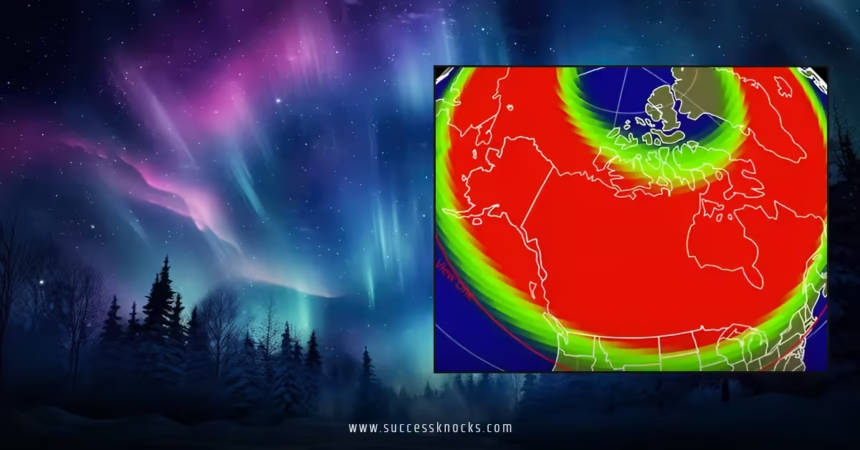
Aurora borealis NOAA watch is one of those exciting phrases that lights up (pun intended) the night sky community whenever solar activity ramps up. If you’ve ever dreamed of standing under a dancing curtain of green, purple, and pink lights, then keeping tabs on an aurora borealis NOAA watch could be your ticket to an unforgettable experience. Issued by the experts at NOAA’s Space Weather Prediction Center (SWPC), these watches alert us to potential geomagnetic storms that push the northern lights farther south than usual. Let’s dive into everything you need to know about this cosmic spectacle, from what triggers it to how you can spot it yourself.
What Exactly Is an Aurora Borealis NOAA Watch?
Imagine the Sun sneezing out a massive cloud of charged particles straight toward Earth—that’s basically a coronal mass ejection (CME), and it’s the main culprit behind strong auroral displays. When those particles slam into our planet’s magnetic field, they spark geomagnetic storms. NOAA steps in here with their aurora borealis NOAA watch system.
An aurora borealis NOAA watch specifically means the SWPC has forecasted conditions ripe for a geomagnetic storm, often rated on the G-scale (G1 being minor, up to G5 extreme). These watches give advance notice—sometimes days ahead—about possible aurora activity. Unlike alerts (which are immediate) or warnings (higher urgency), a watch is like a heads-up: “Hey, keep your eyes peeled in the coming nights!”
The SWPC uses models like OVATION to predict auroral intensity and location. During an active aurora borealis NOAA watch period, the auroral oval expands, making the northern lights visible in places far from the poles—like the northern United States or even parts of Europe and Asia during big events.
Why does this matter? Because auroras aren’t just pretty; they’re a visible sign of space weather impacting tech, from power grids to satellite communications. But for most of us, it’s the thrill of witnessing nature’s light show.
How Does NOAA Monitor and Forecast the Aurora Borealis?
NOAA’s Space Weather Prediction Center is the go-to authority for all things space weather. They track solar wind speed, density, and the interplanetary magnetic field (IMF) using satellites like ACE and DSCOVR. When the Bz component of the IMF turns southward, it opens a door for particles to pour into our atmosphere—hello, vibrant auroras!
Key tools in their arsenal include:
- Aurora 30-Minute Forecast — A short-term prediction showing where and how bright the lights might be in the next half-hour to 90 minutes.
- Aurora Viewline for Tonight and Tomorrow Night — An experimental map predicting visibility over North America, based on expected Kp index peaks.
- Aurora Dashboard (Experimental) — A one-stop hub with real-time animations of the last 24 hours and forecasts.
The Kp index is crucial here—it’s a global measure of geomagnetic activity on a 0-9 scale. During a solid aurora borealis NOAA watch, Kp often climbs to 5 or higher, signaling G1 or G2 storms that extend visibility southward.
These forecasts aren’t crystal balls, but they’re incredibly reliable thanks to decades of data and advanced modeling. NOAA updates them regularly, so checking during an aurora borealis NOAA watch keeps you ahead of the game.
The Science Behind the Aurora Borealis During NOAA Watches
Picture this: high-energy electrons rain down from space, colliding with oxygen and nitrogen molecules about 60-250 miles above Earth. Oxygen glows green at lower altitudes, while nitrogen adds purple and red hues higher up. It’s like nature’s neon sign, powered by solar fury.
During quiet times, the aurora hugs the poles in oval rings. But when an aurora borealis NOAA watch is active—often triggered by a CME—the magnetic field gets jostled, expanding those ovals. Suddenly, folks in mid-latitudes get a front-row seat.
The colors and shapes vary wildly. Sometimes it’s a faint glow; other times, full-on curtains waving like ethereal flags. Fast-moving rays or pulsing patches often signal stronger activity. The best shows peak around midnight local time, when your location rotates under the auroral zone.
Fun analogy: Think of Earth’s magnetic field as a shield, but during storms, it’s like the shield gets dented, letting solar particles sneak in and paint the sky.
Tips for Viewing During an Active Aurora Borealis NOAA Watch
Got an aurora borealis NOAA watch in play? Here’s how to maximize your chances:
- Find Dark Skies — Light pollution is the enemy. Head to rural areas, state parks, or anywhere with low Bortle scale ratings.
- Check the Timing — Peak activity often hits between 10 PM and 2 AM. Watches cover tonight and tomorrow, so plan accordingly.
- Look North (in the Northern Hemisphere) — Even if you’re not under the oval, the lights can appear low on the horizon.
- Be Patient and Warm — Auroras are fickle. Bundle up, bring hot drinks, and give it time—displays can fade and flare unexpectedly.
- Use Apps and Alerts — Set notifications for NOAA updates or use apps that pull SWPC data.
Clear skies are non-negotiable. Cloud cover ruins everything, so pair your aurora borealis NOAA watch excitement with a good weather forecast.
For the best viewing tips straight from the pros, check out NOAA’s Tips on Viewing the Aurora.

Recent Examples of Aurora Borealis NOAA Watch Events
Aurora borealis NOAA watch alerts have led to some spectacular shows in recent years, especially during the rising phase of Solar Cycle 25. Strong CMEs have triggered G1-G3 storms, pushing lights into unusual spots.
For instance, minor geomagnetic storm watches have allowed sightings in northern U.S. states like Minnesota, Michigan, and Maine—far south of typical auroral zones. During these events, people reported vivid greens and occasional reds, with photos flooding social media.
The key takeaway? Even modest aurora borealis NOAA watch levels can deliver magic if conditions align. Higher Kp values mean broader reach and brighter displays.
Understanding Geomagnetic Storms and Their Link to Aurora Visibility
Geomagnetic storms are classified G1 (minor) to G5 (extreme). An aurora borealis NOAA watch often precedes G1 or G2 storms, where auroras become visible at lower latitudes.
- G1: Lights visible in northern states.
- G2-G3: Mid-latitudes, stronger colors.
- G4+: Rare, widespread spectacles.
These storms also bring risks like power fluctuations or GPS disruptions, but for skywatchers, they’re a gift.
NOAA issues watches when models predict storm levels, giving you time to prepare. Always cross-check with the latest 3-Day Forecast for context.
Why Trust NOAA for Your Aurora Borealis NOAA Watch Updates?
NOAA’s SWPC is backed by government resources, satellite data, and scientific expertise. They’re the official U.S. source for space weather, collaborating globally. Their forecasts are transparent, updated frequently, and free—perfect for beginners and pros alike.
Unlike some apps or sites that sensationalize, NOAA sticks to facts. During an aurora borealis NOAA watch, their dashboard and products provide the most trustworthy info.
Conclusion
Aurora borealis NOAA watch isn’t just jargon—it’s your gateway to one of Earth’s most mesmerizing natural wonders. From understanding solar triggers to using NOAA’s cutting-edge forecasts, you’re now equipped to chase the northern lights like a pro. Next time a watch drops, grab your camera, find a dark spot, and let the sky put on its show. Who knows? You might witness something truly unforgettable. Stay alert, stay curious, and happy hunting!
Here are three high-authority external links for more information:
- NOAA Space Weather Prediction Center Aurora Dashboard
- NOAA Aurora 30-Minute Forecast
- NOAA Tips on Viewing the Aurora
FAQs
What does an aurora borealis NOAA watch actually mean?
An aurora borealis NOAA watch is a heads-up from NOAA’s Space Weather Prediction Center that geomagnetic conditions could lead to visible northern lights in the coming days, often due to expected solar activity pushing auroras southward.
How far in advance does NOAA issue an aurora borealis NOAA watch?
NOAA typically issues aurora borealis NOAA watch notices 1-3 days ahead based on solar wind and CME data, with more precise short-term forecasts available via their 30-minute and nightly viewline tools.
Where can I see the aurora during an active aurora borealis NOAA watch?
During an aurora borealis NOAA watch, visibility extends to northern U.S. states like Alaska, Minnesota, Michigan, and Maine if activity reaches G1-G2 levels—check NOAA’s viewline map for your exact location.
Is an aurora borealis NOAA watch the same as an alert or warning?
No—an aurora borealis NOAA watch is a forecast of potential activity, while alerts are real-time notifications and warnings indicate higher confidence or severity in ongoing or imminent storms.
How reliable are aurora borealis NOAA watch predictions?
Aurora borealis NOAA watch predictions from SWPC are highly reliable, using satellite data and models like OVATION, though exact intensity and timing can vary due to the dynamic nature of space weather.