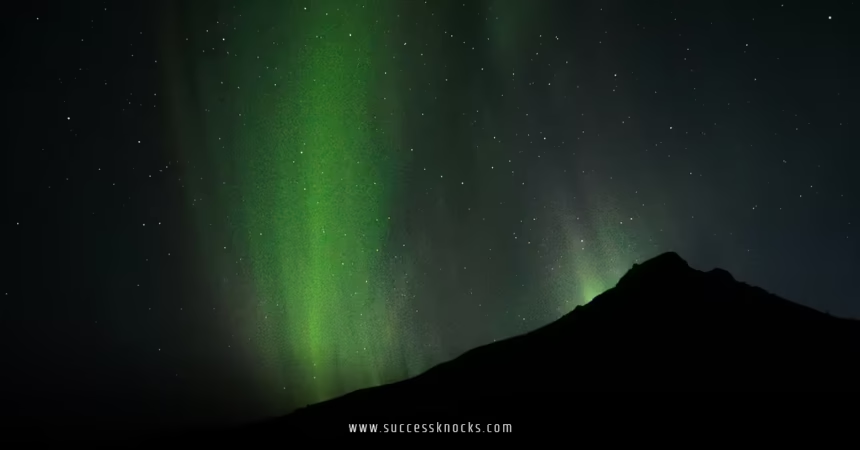
Best spots to see northern lights auroras in 2026 have shifted slightly compared to previous years, thanks to natural solar activity cycles and evolving accessibility across North America. If you’re chasing that green curtain dancing across the night sky, you need to know where the odds are genuinely in your favor—and when.
Here’s the thing: the aurora borealis doesn’t care about your convenience. It’s a function of solar wind, Earth’s magnetosphere, and your position relative to the auroral oval. But there are specific locations where you stack the deck in your favor, especially heading into the latter half of 2026 when solar activity is expected to remain relatively high following the peak of Solar Cycle 25.
Early Overview: What You Need to Know
Best spots to see northern lights auroras in 2026 are concentrated in three primary regions across the USA, each with distinct advantages:
- Alaska remains the most reliable, with Fairbanks sitting almost directly under the auroral zone
- Northern Minnesota and Wisconsin offer better accessibility for those who can’t travel as far west
- Montana’s far north is emerging as an underrated option for serious aurora chasers
- Timing matters more than location: geomagnetic storms (rated on the Kp index) make or break a viewing session
- Winter viewing (September–March) yields higher success rates, though auroras occur year-round during strong geomagnetic activity
The reason these spots work? Latitude. Proximity to the auroral oval—an imaginary ring around Earth’s magnetic poles—is everything. The further north you go, the higher your baseline odds.
Why 2026 Is a Better Year for Aurora Chasing
We’re riding the tail end of Solar Cycle 25, which peaked in 2024. Don’t let that fool you. Solar activity doesn’t drop off a cliff; it declines gradually. Through 2026, we’re still expecting solid auroral activity, especially during geomagnetic storms triggered by coronal mass ejections (CMEs) from the sun.
What does that mean for you? More viewing windows. More chances to witness the show.
The misconception is that you only see auroras during the solar maximum. False. Strong geomagnetic storms can push the aurora south into lower latitudes, making sites in Wisconsin or Minnesota viable on active nights. But I wouldn’t bank on it. Your best bet? Get north. Stay north. Wait for the sky to light up.
The Top US Locations for Northern Lights Auroras in 2026
Alaska: The Gold Standard
Fairbanks is the heavyweight champion here. Located at 64.8° north latitude, Fairbanks sits almost directly beneath the auroral oval during peak geomagnetic activity. The city sees auroras on roughly 240 nights per year on average, though not every night is equally dramatic.
The trade-off? It’s expensive to get there, and it’s cold. Winter temperatures regularly hit -30°F or colder. But if you’re serious about seeing the aurora—not hoping to catch it on a random night—Fairbanks is where you go.
Nearby Denali National Park (about 120 miles south) is another solid option if you want a scenic backdrop with fewer tourists. The park itself offers darker skies away from Fairbanks’s light pollution, though accessibility in winter can be tricky.
Prudhoe Bay, on Alaska’s Arctic coast, is the northern extreme. It’s brutal to reach and even more brutal to experience, but it offers the absolute highest latitude accessible by vehicle (70.2° north). This is for the committed only.
What I’d do: Base yourself in Fairbanks. It has infrastructure, restaurants, hotels, and scheduled tour operators. From there, take day trips to darker sky sites outside the city if conditions look favorable.
Northern Minnesota & Wisconsin: The Accessible Alternative
Here’s the kicker: Minnesota and Wisconsin are heavily underrated for aurora viewing. Grand Rapids, Minnesota (47.5° north) and Bayfield, Wisconsin (47.0° north) sit on the edge of the auroral zone during moderate-to-strong geomagnetic activity. During Kp index ratings of 6 or higher, auroras are genuinely visible from these locations.
The advantage? Lower cost, shorter travel time for US-based viewers, and milder winters compared to Alaska (though still cold—we’re talking -10°F to 0°F, not -30°F).
The downside? Lower baseline frequency. You’re counting on geomagnetic storms to bring the aurora into view. Passive waiting doesn’t work. You need to monitor space weather forecasts and be ready to drive north on short notice.
Voyageurs National Park in Minnesota is worth mentioning. It’s remote, has minimal light pollution, and sits at the right latitude. December through February is prime time. The caveat: winter accessibility can be limited.
Montana & Wyoming: Emerging Options
West Glacier, Montana (48.5° north) sits tantalizing close to the auroral oval. During strong geomagnetic events (Kp 7+), auroras are visible here. The bonus: the area is less crowded than Alaska, and it’s close to Glacier National Park if you want to combine your trip.
Yellowstone’s northern sections and the Beartooth Highway region offer similarly favorable latitude with excellent dark skies, though aurora visibility is hit-or-miss outside of strong storm events.
These aren’t my primary recommendations for aurora-specific trips, but they’re solid secondary options if you’re already in the region or want to combine aurora chasing with other outdoor activities.
Location Comparison Table: Best Spots to See Northern Lights Auroras in 2026
| Location | Latitude | Avg. Annual Aurora Nights | Best Months | Cost Level | Accessibility | Ideal For |
|---|---|---|---|---|---|---|
| Fairbanks, AK | 64.8°N | ~240 | Sep–Mar | High | Good (flights) | Serious chasers |
| Denali, AK | 63.7°N | ~220 | Sep–Mar | High | Moderate (drive) | Scenic combo trips |
| Prudhoe Bay, AK | 70.2°N | ~280 | Sep–Mar | Very High | Limited (tours only) | Extreme adventurers |
| Grand Rapids, MN | 47.5°N | ~60 | Dec–Feb | Low | Excellent (drive) | Storm watchers |
| Bayfield, WI | 47.0°N | ~50 | Dec–Feb | Low | Excellent (drive) | Casual viewers |
| West Glacier, MT | 48.5°N | ~40 | Dec–Feb | Medium | Good (drive) | Combined activities |
Timing Your Trip: When to Chase the Aurora in 2026
Latitude matters, but timing is the multiplier. You can be at the best latitude on Earth and see nothing if the space weather is quiet.
Understanding Geomagnetic Activity
The Kp index measures geomagnetic disturbance on a scale of 0 to 9. Here’s the practical breakdown:
- Kp 0–3: Aurora likely only visible above 65°N (Fairbanks has a shot; Minnesota doesn’t)
- Kp 4–5: Fairbanks almost guaranteed; Minnesota possible
- Kp 6–7: Visible from Minnesota and Wisconsin; Fairbanks lights up dramatically
- Kp 8–9: Aurora visible from 40°N southward; you might catch it from Nebraska
Check NOAA’s Space Weather Prediction Center daily. They provide 3-day forecasts and Kp index predictions. When they call for Kp 6 or higher, move north immediately if you can.
Seasonal Patterns for 2026
September–November (autumn): Solar activity is unpredictable, but long nights mean extended viewing windows once darkness sets in. Success is boom-or-bust.
December–February (winter): Prime season. Maximum darkness (civil twilight ends around 2–3 PM at high latitudes), and historically consistent geomagnetic activity. This is when I’d plan my serious aurora trip.
March–May (spring): Shoulder season. Days lengthen quickly, shortening viewing windows. But spring storms can trigger intense auroral displays. Play it by ear.
June–August (summer): Forget it at southern latitudes. Midnight sun makes traditional aurora viewing impossible. Even in Fairbanks, 24-hour daylight makes auroras too faint to see visually. (Photography might catch them, but not naked-eye viewing.)
Step-by-Step Action Plan: How to See the Northern Lights in 2026
Step 1: Choose Your Location
Decide based on budget, travel distance, and risk tolerance:
- Priority 1: See the aurora no matter what → Fairbanks, Alaska
- Priority 2: Balance cost and odds → Grand Rapids, Minnesota or Bayfield, Wisconsin
- Priority 3: Combined trip (aurora + sightseeing) → Denali or West Glacier
Step 2: Lock in Your Dates
Book flights/hotels for December–February when possible. This is non-negotiable if you want high odds. Give yourself at least 3–4 nights. One night is rarely enough to catch a display.
Step 3: Monitor Space Weather
Starting 2 weeks before your trip, check NOAA’s forecast daily. If they predict Kp 5+, you’re in good shape. If it’s Kp 3 or lower, manage expectations—you might still see something, but no guarantees.
Pro tip: Sign up for email alerts from Space Weather Prediction Center or use a mobile app like MyACT or Aurora Forecast. They’ll ping you when conditions spike.
Step 4: Prepare Gear
- Camera: Optional but recommended. Your phone works if you’re desperate, but a DSLR or mirrorless camera with a wide-angle lens (14mm–24mm) captures the aurora much better than the naked eye.
- Clothing: Layers. Thermal base layers, insulating mid-layer, waterproof outer shell. Extreme cold can be dangerous; don’t skimp here.
- Tripod: If you’re photographing, non-negotiable.
- Hand warmers and thermos: Coffee is your friend.
Step 5: Get Away From Light Pollution
Once you’re in your chosen town, find a viewing spot at least 20–30 minutes away from major city lights. Ask your hotel for recommendations. Dark sky sites (check Dark Sky Finder) are ideal but not strictly necessary if geomagnetic activity is strong enough.
Step 6: Wait (Actively)
Set your phone alarm for midnight and 2 AM. Check the sky every 1–2 hours between 10 PM and 4 AM. Auroras are most reliable between these hours, though they can appear earlier or later.
Bring a camping chair and thermos. This isn’t passive—it’s active vigilance. When you see the first faint green glow, you’ll understand why.
Common Mistakes—And How to Fix Them
Mistake 1: Booking Only One Night
The Fix: Commit to at least 3 nights, ideally 4–5. One night gives you a 20% success rate even in Fairbanks. Multiple nights compound your odds.
Mistake 2: Traveling During Summer
The Fix: The midnight sun in Alaska makes auroras invisible to the naked eye between May and August. Winter or shoulder season only.
Mistake 3: Ignoring the Kp Index
The Fix: Don’t just book a trip and hope. Check geomagnetic forecasts 2 weeks out. Adjust your dates if a strong storm is predicted.
Mistake 4: Staying in the City
The Fix: Light pollution kills aurora visibility. Drive or book accommodations outside city limits. Even 30 minutes makes a difference.
Mistake 5: Expecting the Aurora to Match Photos
The Fix: Camera sensors capture auroras more intensely than your eye. The real display is more subtle but still stunning. Adjust expectations—it’s still magical, just different.
Mistake 6: Poor Cold-Weather Preparation
The Fix: Extreme cold is dangerous. Invest in real winter gear. Frostbite is real. Cotton kills—use synthetic or wool base layers.
Key Takeaways
- Best spots to see northern lights auroras in 2026 range from Fairbanks (most reliable) to Minnesota/Wisconsin (more accessible) depending on your priorities
- Latitude is foundational, but the Kp index determines actual visibility on any given night
- Winter (December–February) is prime season; don’t waste time in summer
- Commit to at least 3–4 nights to meaningfully improve your odds
- Monitor NOAA space weather forecasts starting 2 weeks before your trip and be ready to adjust dates
- Get away from city lights and bring proper cold-weather gear
- The naked eye display is more subtle than photos suggest, but equally awe-inspiring if you manage expectations
- Solo trips work, but group tours offer structure—choose based on your comfort level and budget
Conclusion
Best spots to see northern lights auroras in 2026 demand respect for both latitude and timing. Fairbanks remains your best bet for raw probability, but Minnesota and Wisconsin offer genuinely viable alternatives if you’re willing to chase geomagnetic forecasts and commit to multiple nights.
The real secret? Stop thinking of this as a vacation where you show up and the aurora performs. Reframe it as an active hunt. You’re monitoring space weather, driving at midnight, sitting in the cold with coffee and patience. That’s not a downside—that’s the actual experience. The aurora is the payoff.
Book your trip for December or January. Keep tabs on NOAA’s forecasts. Get north. Bring real winter gear. Give yourself at least three nights. When that green curtain starts dancing across the sky, you’ll forget every moment of cold and inconvenience.
FAQ: Northern Lights Viewing in 2026
Q: What’s the difference between “aurora borealis” and “northern lights”?
A: They’re the same thing. Aurora borealis is the scientific name; northern lights is the colloquial term. Both refer to the luminous display caused by charged particles from the sun colliding with Earth’s magnetosphere.
Q: Is 2026 still a good year for seeing auroras, or is the solar cycle winding down?
A: 2026 remains favorable. While Solar Cycle 25 peaked in 2024, geomagnetic activity stays elevated through 2026 and into 2027. You’re not missing a window—strong storms are still occurring regularly.
Q: Can I see best spots to see northern lights auroras in 2026 from the continental US without traveling to Alaska?
A: Yes, but with caveats. During Kp 6+ geomagnetic storms, auroras can reach Minnesota, Wisconsin, and Montana. However, you’re banking on storm activity. Alaska offers higher baseline frequency. If you’re constrained to the lower 48, monitor forecasts closely and be ready to drive north on short notice.
Q: Do I need expensive camera gear to enjoy the aurora, or is the naked eye enough?
A: The naked eye is absolutely sufficient for a memorable experience. Cameras enhance the colors and intensity in photos, but your eyes will see the display in real time, which is equally powerful. Expensive gear is optional, not essential.
Q: What’s the best aurora tour company for beginners in 2026?
A: Fairbanks-based operators like Aurora Village Tours and companies operating through hotels have established reputations. For Minnesota, local guides in Grand Rapids or International Falls are solid options. Read recent reviews, confirm their guarantees, and ask about backup dates if conditions don’t cooperate on your first night.