


Best V8 muscle cars under $40,000—this is where the real deal lives. You don’t need to drop $60k to feel genuine American muscle thrashing beneath your foot. In 2026, the used market is flooded with capable V8 performers that’ll deliver head-turning acceleration and that unmistakable rumble without bankrupting you. The trick is knowing which ones are worth your money and which ones are money pits wearing a cool badge.
Quick Overview: Best V8 Muscle Cars Under $40,000
- Best overall value: Used Dodge Charger/Challenger with recent V8s
- Best for reliability: Chevrolet Camaro (2016+) or Corvette stingray variants
- Best bang-for-buck: Chrysler 300C with V8 (often overlooked gem)
- Best depreciation play: Ford Mustang GT models (2015–2018)
- Best sleeper pick: Dodge Magnum R/T (if you can find one)
Why Under $40k? The Golden Zone Explained
Here’s the reality: depreciation hits hardest in the first five years. A $55,000 new muscle car becomes a $35,000 used car within 48 months. That’s your window. You get recent enough technology (good infotainment, reliable electronics), young enough engines (fewer miles, less wear), but priced like someone else absorbed the depreciation hit.
Insurance is still reasonable. Parts are abundant and cheap. And most importantly, you’re not financing for seven years to own a depreciating asset.
The sweet spot? 2015–2021 model years. Old enough to have dropped significantly in price. New enough that you’re not gambling on reliability. Think of it as catching yesterday’s luxury car at today’s bargain prices.
The Contenders: Best V8 Muscle Cars Under $40,000
1. Dodge Charger & Challenger (Used V8 Models)
Why they top the list: The Dodge Charger vs Challenger comparison I mentioned earlier? That dynamic gets even better when you’re shopping used. A 2016–2019 Charger R/T with 370 HP or a Challenger R/T with similar output is pure value. You’re getting genuine American muscle—not some turbocharged pretender—with proven reliability and a massive aftermarket ecosystem.
Real numbers (2026 market):
- 2017 Charger R/T: $28,000–$36,000 (80,000+ miles)
- 2016 Challenger R/T: $25,000–$35,000 (75,000+ miles)
- Cleaner examples push toward $40k
What to watch: Transmission. The 8-speed automatic is solid, but check service records. Any evidence of burnouts or track use? Walk. Rust on undercarriage? Potential money pit. Otherwise, these are workhorses.
Horsepower: 370–495 HP depending on year and package 0–60: 5.8–6.2 seconds (R/T models) MPG: 15–18 combined (realistic, not EPA optimistic)
2. Chevrolet Camaro SS (2016+)
Why it deserves your attention: The Camaro SS punches above its weight in this price range. The 6.2L V8 is a monster—455 HP standard, and the chassis is genuinely responsive. This isn’t a muscle car that felt dated by 2020; it’s a modern sports car that happens to have traditional muscle car proportions.
Real numbers (2026 market):
- 2017 Camaro SS: $26,000–$35,000 (70,000+ miles)
- 2018–2019 examples: $30,000–$40,000 (60,000–80,000 miles)
What to watch: Interior quality is middle-of-the-road—don’t expect luxury. Visibility is notoriously tight (a design quirk, not a defect). Rear differential whine under heavy acceleration is normal, not a problem. Check suspension bushings for wear; replacements aren’t cheap.
Horsepower: 455 HP standard 0–60: 3.9–4.1 seconds MPG: 16–19 combined (better than Dodge, actually)
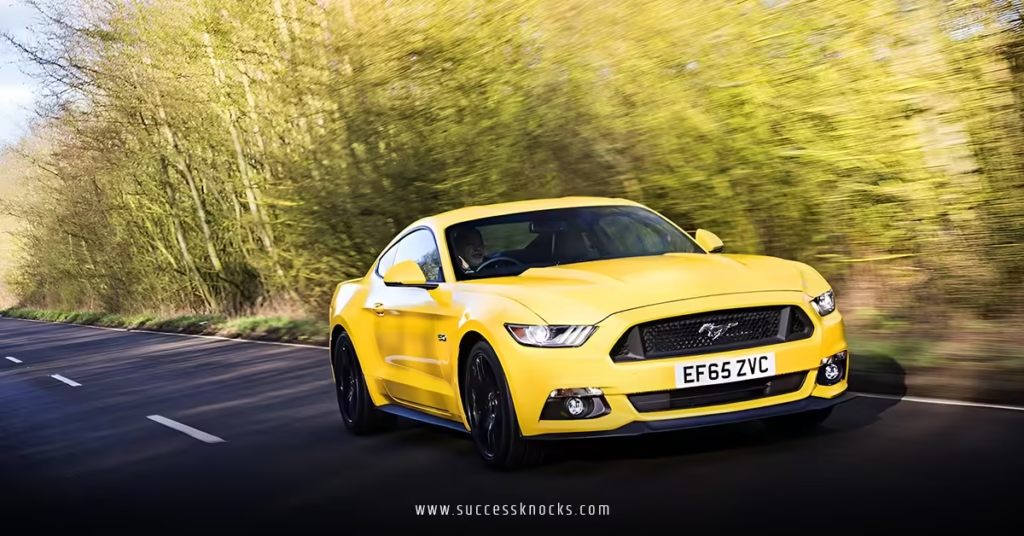
3. Ford Mustang GT (2015–2018)
Why it’s the classics guy’s choice: The S550 generation (2015+) finally gave the Mustang a proper chassis. The 5.0L V8 is legendary—simple, reliable, and easy to modify. You get heritage, proven engineering, and a car that’s been out of warranty long enough that prices have settled.
Real numbers (2026 market):
- 2015–2016 Mustang GT: $24,000–$32,000 (80,000+ miles)
- 2017–2018 examples: $28,000–$37,000 (65,000–75,000 miles)
What to watch: Transmission is a weak point on early models. The 6-speed manual is solid, but some automatics had issues. Ask for transmission service records specifically. Otherwise, 5.0Ls are bulletproof if maintained.
Horsepower: 435 HP (2015–2018) 0–60: 4.0–4.2 seconds MPG: 16–18 combined
4. Chevrolet Corvette Stingray (C7, Pre-2014)
The curveball pick: C7 Corvettes are dropping into this price range for used examples with higher mileage. You’re getting supercar performance in a package that turns heads differently than a Charger. The 6.2L LS engine is torque-rich (455 HP standard), and handling is genuinely sharp.
Real numbers (2026 market):
- 2014–2015 C7 Stingray: $38,000–$42,000 (30,000–50,000 miles; slightly over budget but worth noting)
- Earlier C6 models (2008–2013): $28,000–$35,000 (60,000–90,000 miles)
What to watch: Corvettes are complex. Service costs are higher than muscle cars. Tires are expensive. Insurance can be pricey. But reliability is excellent if serviced at Chevy dealers. C6s are more affordable and nearly as capable.
Horsepower: 455 HP (C7), 430 HP (C6) 0–60: 3.7–3.9 seconds (C7) MPG: 16–18 combined
5. Chrysler 300C V8 (Pre-2015)
The overlooked gem: This one’s flying under the radar, which means prices are stupid low. You’re getting a 363-HP V8 wedged into a full-size sedan that feels like a luxury car and looks like a mobster’s fantasy. It’s not as sharp-handling as a Charger, but it’s deeply underrated and wildly underpriced.
Real numbers (2026 market):
- 2011–2014 Chrysler 300C: $18,000–$28,000 (70,000–100,000 miles)
- Cleaner examples: $25,000–$35,000
What to watch: These can have transmission issues if flogged hard. Suspension components wear faster than modern designs. But a well-maintained example is a bargain. Check service records obsessively.
Horsepower: 363 HP 0–60: 5.5–5.8 seconds MPG: 13–17 combined (not efficient, but honest)
6. Dodge Magnum R/T (2005–2008)
The wagon wildcard: A performance wagon with a V8? That’s either brilliant or insane depending on your perspective. The Magnum R/T has a cult following for good reason. It’s practical, unusual, and fast for its size. You’ll own the only one on your block.
Real numbers (2026 market):
- 2006–2008 Magnum R/T: $18,000–$28,000 (80,000–120,000 miles)
What to watch: These are older, so wear and tear is expected. Transmission reliability is decent but not guaranteed. Parts are available but not always in stock. Rust on undercarriage is common in salt-belt states.
Horsepower: 425 HP 0–60: 5.8–6.1 seconds MPG: 14–17 combined
Comparison Table: Best V8 Muscle Cars Under $40,000
| Car | Engine | HP | 0–60 | Typical Price | Best For |
|---|---|---|---|---|---|
| Dodge Charger R/T (2017) | 5.7L V8 | 370 | 5.9s | $28k–$36k | Practicality + Power |
| Dodge Challenger R/T (2016) | 5.7L V8 | 370 | 6.1s | $25k–$35k | Classic looks |
| Chevy Camaro SS (2017) | 6.2L V8 | 455 | 3.9s | $26k–$35k | Handling + Speed |
| Ford Mustang GT (2017) | 5.0L V8 | 435 | 4.1s | $28k–$37k | Reliability |
| Corvette C7 (2014) | 6.2L V8 | 455 | 3.7s | $38k–$42k | Performance |
| Chrysler 300C (2014) | 5.7L V8 | 363 | 5.7s | $20k–$28k | Value |
| Dodge Magnum R/T (2007) | 6.1L V8 | 425 | 5.9s | $18k–$28k | Uniqueness |
The Economics: Total Cost of Ownership
Buying the car is step one. Owning it is step two, and that’s where surprises happen.
Annual fuel costs (estimated):
- 12,000 miles/year at $3.50/gallon and 16 MPG combined = ~$2,625/year
- These aren’t hybrids. Budget accordingly.
Insurance (varies by location, driver age, and model):
- Sports car classifications can bump premiums 15–25% vs. sedans
- Muscle cars are generally cheaper to insure than exotics
- Realistic estimate: $1,200–$1,800/year for a 30+ driver with clean record
Maintenance:
- Oil changes: $60–$100 (use synthetic; it’s worth it)
- Tire rotations: $50–$80 per rotation
- Brake service: $400–$800 (don’t cheap out)
- Unexpected repairs on a 7–10 year old car: budget $1,000–$2,000/year as reserve
Real math: Total annual ownership costs for a $35k muscle car run $4,500–$6,500 depending on driving habits and luck. That’s roughly $375–$540/month all-in.
Best V8 Muscle Cars Under $40,000: Common Mistakes
Mistake 1: Ignoring service records Reality: A bargain-priced Charger with spotty maintenance history will cost more in repairs than one priced $2k higher with full service records. Always ask for documentation.
Mistake 2: Confusing “V8” with “performance” Reality: A 2010 Charger R/T isn’t the same as a 2018 Charger R/T. Horsepower, fuel injection tech, transmission responsiveness—all improved. Don’t buy solely on badge; compare generations.
Mistake 3: Underestimating fuel costs Reality: People cringe when they fill up a 18-gallon tank twice a week. If you drive 15k miles annually, you’re spending $2,600+ on fuel alone. Be honest about driving habits.
Mistake 4: Skipping the pre-purchase inspection Reality: A $150 inspection by an independent mechanic can save $5,000+ in hidden repairs. Non-negotiable.
Mistake 5: Buying the cheapest example without context Reality: That $22k Charger with 120k miles might need transmission work in 6 months. The $32k example with 70k miles and service records is the actual deal.
How to Shop Smart: Step-by-Step Action Plan
Step 1: Define your priorities Performance? Practicality? Classic appeal? Budget doesn’t change the answer—it just narrows your options. Be clear before hunting.
Step 2: Set a firm budget (including reserves) If you’re spending $35k on the car, set aside $2k–$3k for immediate repairs or replacements. Honest budget = $37k–$38k total.
Step 3: Identify 3–5 specific models Don’t just search “cheap V8 cars.” Pick exact years and trims. 2017 Mustang GT, 2016 Charger R/T, etc. Narrow the field before browsing.
Step 4: Check market data Use Edmunds, Kelley Blue Book, and local classifieds to understand realistic pricing. If a deal seems too good, it probably is.
Step 5: Inspect in person
- Walk around it cold (don’t let the seller start it first)
- Look for rust, panel gaps, mismatched paint
- Check tire tread and brake pad thickness
- Listen to the engine at idle and under acceleration
- Test all systems (AC, windows, lights, infotainment)
Step 6: Get a pre-purchase inspection Take it to an independent mechanic before negotiating. Their findings are your leverage.
Step 7: Negotiate with data Armed with inspection results, comparable pricing, and service history, you can negotiate confidently. Don’t lowball, but don’t overpay either.
Step 8: Close the deal and maintain religiously Once you own it, change oil every 5,000 miles, rotate tires, and address problems early. Prevention beats cure.
Key Takeaways: Best V8 Muscle Cars Under $40,000
- The used V8 market in 2026 is packed with value—depreciation has reset prices to reasonable levels.
- 2015–2021 model years hit the sweet spot between newness and affordability.
- Dodge Charger and Challenger models dominate the budget muscle car space, especially when comparing Dodge Charger vs Challenger options in the under-$40k range.
- Chevrolet Camaro SS offers better handling and efficiency than direct Dodge competitors.
- Ford Mustang GT prioritizes reliability and simplicity; the 5.0L V8 is proven and modification-friendly.
- Chrysler 300C and Dodge Magnum are hidden gems—massively underpriced due to lack of enthusiast hype.
- Total cost of ownership matters more than purchase price; factor in fuel, insurance, and maintenance.
- Pre-purchase inspection is non-negotiable; it costs $150 and saves thousands.
- Service records trump everything; a well-maintained cheaper car beats a neglected expensive one.
- Depreciation is your friend on used muscle cars; what was a $60k car is now a $35k car.
Conclusion: Finding Your V8 Muscle Car
The best V8 muscle cars under $40,000 aren’t theoretical—they’re sitting in driveways and dealerships right now, waiting for someone willing to do the homework. You don’t need to buy new. You don’t need to spend beyond your means. You just need to know what you’re looking at.
Start with a clear priority: do you want a four-door sedan (Charger), a two-door coupe (Challenger), or pure performance (Camaro)? If you’re torn between the sedan and coupe experience, the Dodge Charger vs Challenger comparison I covered earlier breaks down those differences precisely.
Once you’ve narrowed the field, hunt methodically. Check service records. Get an inspection. Negotiate fairly. And commit to maintaining the car once it’s yours.
Do this right, and you’ll own a genuinely quick car that turns heads and delivers real thrills—all without the financial regret that kills joy.
Now go find your muscle car.
External References:
- Edmunds — Used Car Pricing & Valuations — Verify current market pricing and model comparisons for accurate under-$40k market data.
- Kelley Blue Book — Vehicle Valuations & Reviews — Cross-reference pricing, track depreciation trends, and access owner reviews for real-world ownership feedback.
- National Association of Automotive Service Excellence (ASE) — Find certified mechanics for pre-purchase inspections to verify vehicle condition and identify potential repairs.
FAQ: Best V8 Muscle Cars Under $40,000
Q: Are any of these cars still under factory warranty in 2026?
A: Most are outside factory coverage, but some extended warranties might still apply. Check with the dealer or previous owner. Budget for out-of-pocket repairs.
Q: Which V8 muscle car has the best fuel economy among these options?
A: The Chevrolet Camaro SS and Ford Mustang GT both achieve 16–19 MPG combined—slightly better than Dodge offerings. None are fuel-efficient; it’s just a matter of degree.
Q: Can I finance a used muscle car, or do I need cash?
A: Most banks finance used cars 5–12 years old, but rates are higher than new car loans. Expect 6–8% interest rates depending on credit and term. Get pre-approved before shopping.
Q: Should I buy a used V8 muscle car if I live somewhere cold with winter driving?
A: Yes, but be prepared. Winter tires are essential (don’t cheap out). Undercarriage rust is a risk; inspect carefully. Rear-wheel-drive cars need respect in snow.
Q: What’s the resale market like for best V8 muscle cars under $40,000?
A: Strong among enthusiasts. Muscle cars hold value surprisingly well if maintained. A $35k car today could fetch $32k–$35k in 2–3 years depending on mileage and condition.


