

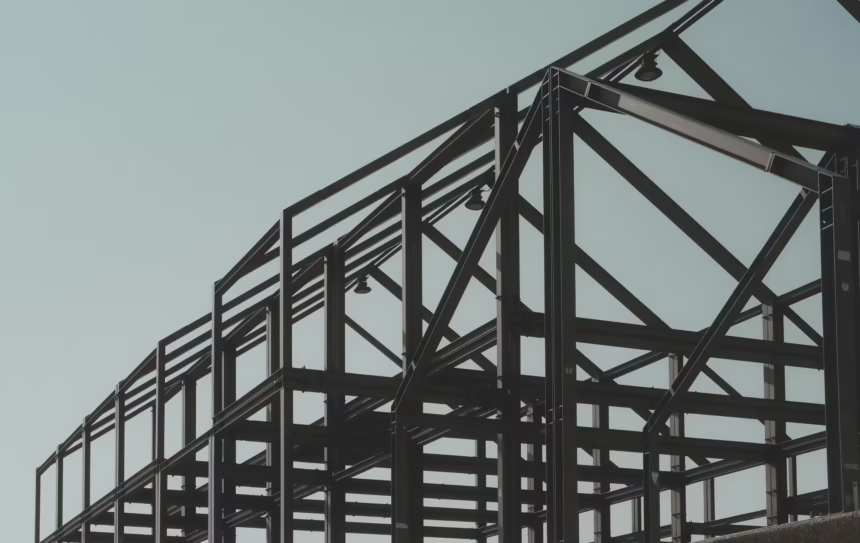
If you’ve ever managed a warehouse, manufacturing plant, or distribution center, you already know how much depends on the building itself. The roof keeps your equipment dry. The walls keep your operation insulated. The structural framing holds the whole thing together while forklifts, machinery, and HVAC systems run inside it. When something on that envelope fails, it’s not just a maintenance ticket — it’s a potential production stoppage.
That’s why Butler Manufacturing has earned such a strong reputation in the pre-engineered metal building world. Their roof systems, wall panels, structural members, and accessories have been protecting industrial facilities for over a century, and for businesses that own a Butler building, sourcing genuine parts is just smart asset management. Let’s look at the six big reasons companies stick with authentic Butler components when it’s time to repair, expand, or upgrade.
1. The Importance of Genuine Components
The Butler system is a system. The MR-24 standing-seam roof, the Butlerib II panels, the Shadowall walls, the Cee and Zee girts, the Butler-Cote finishes — these were all engineered to work together as a single weathertight, load-bearing unit. Substituting “close enough” parts from a generic supplier introduces tolerance issues that compound over time, especially around penetrations, ridges, and gutter terminations.
This is exactly why facility managers go directly to authorized distributors of Butler Manufacturing parts when something needs replacing. Genuine OEM components match the original specs down to the rivet pattern, which means they slot in cleanly without field modifications, custom flashing, or guesswork from your install crew.
BUTLER MFG Parts, run by an authorized Butler dealer, exists for precisely that reason — to give building owners a direct line to authentic components rather than forcing them to settle for aftermarket lookalikes. For commercial and industrial facilities where the building envelope is part of the production equation, that consistency matters.
2. The Industrial Building Market Genuinely Runs on Steel
It’s not an exaggeration to say the U.S. industrial economy is housed inside pre-engineered metal buildings. According to a Grand View Research analysis of the U.S. pre-engineered metal building market, the sector was valued at USD 12.98 billion in 2024 and is projected to reach USD 27.10 billion by 2033, with the manufacturing segment alone accounting for 34% of revenue.
Translation: a huge slice of America’s factories, warehouses, and distribution centers sit under metal roofs and behind metal walls. Keeping those buildings tight, dry, and structurally sound isn’t optional — it’s directly tied to operational uptime. Genuine replacement parts are how owners protect that asset.
3. Warranty and Compliance Stay Intact
Most Butler buildings come with substantial warranties on the roof and wall systems — but those warranties typically require that any repairs or replacements use Butler-approved components. Bring in an off-brand panel or fastener, and you can quietly invalidate coverage on the entire roof system without realizing it.
For facility teams managing capex on tight budgets, that’s a serious risk. Genuine parts protect the warranty, the insurance position, and any existing performance certifications tied to the building.
4. Long-Term Performance, Not Short-Term Savings
Generic panels often look identical at install time. The differences show up at three, five, and ten years in. Inferior coatings chalk and fade. Substandard fasteners corrode. Cheap sealants crack. Suddenly, you’re paying for the “savings” in patch jobs and replacement labor.
Butler’s MR-24 standing-seam roof is one of the most-tested metal roofing systems in the country, designed to handle high wind uplift, thermal cycling, and decades of weather exposure. Pairing that roof with non-OEM parts undermines the engineering. It’s a bit like dropping discount tires on a service truck and wondering why the alignment never holds.
5. Faster Repairs, Less Downtime
When a roof leak threatens production or a wall panel gets damaged by a forklift, the clock starts ticking. Authorized Butler distributors keep common components in stock and can ship cross-country quickly, often with engineering support to confirm the right part for a specific building’s age, system, and configuration.
That speed isn’t a small thing. For a busy distribution center or food-grade manufacturing facility, every day a damaged panel goes unrepaired is a day of moisture, energy loss, and potential code issues. Knowing exactly where to source the right replacement turns a potential multi-week project into a clean, scheduled fix.
6. Engineering Support That Comes With the Parts
This one gets overlooked in product comparisons. When you buy through an authorized Butler distributor, you’re not just buying a panel or a clip — you’re getting access to people who actually understand Butler systems. They can pull original drawings, identify exact part numbers from a building’s age and configuration, recommend compatible upgrades, and flag issues before you place the order.
That kind of expertise is invaluable for older Butler buildings, where part numbers may have evolved over the decades and where matching the original profile takes more than a glance at a catalog. Saving an hour on the phone with someone who knows what they’re looking at can save days of rework on the jobsite.
What This Looks Like in Practice
Most facility teams come to Butler parts at one of three moments:
- Reactive maintenance — a leak, a damaged panel, a corroded fastener pattern that needs addressing before the next storm
- Planned upgrades — re-roofing, re-skinning a wall, adding insulation, or replacing trim and gutters as part of a capex cycle
- Building expansion — adding bays, modifying door openings, or tying a new section into an existing Butler structure
In all three cases, the calculus is the same: a building this expensive, this critical to operations, and this specifically engineered deserves parts that match. The cost difference between OEM and aftermarket is usually small. The performance difference, over the building’s actual service life, is not.
The Bottom Line
For businesses running operations inside a Butler building, the question isn’t really whether to use genuine Butler parts — it’s how quickly you can get them when you need them. Authentic components protect the warranty, the engineering, and the long-term value of the asset. They also tend to keep facility managers out of awkward conversations with insurance adjusters and corporate finance.
The building was built to last for decades. Maintaining it with parts engineered for that purpose is just the responsible call.


