Case study: a regenerative travel company’s business model starts with a simple truth most operators still miss. Regeneration isn’t a marketing add-on or a checklist of solar panels and local produce. It is the operating system. Playa Viva, the off-grid boutique resort on Mexico’s Pacific coast near Juluchuca, shows exactly how that system works in practice—and why it can outperform extractive models over time.
- Regenerative models treat the destination as a living partner, not a resource to extract from.
- Revenue is structured to fund measurable ecological and community gains from day one.
- Guests become active participants rather than passive consumers.
- Long-term resilience comes from deeper local relationships and verified impact, not volume.
- The approach is scalable in principle but demands disciplined measurement and genuine local ownership.
For the bigger picture on where this fits among broader regenerative travel business trends, the patterns are clear. What follows is a close look at one company’s actual mechanics so you can see the moving parts.
How Playa Viva Built Its Regenerative Engine
David Leventhal and his team opened Playa Viva in 2008 on roughly 200 acres of coastal land that had seen better days. The brief was never “build a nice eco-hotel.” It was restore the place while creating a viable hospitality business. That dual mandate shaped every decision: 100% off-grid solar power, on-site permaculture that supplies a meaningful share of the kitchen, grey- and black-water systems that return cleaner water to the aquifer, and construction that leaned on locally harvested materials where possible.
Case study: a regenerative travel company’s business model The financial architecture is equally deliberate. In 2013 the property launched its Regenerative Trust—a 2% fee added to every guest bill. Those funds flow through The Ocean Foundation as fiscal sponsor and support the on-site La Tortuga Viva sea turtle sanctuary, local schools, health infrastructure, and the broader ReSiMar watershed regeneration program. ReSiMar works across five connected nodes: water culture and resources, permaculture and agroecology, education, terrestrial conservation, and marine conservation. Guests can release hatchlings, help on the farm, or simply know their stay is funding the work.
In 2023 Playa Viva earned B Corp certification with a score of 110—well above the typical hotel range at the time. That score reflects verified performance across governance, workers, community, environment, and customers. The certification is not the point; the underlying systems are.
Think of it like a well-managed forest plot. You don’t just stop clear-cutting. You thin selectively, plant native species, improve soil, and create conditions for the whole system to produce more biomass, more water retention, and more biodiversity than it did before. Playa Viva applies the same logic to tourism cash flow and guest experience.
Case Study: a Regenerative Travel Company’s Business Model in Numbers and Structure
The model rests on three interlocking revenue and impact streams:
- Core hospitality (rooms, meals, experiences) priced as an all-inclusive immersion that removes friction and keeps guests on property longer.
- The 2% Regenerative Trust fee that creates a dedicated, non-negotiable funding line for place-based work.
- Ancillary value from guest participation—voluntourism-style activities, education programs, and the soft marketing that comes from authentic stories.
Local hiring and procurement keep a high percentage of spending inside the regional economy. Education programs reach multiple schools in the watershed. The turtle sanctuary relies on local volunteers whose night patrols and equipment are supported by the Trust. These are not side projects. They are load-bearing walls.
| Element | Traditional Luxury Resort Approach | Playa Viva Regenerative Approach | Practical Difference |
|---|---|---|---|
| Energy | Grid + backup diesel | 100% solar off-grid | Eliminates ongoing fuel costs and emissions; forces design discipline |
| Food | National/international suppliers | On-site permaculture + local small farms | Higher freshness, lower transport impact, direct community income |
| Community Funding | Occasional donations or CSR | Mandatory 2% Trust fee on every bill | Predictable, transparent capital for local priorities |
| Guest Role | Consumer of amenities | Participant in restoration and learning | Deeper satisfaction and higher likelihood of return or referral |
| Measurement | Occupancy and RevPAR | Ecological metrics + community outcomes + financials | Decisions optimized for system health, not just short-term profit |
Step-by-Step Action Plan for Operators Ready to Adapt the Model
If you run a small or mid-size travel business and want to move in this direction, start here. In my experience, the operators who succeed treat the first 18–24 months as a systems redesign rather than a marketing campaign.
- Map the living system of your place. Identify the key ecological assets, cultural strengths, and economic leakage points. Talk to elders, fishers, farmers, and teachers—not just tourism officials.
- Redesign one core revenue line so a fixed percentage automatically funds regeneration. Make it visible on the bill or in the booking process. Transparency builds trust.
- Choose 2–3 measurable impact areas you can actually influence (soil health, youth education, marine protection, local supply chains). Set baselines and simple tracking.
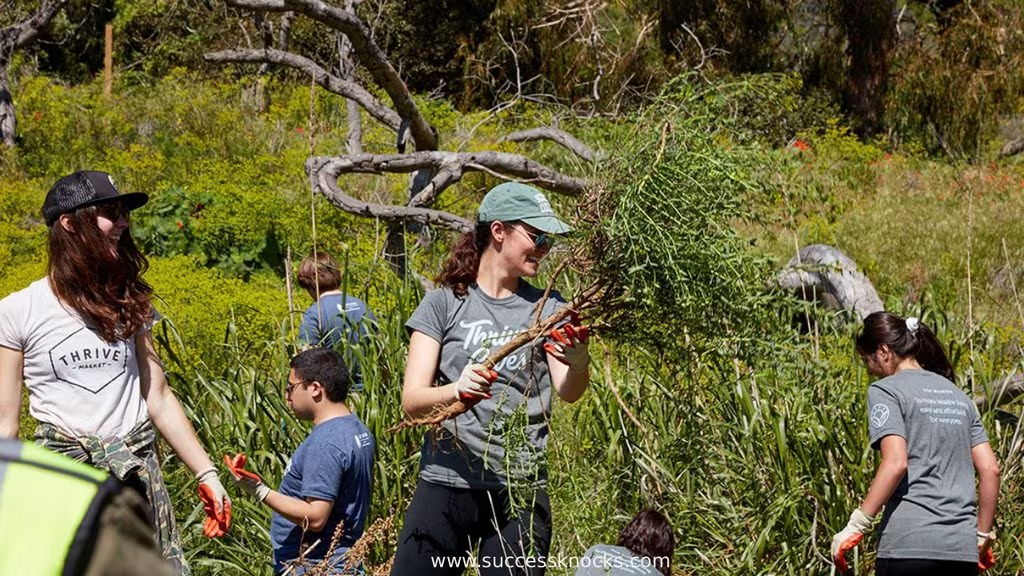
- Embed guest participation without turning the stay into unpaid labor. Short, meaningful activities that educate and contribute work better than forced volunteer days.
- Pursue credible third-party verification only after the systems are running. Certification without substance is just expensive green paint.
- Report progress publicly and adjust. Guests and partners respond to honesty more than perfection.
Common Mistakes & How to Fix Them
Case study: a regenerative travel company’s business model The biggest failure mode is treating regeneration as a product feature instead of an operating principle. Operators bolt on a tree-planting day or a “community visit” and call it done. Guests sense the thinness. Revenue stays extractive.
Another frequent miss: underfunding the measurement. Without baselines and regular data, you cannot prove impact or improve. Start simple—acres restored, students supported, local spend percentage—and tighten over time.
Pricing is often wrong too. Some operators undercharge because they feel guilty about “doing good.” Others overcharge and exclude the very travelers who would become advocates. Test a transparent impact fee and watch conversion; the right guests will pay when the value is clear.
Finally, many keep decision-making centralized. Real regeneration requires shared power with local partners. That feels slower at first. It creates durability later.
Case Study: a Regenerative Travel Company’s Business Model Applied to Your Context
You do not need a Pacific beach or 200 acres. The transferable pieces are the mandatory impact fee, the living-systems map, the insistence on local agency, and the refusal to treat guests as mere consumers. A small tour operator can apply the same logic to guiding fees and supplier contracts. A lodge can restructure its F&B purchasing and guest programming. The scale changes; the principles do not.
For operators still clarifying the line between regenerative and merely sustainable practices, the distinction matters for positioning and for long-term viability.
Key Takeaways
- Regenerative models hard-wire impact funding into the core transaction rather than treating it as optional philanthropy.
- Playa Viva demonstrates that off-grid operations, permaculture, community education, and marine protection can coexist with a premium guest experience.
- A transparent, non-negotiable percentage fee (in this case 2%) creates reliable capital for place-based work.
- B Corp and similar verifications work best as lagging indicators of systems already in place.
- Guest participation deepens satisfaction and strengthens the business case.
- Local agency and shared decision-making are non-negotiable for lasting results.
- Measurement of ecological and social outcomes must sit alongside financial metrics from the start.
- The model rewards patience and systems thinking over short-term occupancy chasing.
Case study: a regenerative travel company’s business model The operators who treat regeneration as the business model—not a department—build harder-to-copy advantages: stronger local relationships, more resilient supply chains, higher guest loyalty, and a story that actually holds up under scrutiny. Start with one clear revenue mechanism and one measurable impact area. Then expand. The places that need this most will reward the ones who get the fundamentals right.
FAQs
What makes the case study: a regenerative travel company’s business model different from standard eco-tourism?
Standard eco-tourism usually focuses on reducing harm. Regenerative models actively restore ecological function and community capacity while generating profit. The difference shows up in mandatory impact fees, living-systems design, and verified positive outcomes rather than just lower footprints.
Can a small U.S.-based operator apply lessons from the case study: a regenerative travel company’s business model?
Yes. The core mechanics—fixed percentage funding for local priorities, guest participation designed for meaning rather than labor, and rigorous local partnerships—transfer across scales and geographies. Start with one revenue line and one impact metric.
How does Playa Viva measure success in its regenerative approach?
Beyond occupancy and revenue, the property tracks ecological restoration (watershed health, biodiversity, carbon sequestration potential), community outcomes (education reach, local employment and spending, turtle sanctuary operations), and third-party verification such as its B Corp score. Guests see the results through activities and transparent reporting.