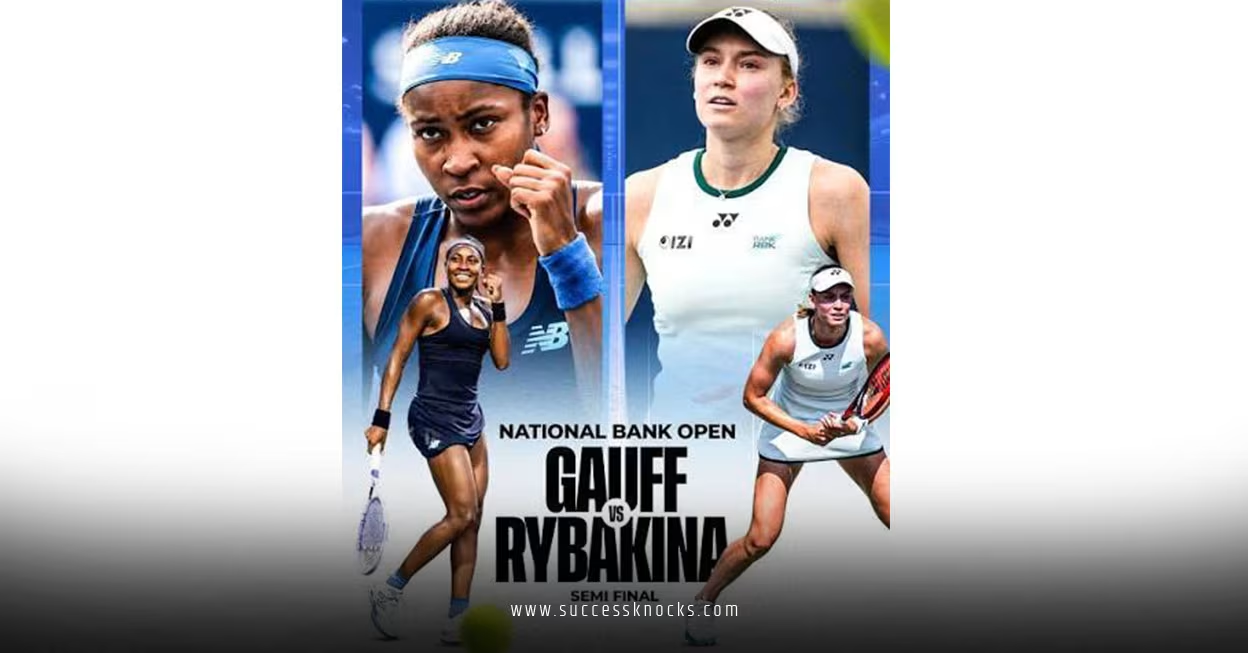
Coco Gauff vs Elena Rybakina National Bank Open 2026 semifinal delivered exactly the kind of high-stakes, momentum-shifting drama that makes WTA tennis so compelling right now. On the evening of August 13, 2026, at Sobeys Stadium in Toronto, World No. 2 Elena Rybakina dismantled World No. 4 Coco Gauff 5-7, 6-2, 6-2 in a performance that swung the power balance of women’s tennis into sharp focus.
Quick Overview — What You Need to Know:
- 🎾 The match: Rybakina defeated Gauff 5-7, 6-2, 6-2 in the National Bank Open 2026 women’s singles semifinal in Toronto.
- 📍 When & where: August 13, 2026, Centre Court, Sobeys Stadium, Toronto, Canada (WTA 1000 event).
- 🔁 Head-to-head update: Series is now tied 1-1; Gauff had won their only prior meeting at this same Toronto tournament in 2022.
- ⚡ Context: Gauff entered the semis via walkover after Belinda Bencic withdrew with a hip injury; Rybakina was battle-tested after a grueling comeback win over Naomi Osaka.
- 🏆 What’s next: Rybakina advances to the final against Iga Świątek, and a victory in Toronto would push her within striking distance of the World No. 1 ranking.
Coco Gauff vs Elena Rybakina National Bank Open 2026 Semifinal: Match Breakdown
First Set — Gauff Strikes First
Gauff came out hot. Fresh and physically unspent after her walkover, she played free, aggressive tennis in the opener. Rybakina’s serve — her most dangerous weapon — wasn’t finding its usual rhythm early on, and Gauff exploited that window ruthlessly. The American closed out the first set 7-5, looking like she was well on her way to the final.
Here’s the thing, though. Winning the first set against Rybakina sometimes gives you a false sense of security. The Kazakh doesn’t unravel. She recalibrates.
Second and Third Sets — Rybakina’s Engine Kicks In
The match turned on a dime in the second set. Rybakina’s serve — which had produced 13 aces just a day earlier against Osaka — started landing like a sledgehammer. Gauff, who had been dictating from the baseline, found herself pinned back, scrambling, forced into defensive positions she’d been avoiding all week.
The final two sets: 6-2, 6-2. Clinical. Ruthless. Think of it like watching a slow-burn fire that suddenly becomes a controlled explosion. The shift in momentum wasn’t gradual — it was a wall. Rybakina won more than 70% of points behind her first serve in those final two sets, and Gauff had no real answer once the returns started coming back short.
Player Comparison: Gauff vs Rybakina at the 2026 National Bank Open Semifinal
| Category | Coco Gauff 🇺🇸 | Elena Rybakina 🇰🇿 |
|---|---|---|
| World Ranking | No. 4 | No. 2 |
| Age | 22 | 27 |
| Grand Slam Titles | 2 (2023 US Open, 2025 French Open) | 2 (2022 Wimbledon, 2026 Australian Open) |
| Hard Court W-L (career) | 172–71 | 199–85 |
| Path to Semifinal | Walkover (Bencic withdrew, hip injury) | Beat Osaka 4-6, 7-6, 6-4 in QF |
| Semifinal Result | Lost 7-5, 2-6, 2-6 | Won 5-7, 6-2, 6-2 |
| Toronto Semifinal Appearances | 1st career semifinal in Toronto | 2nd in four appearances |
| Head-to-Head Record (all-time) | 1 win | 1 win (now tied 1-1) |
| Next Match | Season continues (Cincinnati next) | Final vs Iga Świątek |
Coco Gauff vs Elena Rybakina National Bank Open 2026 Semifinal: Context You Can’t Ignore
The Walkover Factor
Was Gauff’s walkover a blessing or a curse? On paper, it’s a gift — full rest, no physical wear before a big match. In practice? It’s a double-edged sword. Gauff missed a match-sharpness rhythm that Rybakina had built across three hard-fought rounds. When you’re a baseliner who thrives on finding her groove point by point, a free pass into a semifinal can leave you two steps behind a player who’s been battle-tested for hours.
Rybakina had earned her spot the hard way. She came from a set down to beat Osaka in 2 hours 33 minutes, then recovered overnight and came out swinging. That kind of competitive hardening is hard to manufacture.
Rybakina’s Serve: The Match-Defining Weapon
Let’s talk about the serve. Rybakina is the most dangerous server in women’s tennis — period. According to the WTA official tour statistics, she consistently ranks among the tour leaders in aces and first-serve percentage. Against Osaka, she fired 13 aces. Tall at 184cm, she generates angles that aren’t physically available to most of her opponents. Once her rhythm locked in during the second set against Gauff, the American’s return game — which is genuinely excellent — couldn’t consistently get into rally position.
The Ranking Stakes
There’s a bigger picture here. If Rybakina wins the Toronto title, she moves within four ranking points of World No. 1 Aryna Sabalenka, who lost in the round of 16. The ranking race heading into the US Open hard-court swing is now razor-thin. A Wimbledon title, an Australian Open title, and a potential WTA 1000 trophy in Toronto — this Rybakina run in 2026 is as serious as it gets. You can track the live WTA Rankings at the official WTA website to monitor exactly where things stand post-Toronto.
Step-by-Step: How to Follow the Rest of the 2026 National Bank Open (Beginner’s Guide
If you’re new to tennis and this match got you hooked, here’s how to stay connected with the action:
- Know the draw structure. WTA 1000 events like the National Bank Open have 96-player draws. Semifinals produce two finalists. The Toronto 2026 final is Rybakina vs Świątek — scheduled August 14.
- Find where to watch. In the USA, the National Bank Open is broadcast on the Tennis Channel. Check your cable or streaming provider for live scheduling.
- Follow scores in real time. The WTA’s official scores page is the most accurate live source — no third-party delay, no paywalled stats.
- Track the rankings. After Toronto, head into the Western & Southern Open in Cincinnati. Points from here go directly toward the WTA Rankings and US Open seeding.
- Understand what’s at stake. The 2026 US Open starts in late August. Toronto and Cincinnati results directly shape seedings, so the winner here carries real momentum into the year’s final Grand Slam.

Common Mistakes Tennis Fans Make (And How to Avoid Them)
Mistake 1: Assuming the Walkover Player Has the Advantage
Fix it: Rest helps physicality, but competitive rhythm matters. Gauff is proof. A walkover removes pressure but also match sharpness. Never automatically back the rested player in a high-stakes semifinal.
Mistake 2: Judging Rybakina’s Serve on One Set
Fix it: If Rybakina drops the first set, don’t write her off. Her serve is a weapon that peaks mid-match. The 2026 semifinal is a perfect case study — she lost the first set, then her first serve started clicking and Gauff had nothing left to work with.
Mistake 3: Ignoring the Ranking Consequences of WTA 1000 Results
Fix it: WTA 1000 titles carry 1,000 ranking points. These are some of the most valuable events on tour outside Grand Slams. The Toronto result directly changes who gets seeded where at the US Open. Pay attention to the points table, not just the scoreline.
Mistake 4: Overlooking the Head-to-Head History
Fix it: H2H records at specific surfaces matter a lot. Both players had met only once before — on the same Toronto hardcourts in 2022, with Gauff winning in three tight sets. That historical edge gave Gauff a psychological footing in the first set. Rybakina knew she had to change the pattern.
Key Takeaways
- Rybakina won 5-7, 6-2, 6-2 in a match that flipped completely after the opening set.
- Gauff reached her first-ever Toronto semifinal — a milestone, even in defeat.
- Rybakina’s serve was the turning point. Once it locked in, the match had only one likely outcome.
- The H2H is now 1-1, setting up what should become one of women’s tennis’s most anticipated rivalries heading into the US Open era.
- Gauff’s walkover gave her rest but cost her rhythm — a real factor in how the match unfolded.
- Rybakina is one win away from positioning herself within striking range of the World No. 1 ranking.
- The Toronto women’s final is Rybakina vs Świątek — two players who’ve both beaten big names in the same week. That match is unmissable.
- For US fans, the hard-court swing is far from over. Cincinnati comes next, and the US Open seedings are still fluid.
Final Thoughts
This wasn’t an upset. It was a statement. Rybakina reminded everyone watching that her combination of serve power, baseline depth, and mental resilience makes her a genuine threat to win any event on hard courts. Gauff fought her way to the first set, but against a player of this caliber, a single break in concentration — a few loose returns, a couple of second serves landing in the wrong spot — and the match turns.
What should Gauff fans take from this? That she’s on the right track. Reaching a WTA 1000 semifinal, winning her first two Toronto matches convincingly, and fighting through a first set against the world’s second-ranked player is not nothing. The rivalry is only getting started.
If you want to keep up with both players through the Cincinnati WTA 1000 and into the US Open, bookmark the WTA official site for live draws, results, and rankings. The hard-court swing is the sharpest — and most unpredictable — stretch of the entire season.
Frequently Asked Questions
Q1: Who won the Coco Gauff vs Elena Rybakina National Bank Open 2026 semifinal?
Elena Rybakina won the match, defeating Coco Gauff 5-7, 6-2, 6-2 on August 13, 2026, at Sobeys Stadium in Toronto. Rybakina advances to the final where she faces Iga Świątek.
Q2: How did both players reach the Coco Gauff vs Elena Rybakina National Bank Open 2026 semifinal?
Gauff advanced by walkover after Belinda Bencic withdrew with a hip injury. Rybakina earned her spot by defeating Naomi Osaka 4-6, 7-6(5), 6-4 in a 2-hour-33-minute quarterfinal thriller the day prior.
Q3: What is the all-time head-to-head record between Gauff and Rybakina after their 2026 Toronto semifinal?
The series is now tied 1-1. Gauff won their first meeting at the Rogers Cup in Toronto back in August 2022, winning 6-4, 6-7, 7-6 in 169 minutes. Rybakina evened the score with her dominant semifinal victory at the National Bank Open 2026.