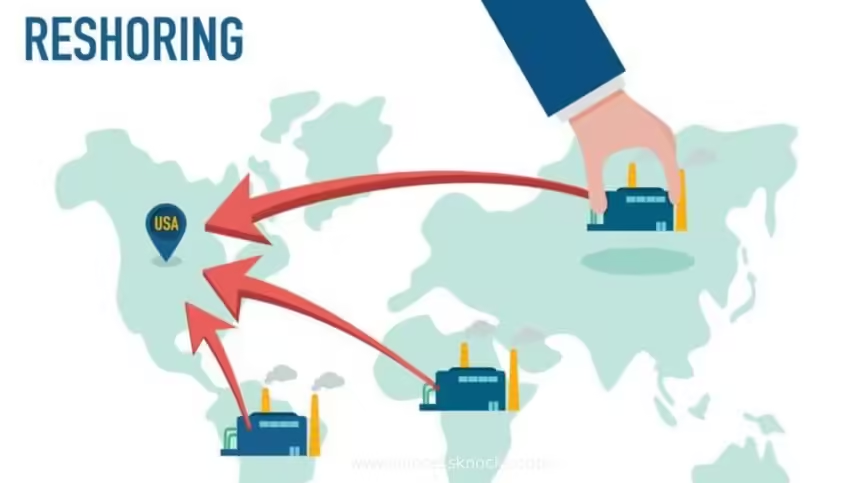
Reshoring Manufacturing to the US 2026 isn’t a trend piece anymore — it’s a live operational decision hundreds of companies are making right now, and the data behind it is messier and more interesting than the headlines suggest. Some sectors are sprinting. Others are stuck in a holding pattern, waiting on tariff clarity before they break ground. Here’s the thing: nobody serious is asking “should we reshore” anymore. They’re asking “when, and how fast can we move without torching the balance sheet.”
Quick summary for the skim-readers:
- Reshoring manufacturing to the US in 2026 means bringing production, assembly, or sourcing back from overseas (mostly China, Mexico, and Southeast Asia) into domestic facilities.
- Roughly 244,000 reshoring and FDI jobs were announced in 2024, with 2025 running closer to 174,000 as tariff policy uncertainty slowed decision-making, per the Reshoring Initiative.
- Tariffs, labor costs abroad, supply chain risk, and federal incentives are the four big drivers pushing companies stateside.
- The gap between “jobs announced” and “jobs filled” matters more than the press releases — about 1.7 million of the 2 million-plus jobs announced since 2010 have actually materialized.
- High-tech and medium-high-tech sectors (electronics, EV batteries, transportation) still dominate the activity.
What Reshoring Manufacturing to the US in 2026 Actually Means
Let’s clear up the terminology first, because it gets thrown around loosely. Reshoring is moving production that already left the US back home. Onshoring is building new capacity domestically that never existed abroad. Nearshoring is the middle ground — shifting to Mexico or Canada instead of Asia.
In practice, most 2026 activity is a blend of all three. Companies aren’t just “coming home.” They’re rebuilding supply networks from scratch, often closer to customers and closer to raw materials.
What’s driving this isn’t sentiment. It’s math — tariff exposure, freight volatility, and the very real cost of a six-week ocean delay when your product line depends on a single overseas supplier.
Why Reshoring Manufacturing to the US Is Accelerating Now
Reshoring Manufacturing to the US 2026 The short answer: tariffs lit the fuse, but the fire was already smoldering. Since 2018, and especially after the 2025 “Liberation Day” tariff expansion, companies have had to run new math on every offshore contract.
I’ve watched procurement teams flip from “cheapest landed cost” to “most resilient landed cost” almost overnight. That’s not a slogan — it’s a spreadsheet change. Freight risk, currency swings, and geopolitical exposure now get their own line items.
If you want the deeper breakdown of exactly what’s pushing companies to make this move, I covered the full driver list in why companies are choosing to reshore right now. Short version: it’s rarely one factor. It’s tariffs plus labor plus risk, stacked together until the offshore math stops working.
The Real Numbers: A 2026 Data Snapshot
Numbers matter more than narrative here, so let’s look at what’s actually verifiable.
| Metric | Latest Figure | Source & Period |
|---|---|---|
| Reshoring + FDI jobs announced (2024) | 244,000 | Reshoring Initiative, 2024 Annual Report |
| Reshoring + FDI jobs announced (2025, est.) | ~174,000–244,000 | Reshoring Initiative, 2026 release |
| Cumulative jobs announced since 2010 | 2,000,000+ | Reshoring Initiative |
| Cumulative jobs actually filled since 2010 | ~1,700,000 | Reshoring Initiative |
| Manufacturing employment (July 2026) | 12,611,000 | U.S. Bureau of Labor Statistics |
| Private manufacturing construction spending (Feb 2026) | $209.8B annualized | U.S. Census Bureau |
| Share of announcements in high/medium-high tech | ~88–90% | Reshoring Initiative |
Two things jump out. One, announcements are running well below the 2022 peak of roughly 364,000 jobs. Two, manufacturing construction spending is actually down year-over-year, largely because semiconductor fab spending cooled after its 2024 CHIPS Act-fueled peak.
That’s not collapse — it’s normalization. The easy, big-ticket electronics announcements already happened. What’s left is slower, sector-by-sector grind.
You can dig into the full Census Bureau construction spending series if you want to track this yourself month to month. It’s free, updated regularly, and it’s the closest thing to a leading indicator this space has.
Cost Reality: Is It Actually Cheaper to Reshore?
Reshoring Manufacturing to the US 2026 Nope, not always — and anyone telling you otherwise is selling something. Labor costs are usually higher domestically. That’s just true.
But total landed cost isn’t just labor. Add tariffs, freight, insurance, inventory carrying costs, and the risk premium of a six-to-ten-week supply chain, and the equation shifts fast for a lot of product categories.
What usually happens is companies run a full landed-cost model before committing, comparing five-year total cost of ownership rather than per-unit manufacturing cost alone. I broke down that exact comparison, line item by line item, in the reshoring vs. offshoring cost breakdown — worth reading before you build your own model.
Is Reshoring Manufacturing to the US Worth the Tariff Math?
For tariff-exposed categories — electronics, metals, certain consumer goods — yes, increasingly. For low-tariff, labor-intensive categories like basic apparel, the math still often favors staying offshore. Context matters more than headlines.
Tax Incentives and Policy Tailwinds
Federal and state incentives are doing real work here, even with policy uncertainty in the mix. The CHIPS Act reshaped semiconductor investment. The Inflation Reduction Act pulled EV battery and solar manufacturing home. States like Texas, South Carolina, and Mississippi are stacking their own credits on top.
None of this is automatic money, though. Programs have eligibility rules, application windows, and clawback clauses if job targets aren’t hit. I walked through the specific credits, deductions, and how to actually qualify for them in the 2026 tax incentives guide — that’s the piece to bookmark before you talk to a CPA.
Case Studies: Who’s Actually Doing This
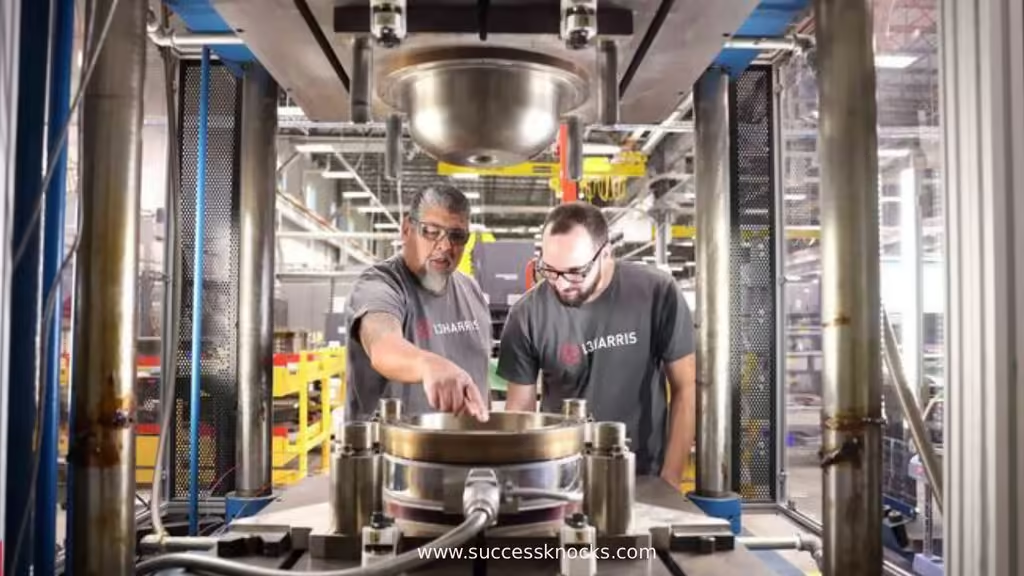
Announcements are cheap. Ribbon-cuttings aren’t. Whirlpool’s $300 million investment in its Ohio operations, projected to create 450–600 jobs, is a solid example of a mid-sized, unglamorous reshoring win that doesn’t make national news but moves real payroll into a real town.
Wistron’s Dallas facility ramping toward mass production by late 2026 is another — electronics assembly, tariff-motivated, quietly executed. If you want a granular walkthrough of how one company actually pulled this off, timeline and all, check this real-world reshoring case study.
Which Industries Are Reshoring Fastest
Reshoring Manufacturing to the US 2026 Not every sector moves at the same speed, and that’s by design — some industries have way more tariff exposure and federal incentive alignment than others.
- Computers & electronics — driven hard by CHIPS Act incentives and semiconductor fab buildouts.
- Electrical equipment (EV batteries, solar) — riding Inflation Reduction Act momentum.
- Transportation equipment — automotive supply chains reacting to tariff exposure.
- Fabricated metals and industrial machinery — slower, steadier growth, less headline-grabbing.
Together, electronics and electrical equipment made up nearly two-thirds of all 2024 reshoring job announcements. If your sector isn’t listed here, don’t assume you’re irrelevant — it usually just means slower-burn, less newsworthy growth. I mapped out the full sector-by-sector pace in which industries are reshoring the fastest.
Step-by-Step Action Plan for Beginners
If you’re a manufacturer or supply chain lead trying to figure out where to even start, here’s the sequence I’d actually run:
- Audit your current landed cost. Not just factory price — include freight, tariffs, inventory carrying cost, and quality-failure risk.
- Map your tariff exposure by SKU or category. Some product lines will make the case for you instantly.
- Identify eligible incentive programs. Federal, state, and local credits can shift the math meaningfully.
- Scout locations based on labor availability, not just tax breaks. A great incentive package with no available workforce is a trap.
- Pilot before you scale. Run one product line domestically before committing your whole catalog.
- Lock supplier and logistics contracts early. Domestic capacity is filling up in hot sectors — waiting costs you leverage.
- Track your build against a real timeline. Remember: announcements land two to four years before hiring actually happens.
Common Mistakes & How to Fix Them
Reshoring Manufacturing to the US 2026 I’ve seen the same errors repeat across dozens of reshoring efforts. Here’s the pattern, and the fix.
| Mistake | Why It Happens | How to Fix It |
|---|---|---|
| Comparing unit cost only, not total landed cost | Old habits from offshore sourcing models | Build a 5-year TCO model including tariffs and risk |
| Announcing before securing workforce | Press release pressure, investor optics | Confirm labor pipeline before public commitment |
| Ignoring incentive clawback clauses | Rushing the application process | Get legal/tax review before signing incentive agreements |
| Underestimating build timeline | Assuming construction moves as fast as press coverage suggests | Plan for 2–4 year lag between groundbreaking and full output |
| Treating tariffs as permanent or temporary without checking | Confusing IEEPA and Section 232 tariff authority | Track the specific legal basis — it changes how durable the policy is |
If you’re navigating the operational headaches specifically, I go much deeper on this in the common challenges companies hit when reshoring — it’s the piece I’d send to anyone six months into a build and hitting friction.
Key Takeaways
- Reshoring manufacturing to the US 2026 is real, measurable activity — not just political messaging.
- Announcements dropped from the 2022 peak but remain historically elevated; policy uncertainty, not lost interest, explains most of the 2025 slowdown.
- High-tech and medium-high-tech sectors still dominate reshoring activity, led by electronics and EV-related manufacturing.
- Total landed cost, not unit labor cost, is the number that actually determines whether reshoring pencils out.
- Federal and state incentives can meaningfully shift project economics, but they come with real compliance strings attached.
- Expect a two-to-four-year lag between a reshoring announcement and actual hiring — plan accordingly.
- Workforce availability, not tax credits, is usually the real bottleneck on the ground.
The Bottom Line
Reshoring Manufacturing to the US 2026 rewards patience and punishes headline-chasing. The companies winning at this aren’t the ones with the flashiest ribbon-cutting — they’re the ones who ran the real cost math, locked their incentive paperwork early, and built workforce pipelines before pouring concrete. If you’re weighing this move, start with your landed-cost audit this quarter. That single spreadsheet will tell you more than any trend report.
FAQs
Is reshoring manufacturing to the US in 2026 actually growing, or slowing down?
It’s normalizing rather than collapsing. Announcements dropped from the 2022 record but remain far above pre-2020 levels, per the Reshoring Initiative.
How long does reshoring manufacturing to the US typically take from announcement to production?
Two to four years is the realistic window between a public announcement and actual hiring, based on Reshoring Initiative tracking since 2010.
Which US states are leading reshoring manufacturing efforts in 2026?
Texas, South Carolina, and Mississippi have topped recent state-level reshoring job totals, driven by combined tax incentives and available industrial land.