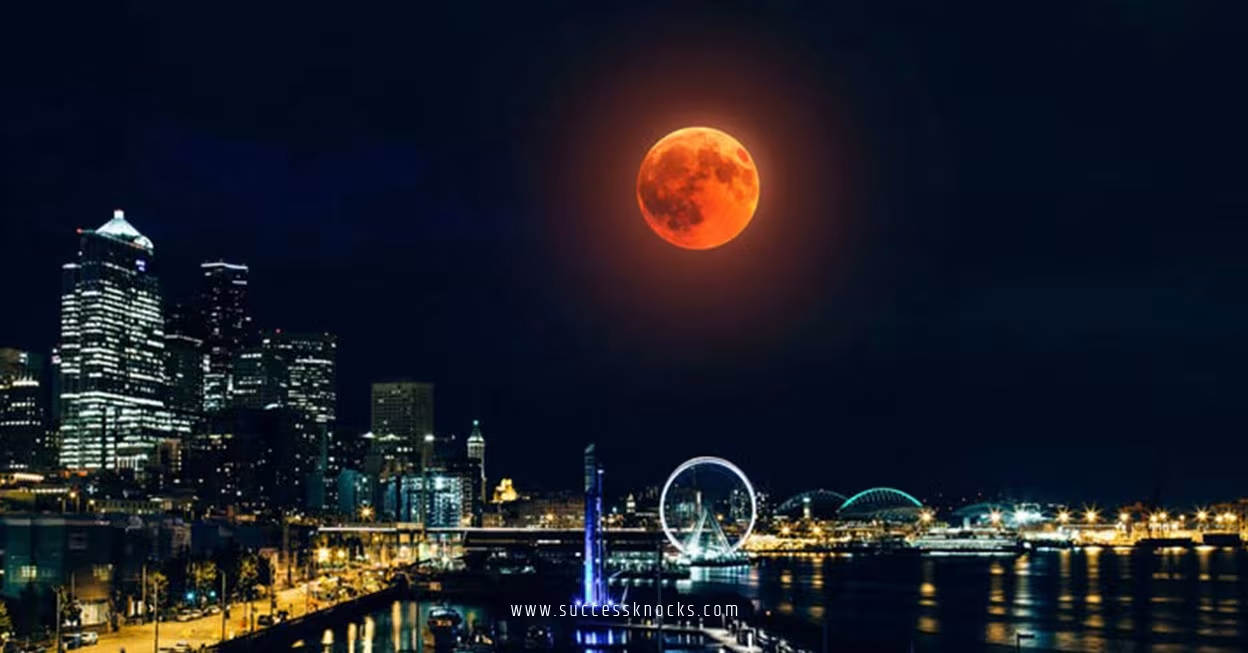
Deep partial lunar eclipse August 27–28 2026 visibility map by location puts nearly the entire lower 48 in prime position for a nearly total “blood Moon” show. About 96% of the lunar disk slips into Earth’s umbra. The remaining bright edge keeps it technically partial, yet the copper-red glow will look dramatic under clear skies.
- Peak coverage hits ~96% of the Moon’s area at greatest eclipse.
- Contiguous U.S. sees the deep partial phase with the Moon well above the horizon for most locations.
- West Coast viewers catch the Moon rising already partially eclipsed; East and Central see the full progression.
- No special glasses needed—safe for naked-eye viewing.
- Local times shift by zone, so check your clock against the universal timeline.
Mark the evening of August 27 into the early hours of the 28th. This one ranks among the deepest partials in recent years and the last strong show of its kind until later in the decade.
What Makes This Eclipse Deep—and Why the Map Matters
Earth’s shadow has two parts: the faint outer penumbra and the dark inner umbra. On this night the Moon’s path cuts deep into the umbra. NASA visualizations put the umbral magnitude near 0.93 and the area obscured at roughly 96%. That thin uneclipsed crescent along one edge is all that prevents totality.
The global visibility footprint covers the Americas, western Europe, and western Africa. For the United States the practical question is simpler: Is the Moon above your horizon while the umbra is doing its work? The answer is yes across the Lower 48. Alaska and Hawaii get shorter windows tied to moonrise.
Think of the umbra as a dark thumb pressing across a full-Moon flashlight. The deeper the press, the redder and more striking the remaining light becomes. Atmospheric scattering of sunlight through Earth’s edge produces that classic copper tone.
Deep partial lunar eclipse August 27–28 2026 visibility map by location: U.S. Time-Zone Breakdown
Universal times (UTC) stay fixed. Local clocks do the translating.
| Eclipse Stage | UTC (Aug 28) | Eastern (EDT) | Central (CDT) | Mountain (MDT) | Pacific (PDT) |
|---|---|---|---|---|---|
| Penumbral begins | ~01:24 | 9:24 p.m. Aug 27 | 8:24 p.m. Aug 27 | 7:24 p.m. Aug 27 | 6:24 p.m. Aug 27 |
| Partial begins | ~02:34 | 10:34 p.m. Aug 27 | 9:34 p.m. Aug 27 | 8:34 p.m. Aug 27 | 7:34 p.m. Aug 27 |
| Greatest eclipse | ~04:13 | 12:13 a.m. Aug 28 | 11:13 p.m. Aug 27 | 10:13 p.m. Aug 27 | 9:13 p.m. Aug 27 |
| Partial ends | ~05:52 | 1:52 a.m. Aug 28 | 12:52 a.m. Aug 28 | 11:52 p.m. Aug 27 | 10:52 p.m. Aug 27 |
| Penumbral ends | ~07:02 | 3:02 a.m. Aug 28 | 2:02 a.m. Aug 28 | 1:02 a.m. Aug 28 | 12:02 a.m. Aug 28 |
East and Midwest observers watch the entire sequence with the Moon high. Pacific viewers often see the partial phase already underway at moonrise; find a clear eastern horizon. Alaska and Hawaii windows are shorter and more sensitive to exact local moonrise.
For precise city-level times and interactive maps, consult the detailed listings at Time and Date’s United States eclipse page. NASA’s visualization page supplies the global geometry and high-resolution diagrams used by most professional sources.
Regional Snapshot Across the Contiguous U.S.
Eastern states (New York, Florida, the Carolinas): Full show. Maximum arrives just after midnight local time with the Moon still climbing or well placed.
Central states (Illinois, Texas, the Plains): Excellent. Greatest eclipse falls in late evening; the Moon sits high enough for easy binocular or camera work.
Mountain states (Colorado, Arizona, New Mexico): Strong views. The partial phase begins in early-to-mid evening; darkest moment arrives while the Moon remains comfortably elevated.
Pacific Coast (California, Oregon, Washington): Convenient evening timing. Moonrise often coincides with or slightly precedes the start of partiality. Western Washington and northern California may need an unobstructed eastern view as the eclipse is already in progress.
Alaska: Limited. In Anchorage the Moon rises after greatest eclipse with only a portion of the remaining phases visible. Hawaii sees an earlier window tied to local afternoon/evening moonrise.
Cloud forecasts favor the western U.S. more often than the East in late August, but local weather always decides. Check the night-of satellite loop.
Step-by-Step Action Plan for Beginners
- Confirm your local times the day before using a reliable converter or the table above. Write them on a sticky note.
- Scout a viewing spot with an open eastern-to-southern sky. Backyards, parks, or modest hills work. Avoid streetlights if possible.
- Step outside 15–20 minutes before partial begins. Let your eyes adapt. The penumbral stage is subtle; the first dark “bite” is the real signal.
- Watch naked-eye first. Binoculars or a small telescope reveal surface detail and the sharp umbral edge, but they are optional.
- Photograph if you like: phone on a tripod or propped steady, night mode or manual exposure. Bracket a few shots around maximum. The red color intensifies as more of the disk enters shadow.
- Stay for the exit. Watching the bright crescent grow back is half the fun.
In my experience the most common regret is arriving only for the absolute peak and missing the progressive darkening. Give yourself the full window.
Common Mistakes & How to Fix Them
Waiting for “blood Moon red” without letting eyes adjust. Fix: Spend a few minutes in relative darkness before maximum. The color becomes obvious once the uneclipsed edge shrinks.
Assuming West Coast moonrise will show the whole event. Fix: Know that the early partial stages may already be underway; prioritize a clear horizon over perfect timing.
Bringing solar eclipse glasses. Unnecessary and counterproductive. Lunar eclipses are safe with the unaided eye.
Ignoring weather until the last hour. Fix: Check the forecast the afternoon before and have a backup indoor livestream option ready if clouds roll in.
Expecting totality. This is deep partial, not total. The thin bright rim is the signature feature. Embrace it.
Viewing Gear and Practical Tips
Naked eye is enough. Binoculars (7×50 or 10×50) sharpen the umbral boundary and crater details along the terminator. A modest telescope with a low-power eyepiece frames the whole disk nicely. Phone cameras work better than most people expect once the red phase deepens—use a tripod or lean against something solid.
Temperature drops after dark in late August. Dress in layers. Bring a chair or blanket. Share the moment; lunar eclipses are social by nature.
For the authoritative geometry and animations that underpin every serious forecast, see NASA’s dedicated page on the August 27-28, 2026 Deep Partial Lunar Eclipse. Sky & Telescope’s North American preview also lays out the zone-by-zone timing clearly for observers across the continent.
Key Takeaways
- Roughly 96% of the Moon enters Earth’s umbra—deep enough to produce strong copper color.
- Contiguous U.S. enjoys excellent visibility; exact clock times depend on your zone.
- Partial phase lasts over three hours; greatest eclipse is the visual highlight.
- No eye protection required.
- West Coast and higher-latitude Alaska/Hawaii have truncated views tied to moonrise.
- Clear eastern horizon and early arrival maximize the experience.
- Check local weather and exact times the day before.
Get outside on the evening of August 27. The deep partial lunar eclipse August 27–28 2026 visibility map by location shows the United States is squarely in the sweet spot. Grab a chair, look up, and watch Earth’s shadow do the rest. If clouds intervene, reputable livestreams will still deliver the view—but nothing beats standing under the real thing.
FAQs
Where can I find the most accurate deep partial lunar eclipse August 27–28 2026 visibility map by location for my city?
Interactive tools from Time and Date and NASA’s visualization suite let you drop a pin or select your city for exact local contact times and Moon altitude.
Will the deep partial lunar eclipse August 27–28 2026 look red everywhere in the U.S.?
Yes, once a large fraction of the disk is inside the umbra the copper-red color appears for all observers with clear skies. Atmospheric conditions can intensify or mute the hue slightly.
Do I need special equipment to enjoy the deep partial lunar eclipse August 27–28 2026?
No. Naked-eye viewing is the classic way. Binoculars or a camera on a steady support simply add detail.