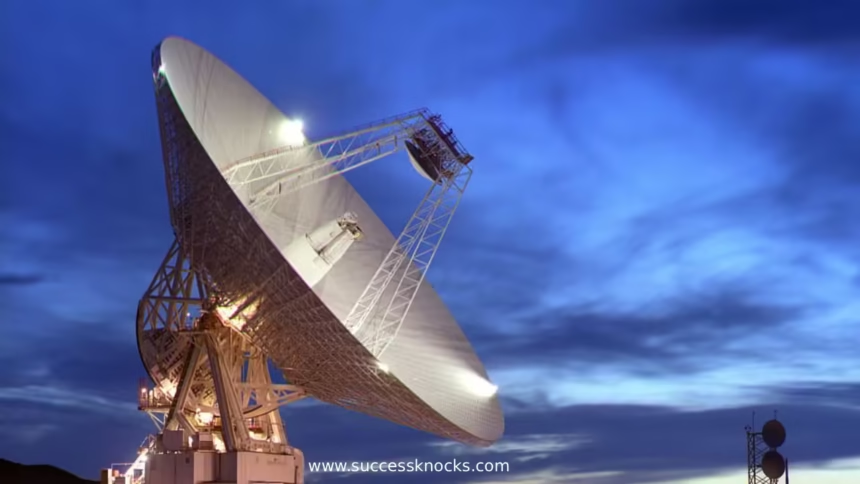
Deep Space Network communication technology explained reveals the sophisticated infrastructure that enables humanity’s most ambitious space missions. This remarkable system serves as Earth’s primary communication lifeline to spacecraft exploring the farthest reaches of our solar system, from lunar missions to Mars rovers operating millions of miles away.
Core DSN Capabilities:
- Three strategically positioned antenna complexes spanning the globe
- Massive 230-foot diameter radio telescopes for maximum sensitivity
- 24/7 coverage ensuring constant spacecraft contact
- Multi-frequency transmission supporting diverse mission requirements
- Real-time data processing handling terabytes of scientific information daily
Understanding how this network operates provides crucial insight into modern space exploration’s technological foundation and future possibilities.
What Is the Deep Space Network?
The Deep Space Network (DSN) represents NASA’s most critical ground-based infrastructure for space exploration. Think of it as the universe’s largest telephone network—except instead of connecting cities, it connects Earth to spacecraft scattered throughout the solar system.
Established in 1963, the DSN has evolved from supporting early lunar missions to managing communication with over 40 active spacecraft simultaneously. The system’s architecture ensures that as Earth rotates, at least one antenna complex maintains contact with any spacecraft, anywhere in the solar system.
The Three-Point Global Strategy
DSN Locations:
- Goldstone, California (North America)
- Madrid, Spain (Europe)
- Canberra, Australia (Asia-Pacific)
These locations were chosen based on precise mathematical calculations. Positioned approximately 120 degrees apart in longitude, they provide seamless coverage as our planet rotates. When one complex loses sight of a spacecraft due to Earth’s rotation, another automatically takes over.
How Deep Space Network Communication Technology Works
Signal Generation and Transmission
The process begins with spacecraft like those in the Artemis program generating radio signals using onboard transmitters. These signals carry everything from crew voice communications to scientific data and spacecraft health information.
Transmission Process:
- Spacecraft generates radio frequency signals
- Onboard high-gain antennas focus signals toward Earth
- Signals travel through space at light speed
- DSN antennas capture extremely weak signals
- Ground systems amplify and process received data
- Information routes to mission control centers worldwide
The challenge lies in the signal strength. By the time radio waves travel from Mars to Earth, they arrive with less power than a digital watch battery produces.
The Technology Behind DSN Antenna Systems
Massive Parabolic Dishes
Each DSN complex features multiple antenna sizes optimized for different mission types:
| Antenna Diameter | Primary Use | Key Capabilities |
|---|---|---|
| 230 feet (70m) | Deep space missions | Maximum sensitivity, Mars/outer planets |
| 112 feet (34m) | Near-Earth missions | Lunar, asteroid, routine communications |
| 85 feet (26m) | Earth orbit support | ISS, satellites, emergency backup |
The largest antennas weigh 8.5 million pounds and can pinpoint spacecraft locations with accuracy measured in fractions of degrees across billions of miles.
Advanced Receiver Technology
Modern DSN receivers operate at temperatures approaching absolute zero to minimize electronic noise. NASA’s official DSN documentation details how these systems achieve sensitivity levels that can detect signals weaker than those from a cell phone on Pluto.
Receiver Specifications:
- Operating temperature: -400°F (-240°C)
- Frequency range: S-band, X-band, Ka-band
- Noise levels: Near theoretical minimum
- Data rates: Up to 1 megabit per second from Mars
Real-World Applications: From Apollo to Artemis
Historical Milestones
The DSN supported every major space exploration achievement since the 1960s. During Apollo 11, DSN antennas captured Neil Armstrong’s first words from the Moon. More recently, when NASA Artemis II astronauts call from space on way home made headlines, the same fundamental technology enabled that historic communication.
Mission Support Evolution:
- Apollo Program: Basic voice and telemetry
- Voyager Missions: Long-duration deep space support
- Mars Exploration: Real-time rover operations
- Artemis Program: Advanced crew safety systems
Modern Mission Complexity
Today’s DSN simultaneously supports multiple spacecraft operating at vastly different distances. On any given day, the network might communicate with:
- Lunar missions like Artemis requiring 1.3-second delay compensation
- Mars rovers dealing with 4-24 minute communication delays
- Outer planet missions where signals take hours to arrive
- Earth observation satellites requiring rapid data downlink
Deep Space Network Communication Protocols
Frequency Band Allocation
Different mission types require specific radio frequencies optimized for their operational environments:
S-Band (2-4 GHz):
- Primary use: Crew communications, basic telemetry
- Advantages: Reliable, weather-resistant
- Applications: Crewed missions, emergency communications
X-Band (8-12 GHz):
- Primary use: High-rate data transmission
- Advantages: Higher data throughput
- Applications: Scientific data, high-resolution imaging
Ka-Band (26-40 GHz):
- Primary use: Ultra-high-rate data transmission
- Advantages: Maximum bandwidth
- Applications: Future Mars missions, advanced scientific instruments
Error Correction and Data Integrity
Deep space communication faces unique challenges that terrestrial networks never encounter. Cosmic radiation, solar interference, and extreme distances can corrupt transmitted data.
Protection Mechanisms:
- Reed-Solomon error correction codes
- Automatic repeat request protocols
- Forward error correction algorithms
- Redundant data transmission paths
The Jet Propulsion Laboratory’s technical specifications demonstrate how these systems achieve 99.9% data accuracy even across interplanetary distances.
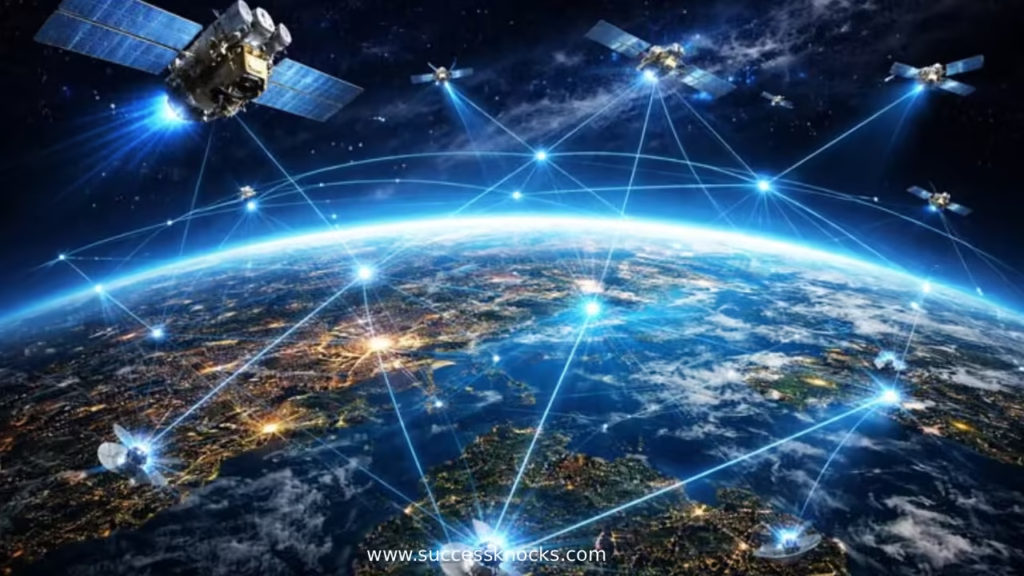
Challenges in Deep Space Communication
The Inverse Square Law Problem
Signal strength decreases dramatically with distance following the inverse square law. Doubling the distance reduces signal strength by 75%. This means communication with Mars requires 10,000 times more sensitive equipment than lunar missions.
Distance-Based Challenges:
- Signal strength degradation over vast distances
- Increasing communication delays as spacecraft travel farther
- Solar interference during planetary conjunctions
- Limited power availability on spacecraft
- Atmospheric interference affecting ground reception
Weather and Atmospheric Effects
Ground-based antennas must contend with Earth’s atmosphere, which can significantly impact signal quality:
Atmospheric Challenges:
- Rain fade: Water droplets absorb radio waves
- Atmospheric ducting: Signal path bending
- Ionospheric interference: Solar activity effects
- Temperature variations: Equipment thermal stability
Future DSN Technology Developments
Next-Generation Capabilities
NASA continues investing in DSN modernization to support future Mars missions and beyond. Planned improvements include:
Upcoming Enhancements:
- Larger antenna arrays for increased sensitivity
- Advanced digital signal processing systems
- Optical communication laser systems
- Automated spacecraft tracking algorithms
- Enhanced cybersecurity protection measures
Laser Communication Systems
The future of deep space communication increasingly involves laser technology. Laser communications can transmit data 10-100 times faster than traditional radio systems while requiring smaller, lighter spacecraft equipment.
Step-by-Step: How to Track DSN Operations
Interested in monitoring real-time DSN activities? NASA provides public access to current network status:
Accessing DSN Now
- Visit NASA’s DSN Now website
- Select your preferred tracking station
- View current spacecraft communications
- Monitor data transmission rates
- Track signal strength and quality metrics
- Observe antenna pointing directions and targets
This real-time visibility demonstrates the network’s constant activity supporting active space missions.
Common Misconceptions About Deep Space Communication
Myth 1: Communication Is Instantaneous
Reality: Even light-speed signals take significant time to cross space. Mars communication involves 4-24 minute delays depending on planetary positions.
Myth 2: Bigger Antennas Always Mean Better Communication
Reality: Antenna size must match mission requirements. Oversized equipment wastes resources and may not improve performance for nearby targets.
Myth 3: Weather Doesn’t Affect Space Communication
Reality: Ground-based antennas are significantly affected by precipitation, atmospheric conditions, and temperature variations.
Myth 4: Modern Technology Eliminates Communication Failures
Reality: Deep space communication remains challenging. Equipment failures, cosmic interference, and extreme distances can still disrupt contact.
International Cooperation in DSN Operations
The DSN exemplifies international space cooperation, with agreements spanning multiple countries and space agencies:
Global Partnerships:
- European Space Agency: Shared tracking resources
- Japan Aerospace Exploration Agency: Technical collaboration
- Canadian Space Agency: Ground station support
- Various national space agencies: Data sharing agreements
These partnerships enable more comprehensive coverage and shared expertise in advancing deep space communication capabilities.
Economic Impact and Resource Management
DSN Operating Costs
Maintaining the Deep Space Network requires significant investment:
| Cost Category | Annual Investment | Purpose |
|---|---|---|
| Personnel | $150+ million | Engineers, operators, maintenance staff |
| Equipment | $100+ million | Antenna upgrades, receiver technology |
| Operations | $75+ million | Power, communications, facility maintenance |
| Research | $50+ million | Future technology development |
Despite high costs, the DSN provides irreplaceable value enabling scientific discoveries worth billions of dollars and advancing human knowledge of the universe.
Return on Investment
Scientific missions supported by the DSN have revolutionized our understanding of planetary science, astronomy, and fundamental physics. The economic benefits extend far beyond space exploration, driving technological innovations that benefit terrestrial communications, medical imaging, and numerous other industries.
Key Takeaways
- Deep Space Network communication technology enables all major space exploration missions through three globally positioned antenna complexes
- Massive 230-foot antennas provide the sensitivity required to communicate across billions of miles with spacecraft
- Advanced error correction and multiple frequency bands ensure reliable data transmission despite extreme distances
- Real-time mission support requires 24/7 operations across multiple time zones and antenna facilities
- Future laser communication systems will dramatically increase data transmission capabilities for Mars missions
- International cooperation strengthens DSN capabilities through shared resources and technical expertise
- The inverse square law creates exponentially increasing challenges as spacecraft travel farther from Earth
- Modern DSN systems simultaneously support over 40 active spacecraft missions across the solar system
Troubleshooting Common DSN Communication Issues
Signal Loss Scenarios
Primary Causes:
- Spacecraft antenna pointing errors
- Ground equipment failures
- Solar interference during conjunctions
- Atmospheric weather effects
- Spacecraft power limitations
Standard Recovery Procedures:
- Switch to backup antenna systems
- Redirect to alternative DSN complex
- Implement emergency communication protocols
- Coordinate with international partner networks
Conclusion
Deep Space Network communication technology explained reveals the remarkable engineering achievement that enables humanity’s exploration of the solar system. From supporting historic moments like the NASA Artemis II astronauts call from space on way home to enabling daily operations of Mars rovers, this network represents one of our species’ most important technological infrastructure investments.
As we prepare for future crewed missions to Mars and beyond, continued DSN evolution remains critical for maintaining the communication lifelines that keep our explorers connected to home. The next breakthrough in space exploration depends on the reliable operation of these giant antennas standing sentinel across three continents.
The universe is vast, but with the Deep Space Network, distance becomes merely another engineering challenge to solve.
Frequently Asked Questions
Q: How does Deep Space Network communication technology differ from regular satellite communications?
A: DSN systems operate at much higher power levels and sensitivity to communicate across millions or billions of miles, while regular satellite communications only need to reach a few hundred miles to Earth orbit satellites.
Q: Can amateur radio operators detect Deep Space Network transmissions?
A: While technically possible with sophisticated equipment, DSN signals are extremely weak and require professional-grade receivers operating near absolute zero temperatures for reliable detection.
Q: What happens if all three DSN complexes experience simultaneous failures?
A: NASA maintains backup protocols including partnerships with international space agencies and emergency procedures, though simultaneous failures at all three sites would create serious communication disruptions for active missions.
Q: How much data can the Deep Space Network handle simultaneously?
A: The network can process several gigabits per second across all active missions, though individual spacecraft data rates vary dramatically based on distance and available power.
Q: Will Deep Space Network technology work for future interstellar missions?
A: Current DSN technology could theoretically communicate with nearby star systems, but signal delays would measure in years and require revolutionary advances in antenna sensitivity and power generation.