Dubai free zone vs mainland setup :
If you are trying to set up in Dubai, the first big question is usually simple: should you choose a free zone or go mainland? The answer depends on where your customers are, how you plan to trade, and how much flexibility you want as you grow. In this article, we’re going to be taking a look at Dubai free zone vs mainland setup, and how you can choose the right structure for your business. If you would like to find out more, feel free to read on.
Pic – CC0 License
The basic difference, in plain English
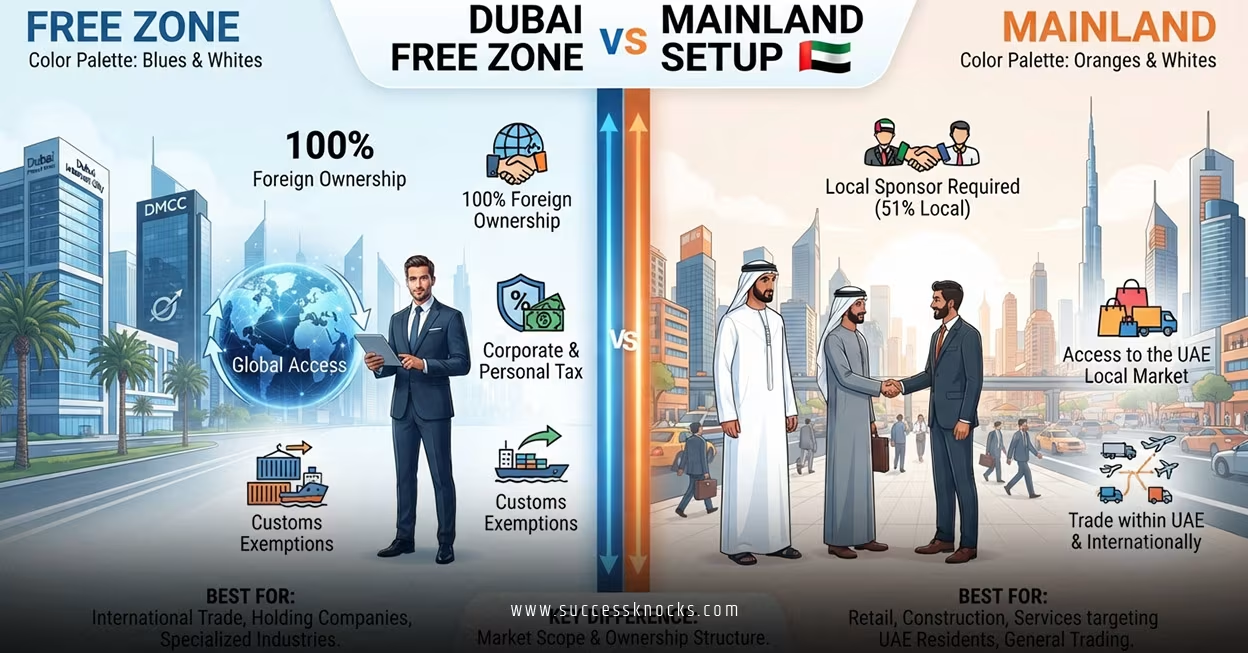
A mainland company is licensed by Dubai’s Department of Economy and Tourism and can trade across the UAE, including with government entities.[1] A free zone company is set up inside a specific free zone and follows that zone’s own rules rather than the mainland regulator.[1]
That is the heart of the decision. If you want broad local market access, mainland usually makes life easier. If your business is built around international trade, remote services, or a lean setup, a free zone can be a better fit.[1][10]
Dubai free zone vs mainland setup: who each one suits
If we strip away the jargon, mainland tends to suit businesses that need direct UAE customers, public-facing premises, or local project work.[10] Free zones tend to suit international services, consulting, ecommerce, holding companies, import and export, and remote-first businesses.[10]
Here is the practical way to think about it:
- Choose mainland if you want to sell directly inside the UAE market, bid for government work, or operate from a customer-facing office.[1][9]
- Choose a free zone if your business mostly serves clients outside the UAE or you want a faster, lighter setup with more flexibility on office space.[1][13]
- Choose mainland if your growth depends on unrestricted local trading.[1][9]
- Choose a free zone if your business model is built around regional or global reach rather than immediate local retail.[10]
That is why Dubai free zone vs mainland setup is not just a legal choice. It is a business model choice.
Market access matters more than the headline tax rate
A lot of founders focus on tax first, but that is only one part of the picture. Mainland companies can trade anywhere in the UAE, while free zone companies are generally restricted to trading within their zone or internationally unless they use a local distributor or similar structure.[1][9]
That matters if your customers are in Dubai itself. If you need to invoice local clients directly, mainland is often the cleaner route.[9] If your clients are mostly overseas, a free zone can give you the freedom to operate without building around local retail access.[10]
The tax picture is also more nuanced than many people expect. Mainland companies are generally subject to the standard UAE corporate tax on profits above AED 375,000, while qualifying free zone businesses can benefit from 0% corporate tax on qualifying income.[1][9] But tax should never be the only deciding factor, because the wrong setup can cost you more in sales friction than you save in tax.
Office space, visas, and setup speed
For smaller founders, this is where the choice often becomes clear. Free zones usually allow flexi-desk or virtual office options, and their visa packages are often capped by the package you buy.[1][9] Mainland setups usually require a physical office and visa allocation is tied more closely to office size.[1][9]
Setup time also tends to be faster in many free zones, with some licenses issued in about one to three weeks, compared with two to six weeks for mainland in the source we reviewed.[1] That does not mean every free zone is always faster, but it does show why many first-time founders start there.
If speed matters, a free zone can help you launch sooner. If your business needs a larger staff base or a more open UAE operating model, mainland may be the better long-term move.
How Dubai business investment opportunities Q3 2026 connect to setup choice
When people search for Dubai business investment opportunities Q3 2026, they are usually looking for the best place to put money, time, and energy next. The setup choice shapes that decision because it affects how easily you can reach customers, what you can sell, and how quickly you can scale.
For example, if you are investing in an ecommerce brand, consulting firm, or cross-border service business, a free zone may support a faster launch and cleaner international structure.[10][13] If you are investing in a local services company, hospitality support business, retail operation, or anything tied to UAE customers, mainland often gives you the access you need.[1][9]
That is why the right setup is part of the investment thesis itself. Good founders do not just ask, “Which license looks cheaper?” They ask, “Which structure helps this business make money sooner and grow with less friction?”
A simple decision framework you can use
Use this quick filter before you choose:
- Pick mainland if your main buyers are in the UAE.[1][9]
- Pick mainland if you want to work with government entities or take on local contracts.[1]
- Pick free zone if your customers are mainly outside the UAE.[10]
- Pick free zone if you want a simpler office setup and a smaller launch cost.[1][13]
- Pick mainland if you expect to hire more staff and need wider operating freedom.[1][9]
If you are still unsure, start with your customer list. Where are they? How do they buy? Do they need you physically in the UAE market, or are you serving them across borders? Your answers usually point to the right structure.
Common mistakes founders make
The biggest mistake is choosing based on price alone. A cheaper license can become expensive if it limits your ability to sell the way you want to sell.
Another mistake is treating Dubai like one single market. It is not. Free zones and mainland setups solve different business problems.[1][10] If you confuse the two, you can end up with a structure that looks fine on paper but slows down real business.
A third mistake is overbuilding too early. Many founders do better when they start with the leanest setup that matches their first sales plan, then upgrade only when demand proves itself.
We hope that you have found this article enlightening in some way, because the smartest Dubai setup is the one that matches your customers, your sales model, and your growth plan. If you are comparing structures as part of your next move, use Dubai business investment opportunities Q3 2026 as your bigger lens, then choose the setup that helps you launch cleanly and scale with confidence.