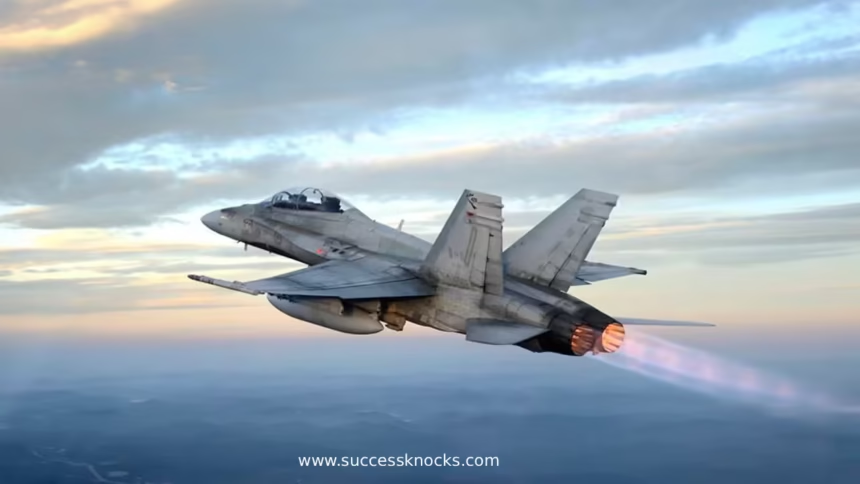
F15 vs F16 represents one of aviation’s most enduring debates, pitting two legendary American fighter jets against each other in a comparison that’s captivated military enthusiasts for decades. While both aircraft serve the U.S. Air Force with distinction, they’re built for completely different missions—and understanding those differences reveals why this comparison remains relevant today.
Here’s what you need to know about the F15 vs F16 debate:
- F-15 Eagle: Twin-engine air superiority fighter designed to dominate in air-to-air combat
- F-16 Fighting Falcon: Single-engine multirole fighter built for versatility and cost-effectiveness
- Primary difference: F-15 prioritizes raw power and air dominance; F-16 emphasizes agility and multi-mission capability
- Current status: Both remain active in 2026, with modern variants still being produced
- Bottom line: They complement rather than compete—different tools for different jobs
What Makes the F15 vs F16 Comparison So Compelling?
The F15 vs F16 debate isn’t just about specs on paper. It’s about two fundamentally different philosophies of air combat that emerged from hard lessons learned in Vietnam.
The F-15 Eagle came first, born from the Air Force’s realization that they needed a dedicated air superiority fighter. No compromises. No jack-of-all-trades mentality. Just pure, unadulterated air-to-air dominance.
The F-16 Fighting Falcon followed a different path entirely.
Here was a fighter that said, “What if we could do everything reasonably well instead of one thing perfectly?” The result? A nimble, affordable multirole platform that became one of history’s most successful fighter programs.
F15 vs F16: Head-to-Head Comparison
| Feature | F-15 Eagle | F-16 Fighting Falcon |
|---|---|---|
| First Flight | 1972 | 1974 |
| Engines | Twin F100-PW-220/229 | Single F100-PW-220/229 or F110-GE-129 |
| Max Speed | Mach 2.5+ | Mach 2+ |
| Range | 3,450 miles | 2,280 miles |
| Payload | 23,000 lbs | 17,000 lbs |
| Cost (2026) | ~$30-35 million | ~$18-25 million |
| Primary Role | Air superiority | Multirole fighter |
| Combat Record | 104-0 air-to-air | Extensive multirole success |
The F-15 Eagle: Built for One Thing Only
When McDonnell Douglas (now Boeing) designed the F-15, they had one mandate: create an air superiority fighter that could outfight anything in the sky. Period.
F-15 Strengths That Still Matter
The F-15’s twin-engine configuration isn’t just about redundancy—though that’s nice when you’re over hostile territory. It’s about raw, uncompromising power. Those two engines generate enough thrust to actually accelerate while climbing vertically. Try that in most other fighters.
The radar system? Absolutely massive. The APG-63 and its successors can track multiple targets simultaneously while maintaining situational awareness that borders on supernatural. When F-15 pilots talk about “seeing first, shooting first,” they’re not bragging—they’re stating operational reality.
Range is where the F-15 really shines in the F15 vs F16 comparison. With a combat radius exceeding 1,000 nautical miles, F-15s can project power deep into enemy territory and still have fuel to fight on the way home.
F-15 Limitations in Modern Context
But here’s the thing about specialization—it comes with trade-offs.
The F-15 is expensive. Not just to buy, but to operate. Those twin engines burn fuel like a bonfire consumes newspaper. Maintenance requirements are substantial, and the logistics footprint is significant.
Air-to-ground capability exists in later variants like the F-15E Strike Eagle, but it was never the primary focus. When you need to hit ground targets, the F-15 can do it—but it’s like using a Formula 1 car for grocery shopping. It works, but it’s not ideal.
The F-16 Fighting Falcon: The Swiss Army Knife of Fighters
The F-16 took a completely different approach to the fighter equation. Instead of maximizing one capability, it sought to optimize the balance between air-to-air combat, air-to-ground strikes, cost-effectiveness, and operational flexibility.
F-16 Advantages That Changed Everything
Agility. That’s the word that comes up first in any F15 vs F16 discussion focusing on the Falcon.
The F-16’s fly-by-wire system was revolutionary when introduced, allowing the aircraft to be deliberately unstable for enhanced maneuverability. Pilots describe the sensation as the aircraft wanting to turn before you even move the stick.
The single-engine design reduces complexity and cost while the side-mounted control stick and reclined seat position help pilots handle higher G-forces during aggressive maneuvering.
But here’s where the F-16 really earned its reputation: multirole capability. The same aircraft that can dogfight at dawn can drop precision-guided munitions by noon and provide close air support by evening. That versatility translates directly into operational value for air forces worldwide.
F-16 Trade-offs in the Modern Era
Single-engine operation means no redundancy. While modern engines are incredibly reliable, that statistical backup of a second powerplant isn’t there when things go wrong over unfriendly territory.
Range and payload limitations become apparent when compared directly to the F-15. The F-16 simply can’t carry as much ordnance as far as its twin-engine counterpart.
Radar capabilities, while excellent, don’t match the raw power and range of the F-15’s systems. In beyond-visual-range combat scenarios, that difference can be decisive.
Combat Record: Where the F15 vs F16 Debate Gets Real
Numbers don’t lie, and the combat records of both aircraft tell fascinating stories.
F-15 Combat Performance
The F-15’s air-to-air record remains unmatched: 104 confirmed kills with zero losses in aerial combat. This isn’t just marketing material—it represents decades of air superiority missions across multiple conflicts and operators.
From Israeli operations in the Bekaa Valley to coalition air campaigns in Iraq, the F-15 has consistently delivered on its air superiority promise. The U.S. Air Force continues to invest in F-15 upgrades specifically because this combat record validates the design philosophy.
F-16 Operational Success
The F-16’s success story is different but equally impressive. With over 4,600 aircraft delivered to 25+ nations, the Fighting Falcon has participated in virtually every major conflict since the 1980s.
Its multirole capability means F-16 success stories span air-to-air victories, precision strikes, close air support, and reconnaissance missions. The Department of Defense credits F-16 operations with significantly advancing precision warfare concepts.
Technical Evolution: How F15 vs F16 Capabilities Have Advanced
Both aircraft have undergone substantial upgrades since their initial deployments, maintaining relevance in 2026’s threat environment.
Modern F-15 Variants
The F-15EX Eagle II represents the latest evolution of the F-15 platform. Boeing has integrated modern avionics, expanded weapons capacity, and enhanced electronic warfare systems while maintaining the core air superiority advantages.
Key improvements include:
- Advanced radar systems with enhanced tracking capability
- Expanded weapons pylons for increased payload flexibility
- Modern electronic warfare suites
- Updated cockpit displays and human-machine interfaces
Contemporary F-16 Developments
The F-16 Block 70/72 configuration demonstrates how continuous modernization keeps older designs competitive. Lockheed Martin has focused on sensor fusion, advanced radar systems, and expanded multirole capabilities.
Recent enhancements include:
- APG-83 SABR radar with significantly enhanced range and resolution
- Advanced targeting pods for precision strike missions
- Improved electronic warfare systems
- Enhanced helmet-mounted display systems
Cost Analysis: The Economic Reality of F15 vs F16 Operations
Military procurement isn’t just about capability—it’s about cost-effectiveness over decades of operation.
F-15 Economic Considerations
The F-15’s higher acquisition and operational costs reflect its specialized mission focus. Twin-engine maintenance, larger logistics footprint, and higher fuel consumption create ongoing expense streams.
However, the cost-per-capability ratio remains competitive when air superiority is the primary requirement. For nations facing sophisticated air threats, the F-15’s advantages justify the additional expense.
F-16 Cost Advantages
The F-16’s economic appeal has driven its international success. Lower acquisition costs, reduced maintenance requirements, and single-engine operation create a more accessible ownership proposition.
For air forces requiring multirole capability without specialized air superiority requirements, the F-16 offers exceptional value. This cost-effectiveness has enabled smaller nations to operate modern fighter capabilities.
Step-by-Step Guide: Choosing Between F15 vs F16 for Your Mission
If you were advising an air force on the F15 vs F16 decision, here’s how to approach it:
- Define Primary Mission Requirements
- Air superiority focus = lean toward F-15
- Multirole flexibility = consider F-16
- Budget constraints = favor F-16
- Assess Threat Environment
- Sophisticated air threats = F-15 advantages clear
- Mixed threat scenarios = F-16 versatility valuable
- Limited air opposition = F-16 cost-effectiveness optimal
- Evaluate Operational Context
- Large geographic areas = F-15 range crucial
- Varied mission sets = F-16 flexibility important
- Limited airbases = F-16 logistics advantages
- Consider Long-term Sustainability
- Available maintenance infrastructure
- Pilot training pipeline requirements
- Spare parts and upgrade path availability
Common Mistakes in F15 vs F16 Analysis
Mistake 1: Treating Them as Direct Competitors
The biggest error in F15 vs F16 discussions is assuming they compete for the same role. They don’t. They complement each other in a balanced air force structure.
Fix: Evaluate each aircraft against its intended mission rather than head-to-head specs.
Mistake 2: Ignoring Operational Costs
Focusing solely on acquisition costs while ignoring decades of operational expenses leads to poor decisions.
Fix: Calculate total cost of ownership including fuel, maintenance, training, and infrastructure requirements.
Mistake 3: Overweighting Specifications
Paper specifications don’t always translate to operational effectiveness in complex, real-world scenarios.
Fix: Prioritize combat record, user feedback, and operational flexibility over raw performance numbers.
Mistake 4: Neglecting Logistics Requirements
Both aircraft have different support requirements that significantly impact operational capability.
Fix: Assess maintenance infrastructure, spare parts availability, and training pipeline compatibility.
Mistake 5: Assuming Newer is Always Better
While both platforms have modern variants, the fundamental design philosophies remain distinct and mission-appropriate.
Fix: Match aircraft capabilities to actual operational requirements rather than chasing latest technology for its own sake.

International Operators: Global F15 vs F16 Success Stories
The international success of both platforms provides real-world validation of their respective design philosophies.
F-15 International Operators
Countries operating F-15 variants have consistently chosen the platform for air superiority missions. Japan, Saudi Arabia, Israel, and South Korea represent diverse operational environments where F-15 capabilities have proven decisive.
The Japan Air Self-Defense Force has operated F-15s for decades, crediting the platform with maintaining air superiority in a challenging regional security environment.
F-16 Global Adoption
With 25+ operator nations, the F-16 represents one of history’s most successful fighter export programs. From NATO allies to Middle Eastern partners, the F-16’s adaptability has enabled diverse air forces to maintain modern capabilities.
The platform’s success across varied operational requirements validates the multirole design philosophy that defines the F-16 approach.
Future Outlook: F15 vs F16 Relevance in Modern Air Warfare
Both platforms continue evolving to meet 2026’s threat environment, though their roles are shifting as newer generation fighters enter service.
F-15 Future Role
The F-15’s evolution toward the F-15EX configuration demonstrates continued relevance in specific mission sets. As air threats become more sophisticated, the F-15’s raw capability advantages maintain value.
Boeing’s continued investment in F-15 modernization suggests the platform will remain operationally relevant through the 2040s, particularly in air superiority and homeland defense roles.
F-16 Continued Evolution
Lockheed Martin’s ongoing F-16 development reflects the platform’s adaptability to changing requirements. The F-16’s cost-effectiveness and upgrade potential ensure continued international demand.
The F-16‘s role may shift toward more specialized missions as fifth-generation fighters assume primary air superiority responsibilities, but its multirole flexibility maintains operational value.
Key Takeaways: What Really Matters in F15 vs F16 Comparisons
- Mission focus drives choice: F-15 for air superiority, F-16 for multirole flexibility
- Combat records validate design: Both aircraft have proven their respective strengths operationally
- Cost considerations are crucial: Total ownership costs significantly impact long-term viability
- They complement, not compete: Optimal air force structures often include both platforms
- Upgrade paths maintain relevance: Continuous modernization keeps both designs competitive in 2026
- International success proves concepts: Global adoption validates both design philosophies
- Threat environment determines priority: Sophisticated air threats favor F-15; mixed scenarios favor F-16
- Logistics matter as much as performance: Support requirements significantly impact operational effectiveness
Conclusion
The F15 vs F16 debate isn’t really about declaring a winner—it’s about understanding two fundamentally different approaches to air power that both succeeded brilliantly at their intended missions.
The F-15 Eagle remains the ultimate air superiority fighter, with a combat record that speaks louder than any specification sheet. When you absolutely, positively need to control the skies, the F-15 delivers.
The F-16 Fighting Falcon represents the triumph of versatility over specialization, proving that a well-designed multirole platform can serve effectively across diverse mission sets while maintaining cost-effectiveness.
In 2026’s complex security environment, the smart money isn’t on choosing between them—it’s on understanding what each brings to the table and how they can work together.
The real winner? Air forces that recognize both aircraft for what they are: complementary tools in a comprehensive air power toolkit.
Choose based on mission. Operate based on capability. Win based on understanding the difference.
Frequently Asked Questions
Q: Which is faster, the F-15 or F-16 in the F15 vs F16 comparison?
A: The F-15 has a higher top speed at Mach 2.5+ compared to the F-16’s Mach 2+. However, in practical air combat scenarios, both aircraft operate well below maximum speed, making acceleration and sustained turn performance more relevant than top speed.
Q: Why does the F-15 cost more than the F-16?
A: The F-15’s twin-engine configuration, larger size, more complex systems, and specialized air superiority focus drive higher acquisition and operational costs. The F-16’s single-engine design and multirole efficiency create cost advantages that have enabled broader international adoption.
Q: Can the F-16 beat the F-15 in air-to-air combat?
A: While the F-16’s superior agility provides advantages in close-range dogfights, the F-15’s radar range, weapons capacity, and twin-engine power typically provide decisive advantages in beyond-visual-range scenarios. Combat outcomes depend heavily on pilot skill, tactics, and engagement parameters.
Q: Which aircraft is easier to maintain?
A: The F-16’s single-engine configuration generally requires less complex maintenance procedures and smaller logistics footprints compared to the F-15’s twin-engine systems. However, both platforms have mature support infrastructures that enable reliable operations when properly maintained.
Q: Are there any countries that operate both F-15 and F-16 aircraft?
A: Yes, several countries including the United States, Israel, and South Korea operate both platforms simultaneously, utilizing each aircraft’s strengths for different mission requirements. This mixed approach validates the complementary nature of the F15 vs F16 relationship rather than direct competition.