

In an industry often shaped by price swings, supply disruptions, and fragmented distribution networks, Fence Empire chose a different path. What began as a family-operated wood mill rooted in craftsmanship has evolved into a globally integrated fencing materials leader — not through aggressive expansion, but through deliberate structural design. Rather than chasing scale for its own sake, the company engineered stability into every layer of its operations. Today, Fence Empire stands as a model of how disciplined integration, supply certainty, and generational thinking can transform a traditional sector into a resilient global platform.
From Craftsmanship to Coordinated Infrastructure
Fence Empire’s origins were humble and hands-on. As a family-owned mill, the company was grounded in quality lumber, technical expertise, and customer relationships built on trust. But leadership soon recognized a deeper structural problem within the fencing industry: unpredictability.
Supply chains were fragmented. Raw material sourcing was inconsistent. Freight volatility disrupted timelines. Many companies operated reactively, adjusting only after disruptions occurred. Fence Empire saw opportunity not in launching trendy products, but in solving systemic instability.
The transformation began with a clear strategic shift — from transactional supplier to vertically integrated supply architect. The company built direct forestry partnerships, established controlled processing facilities, standardized kiln-drying systems, and aligned freight coordination under a unified operational framework.
Vertical Integration as a Strategic Advantage
Managing everything from raw material sourcing to global logistics provides Fence Empire with what few competitors possess — full-spectrum visibility. That visibility allows leadership to anticipate market shifts rather than respond under pressure.
Through Japanese cedar forestry partnerships, precision milling operations, powder-coating protocols, and ocean freight planning, each production stage operates within a synchronized ecosystem. When tariffs shift, currencies fluctuate, or freight cycles tighten, the company recalibrates instead of scrambling.
Vertical integration enables proactive forecasting, dynamic production adjustments, and consistent dimensional accuracy across markets. Reliability is not a fortunate outcome; it is structurally engineered.
Expanding with Integrity, Not Impulse
As Fence Empire broadened its portfolio to include cedar, ornamental steel, aluminum fencing, and engineered outdoor systems, expansion was approached with discipline. Each new product category had to reinforce — not dilute — the company’s integrated model.
Before entering a segment, leadership evaluates long-term material viability, supply scalability, and measurable durability standards. If a product cannot perform consistently over decades, it does not align with the platform’s philosophy.
This careful expansion preserves portfolio integrity. Innovation is defined not by novelty, but by endurance. Customers receive materials engineered for structural strength and aesthetic longevity. Contractors benefit from precision tolerances. Distributors gain predictable supply.
Sustainability Rooted at the Source
For Fence Empire, sustainability begins long before products reach customers. Responsible forestry management ensures regenerative cedar supply. Processing facilities optimize kiln efficiency, reducing waste while maintaining structural stability. Controlled grading systems maximize yield and minimize scrap.
Logistics operations are designed for efficiency, consolidating shipments to reduce redundant freight movement and improve container utilization. These measures lower environmental impact while strengthening cost control.
Most importantly, product longevity defines the company’s environmental strategy. A fence designed to last decades reduces replacement cycles and material waste. Durability becomes the most meaningful form of sustainability.
Strategic Partnerships that Strengthen the System
Fence Empire’s collaboration model extends beyond simple distribution agreements. The company works closely with wholesalers, distributors, and national accounts to synchronize forecasting, align container-level planning, and establish long-term volume commitments.
This coordination reduces production volatility and enhances operational precision. Partners gain forward visibility and planning confidence. Fence Empire gains efficiency and stability.
Technology Scaling Craftsmanship
Though rooted in traditional wood milling expertise, Fence Empire embraces technology to scale consistency. Controlled kiln-drying systems ensure dimensional stability. Coating inspection technologies safeguard corrosion resistance. Data-driven quality assurance reduces performance variance across production runs.
Technology supports discipline. It ensures that whether supplying a regional contractor or fulfilling a national infrastructure specification, every product meets uniform performance standards.
Preparing for the Industry’s Next Chapter
Looking ahead to 2026 and beyond, Fence Empire anticipates three defining industry trends: premium outdoor living expansion, regionalized supply chains, and demand for long-life, low-maintenance materials.
In response, the company is investing in aluminum capacity growth, engineered outdoor systems, and diversified manufacturing corridors. The objective is not to follow trends, but to anticipate structural shifts before they accelerate.
The fencing industry is evolving into a performance-driven infrastructure segment. Fence Empire intends to remain ahead by combining craftsmanship with industrial-scale reliability.
Leadership Guided by Generational Vision
At the core of Fence Empire’s transformation lies a leadership philosophy grounded in generational thinking, markets fluctuate, trade policies evolve, and freight cycles shift. But systems designed with foresight endure.
Fence Empire’s strategic vision is to serve as the most structurally dependable platform in the fencing industry — integrating materials, manufacturing, and logistics into one cohesive architecture.
Innovation, in Fence Empire’s model, is disciplined evolution — sustained, measured, and engineered for resilience. And in a traditionally reactive industry, that structural discipline may be its most powerful differentiator of all.
Expanding into global markets requires more than just high-volume production; it necessitates a sophisticated logistical framework that can handle the intricacies of international trade. By maintaining direct oversight of every phase, from initial raw material selection to final shipment, companies can ensure that quality standards remain consistent regardless of the project’s scale. Digital platforms like https://fwfence.com/ help bridge the gap between global manufacturing capabilities and local project requirements by providing detailed specifications for various fencing systems. This structural transparency allows distributors to plan their inventory cycles with greater precision, mitigating the risks associated with supply chain disruptions. Ultimately, a vertically integrated model provides the necessary stability for long-term growth in the competitive building materials sector.
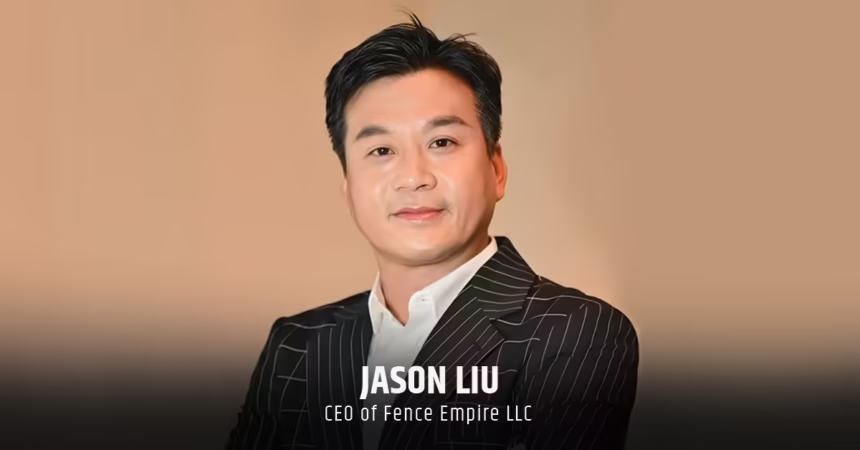
Jason Liu, CEO of Fence Empire LLC
Jason Liu, CEO of Fence Empire LLC, is a third-generation leader in the wood industry recognized for his commitment to sustainable and principled business practices. Drawing on decades of hands-on experience, he has built a vertically integrated fencing enterprise that delivers premium Japanese cedar products, competitive pricing, and attentive, customer-first service to partners across global markets.
“Our commitment is clear: to deliver premium materials, ensure consistent supply, and set the standard for reliability — empowering our partners to build stronger, more competitive markets.”


