

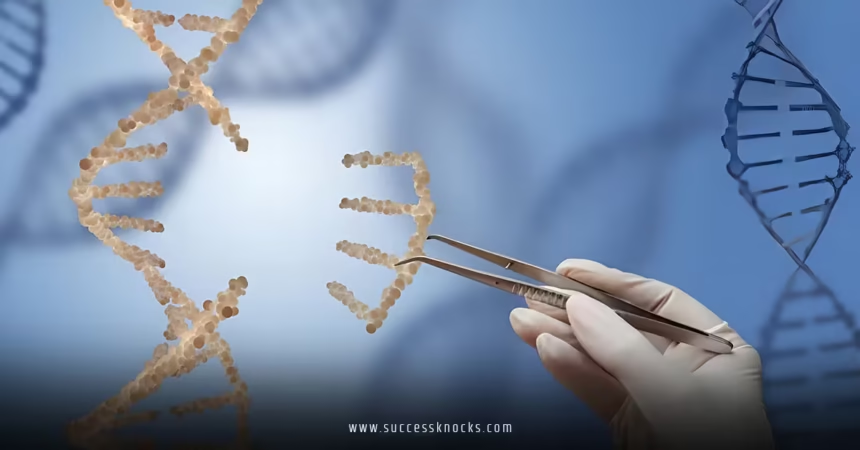
Future of CRISPR gene editing for disease prevention is reshaping how we think about stopping diseases before they start. Think of it as upgrading from treating symptoms to editing the source code. We’re not just talking about better treatments—we’re looking at potentially erasing genetic diseases from family trees entirely.
Here’s what makes this revolutionary:
- Prevention beats treatment: Stop diseases at the genetic level before symptoms appear
- Hereditary disease elimination: Break cycles of inherited conditions like sickle cell and Huntington’s
- Precision targeting: Edit specific genes without affecting healthy DNA
- Germline editing potential: Changes that could be passed to future generations
- Cost efficiency: One intervention instead of lifelong treatments
The technology has moved beyond laboratory curiosity. Real people are getting treated. Real diseases are disappearing. And we’re just getting started.
How CRISPR Gene Editing Actually Prevents Disease
CRISPR works like molecular scissors with GPS.
It finds the exact genetic address causing problems, cuts out the faulty code, and either deletes it or replaces it with healthy DNA. For disease prevention, this means intercepting genetic conditions before they can cause damage.
The process breaks down into three main approaches:
Somatic Cell Editing targets cells in your body that won’t be passed to children. This prevents disease in you specifically—like editing immune cells to resist HIV or modifying liver cells to process toxins better.
Germline Editing changes reproductive cells (eggs, sperm, early embryos). These modifications get inherited by future generations. One edit could eliminate a genetic disease from an entire family line.
Base Editing makes precise single-letter changes in DNA without cutting. Think of it as using “find and replace” instead of scissors. This approach reduces errors and works perfectly for diseases caused by single DNA letter mistakes.
Current CRISPR Success Stories in Disease Prevention
The proof isn’t theoretical anymore.
Victoria Gray had sickle cell disease—a genetic condition causing excruciating pain and organ damage. In 2019, doctors edited her bone marrow cells using CRISPR. Her body now produces healthy blood cells. The pain that dominated her life? Gone.
Similar success happened with beta-thalassemia, another blood disorder. Patients who needed monthly blood transfusions are now transfusion-free after their bone marrow received genetic edits.
- CTX001 therapy: Approved for sickle cell disease and beta-thalassemia
- NTLA-2001: Shows promise for hereditary transthyretin amyloidosis
- EDIT-301: Being tested for sickle cell disease prevention
- Base editing trials: Targeting inherited blindness and metabolic disorders
But here’s the kicker—these are just the opening acts.
What’s Coming in the Next 5 Years
The pipeline reads like science fiction becoming reality.
Heart Disease Prevention tops the list. Researchers are targeting genes like PCSK9 that control cholesterol. One edit could provide lifelong protection against heart attacks—the leading killer in America.
Cancer Prevention through genetic editing is showing remarkable progress. Scientists are engineering immune cells to recognize and eliminate cancer cells before tumors form. Think of it as installing better antivirus software in your immune system.
Alzheimer’s Prevention could become reality through APOE gene editing. People with certain APOE variants face dramatically higher Alzheimer’s risk. CRISPR could potentially rewrite these genetic predispositions.
| Disease Category | Target Timeline | Prevention Method | Current Status |
|---|---|---|---|
| Inherited Blindness | 2025-2027 | In-eye gene editing | Phase 2/3 trials |
| Muscular Dystrophy | 2026-2028 | Muscle cell editing | Phase 1/2 trials |
| Huntington’s Disease | 2027-2030 | Brain cell targeting | Preclinical |
| Type 1 Diabetes | 2028-2031 | Pancreatic cell editing | Early research |
The Germline Editing Frontier
This is where things get ethically complex and scientifically thrilling.
Germline editing means changes pass to children and grandchildren. One intervention could eliminate genetic diseases from entire bloodlines. Forever.
China shocked the world in 2018 when He Jiankui created the first CRISPR babies—twin girls edited to resist HIV. The scientific community condemned the rushed, secretive approach, but the technological capability became undeniable.
The National Academy of Sciences now supports germline editing research under strict conditions. Key requirements include:
- Serious genetic diseases only
- No viable alternatives
- Rigorous oversight
- Transparent public engagement
Countries like the UK are developing regulatory frameworks. The technology is advancing faster than policies can keep pace.
Technical Breakthroughs Changing Everything
Prime Editing represents the next evolution. Developed by David Liu’s team at the Broad Institute, it makes precise edits without double-strand breaks. This dramatically reduces unwanted mutations—the biggest safety concern with traditional CRISPR.
Base Editing can fix up to 60% of known genetic diseases. Instead of cutting DNA, it chemically converts one DNA letter to another. It’s like using correction fluid instead of scissors and glue.
Epigenetic Editing changes how genes behave without altering DNA sequence. This opens possibilities for reversible genetic modifications—turning disease-causing genes off and on as needed.
The delivery systems are improving too. New lipid nanoparticles can deliver CRISPR components to specific organs. Adeno-associated viruses (AAV) provide precise tissue targeting. These advances make in-body editing safer and more effective.
Common Mistakes in Understanding CRISPR Prevention
Mistake 1: Thinking CRISPR is one-size-fits-all Different genetic diseases need different approaches. Sickle cell requires cell editing outside the body. Inherited blindness needs direct eye injection. Huntington’s disease will require brain-specific delivery systems.
Fix: Understand that CRISPR is a toolbox, not a single tool.
Mistake 2: Expecting immediate results Genetic editing often requires weeks or months to show full effects. Edited cells need time to replace old ones. Some benefits might take years to fully manifest.
Fix: Set realistic timelines based on the specific condition and approach.
Mistake 3: Ignoring mosaicism Not every cell gets edited successfully. This creates a mixture of edited and unedited cells (mosaicism). Higher editing efficiency means better outcomes.
Fix: Ask about editing efficiency rates when evaluating treatments.
Mistake 4: Overlooking immune responses Your immune system might recognize CRISPR components as foreign and attack them. This can reduce effectiveness or cause side effects.
Fix: Understand immunosuppression protocols and monitoring requirements.
The Economics of Genetic Disease Prevention
The numbers tell a compelling story.
Current CRISPR treatments cost $2-3 million per patient. That sounds expensive until you compare it to lifelong disease management. Sickle cell disease costs the US healthcare system over $1 billion annually. Treating one patient costs approximately $1.7 million over their lifetime.
One $2 million CRISPR intervention versus $1.7 million in ongoing treatments? The math works.
Insurance companies are starting to pay attention. Some are covering approved CRISPR therapies. As more treatments get approved and costs decrease through scale, coverage will expand.
The FDA’s expedited approval pathways are speeding genetic therapies to market. Breakthrough therapy designation can cut approval times in half.
Safety Considerations and Risk Management
Off-target effects remain the biggest concern.
CRISPR might edit unintended DNA locations, potentially causing new problems while fixing others. Modern CRISPR systems have dramatically improved accuracy, but the risk isn’t zero.
Comprehensive safety protocols now include:
- Whole genome sequencing before and after editing
- Long-term patient monitoring (sometimes decades)
- Advanced computational modeling to predict effects
- Gradual dose escalation in clinical trials
- Multiple backup safety systems
The good news? Safety records from current trials are encouraging. Serious adverse events directly linked to CRISPR editing remain rare.
Step-by-Step Path to CRISPR Disease Prevention
If you’re considering CRISPR for disease prevention, here’s your roadmap:
Step 1: Genetic Counseling Meet with certified genetic counselors to understand your disease risk. They’ll explain inheritance patterns, test options, and family implications.
Step 2: Comprehensive Testing Get detailed genetic testing beyond basic panels. This might include whole genome sequencing, not just targeted gene tests.
Step 3: Research Current Trials Check ClinicalTrials.gov for relevant studies. Many cutting-edge treatments are only available through clinical trials.
Step 4: Specialist Consultation Connect with medical centers specializing in genetic diseases and gene therapy. Academic medical centers often lead in this field.
Step 5: Insurance Navigation Work with patient advocates to understand coverage options. Some treatments qualify for compassionate use programs or patient assistance.
Step 6: Treatment Planning If you’re eligible, work with your medical team to plan timing, logistics, and monitoring protocols.
Step 7: Long-term Follow-up Commit to long-term monitoring. This protects you and contributes valuable safety data for future patients.
Regulatory Landscape and Global Perspectives
The regulatory environment varies dramatically by country.
The US takes a cautious but progressive approach. The FDA approves somatic cell editing but maintains strict oversight. Germline editing research continues but clinical applications remain prohibited.
The UK leads in regulatory sophistication. The Human Fertilisation and Embryology Authority provides clear frameworks for germline editing research. They’re developing pathways for eventual clinical applications.
China implemented strict regulations after the 2018 germline editing controversy. New laws include criminal penalties for unauthorized genetic editing of human embryos.
The World Health Organization is developing global governance frameworks for human genome editing. International coordination becomes crucial as the technology advances.
Key Takeaways
- CRISPR disease prevention has moved from laboratory to clinic with proven successes
- Next five years will bring treatments for major diseases like inherited blindness and muscular dystrophy
- Germline editing could eliminate genetic diseases from family lines but faces ethical and regulatory hurdles
- Technical advances like prime editing and base editing dramatically improve safety and precision
- Economics favor prevention over lifelong treatment for many genetic diseases
- Safety protocols continue improving with comprehensive monitoring and risk management
- Regulatory frameworks are evolving but vary significantly between countries
- Patient access requires navigating complex medical, insurance, and trial systems
The Road Ahead
Future of CRISPR gene editing for disease prevention isn’t just promising—it’s delivering.
We’re transitioning from asking “Can we edit genes to prevent disease?” to “Which diseases should we tackle first?” The technology works. The safety data looks good. The economics make sense.
The next decade will determine whether genetic disease becomes optional for future generations. Early evidence suggests we’re heading in exactly that direction.
Your next step? Stay informed. If genetic disease affects your family, connect with genetic counselors and research current treatment options. The landscape changes monthly, and new possibilities emerge constantly.
The future of medicine is being written in DNA. And for the first time in history, we hold the pen.
Conclusion
The transformation happening in genetic medicine isn’t incremental—it’s revolutionary. We’ve moved beyond treating symptoms to editing the source code of disease itself. The early successes with sickle cell disease and beta-thalassemia prove the concept works in real patients with real lives.
What excites me most? We’re just scratching the surface. The diseases coming into CRISPR’s crosshairs—heart disease, cancer, Alzheimer’s—affect millions. The potential to prevent rather than treat these conditions could redefine what it means to be human in the 21st century.
Start by understanding your genetic risks. The future of medicine is personalized, and knowledge is your best prevention strategy.
Frequently Asked Questions
Q: How long does CRISPR gene editing for disease prevention take to show results?
A: Timeline varies by condition and approach. Blood disorders like sickle cell show improvements within 3-6 months as new healthy cells replace diseased ones. Neurological conditions may take years for full benefits to appear. The future of CRISPR gene editing for disease prevention includes faster-acting delivery systems that could reduce these timelines.
Q: Is CRISPR disease prevention covered by insurance?
A: Coverage is expanding but still limited. Approved therapies like CTX001 for sickle cell disease are increasingly covered by major insurers. Experimental treatments often require clinical trial participation or compassionate use programs. Work with patient advocates and genetic counselors to navigate options.
Q: Can CRISPR editing be reversed if something goes wrong?
A: Traditional CRISPR edits are permanent, but newer approaches offer more flexibility. Epigenetic editing can be reversible. Some base editing techniques allow for correction of previous edits. Future systems may include “genetic switches” for reversible modifications.
Q: What’s the difference between treating disease and preventing it with CRISPR?
A: Treatment addresses existing symptoms or damage, while prevention stops disease from developing. For example, treating sickle cell with CRISPR edits cells to produce healthy blood, eliminating the disease at its source rather than managing pain crises. Prevention through germline editing could stop genetic diseases from being inherited entirely.
Q: How do I know if I’m a candidate for CRISPR disease prevention?
A: Start with genetic counseling and comprehensive testing. Good candidates typically have single-gene disorders with clear genetic causes, limited treatment alternatives, and conditions that significantly impact quality of life. Your genetic profile, family history, and overall health all factor into eligibility decisions.


