
generative ai data security risks b2b are becoming a top concern as businesses integrate tools like chatbots and content generators into their operations. In the fast-evolving world of B2B tech, where companies share sensitive data across partnerships, these risks can lead to breaches, compliance violations, and hefty fines. But with the right strategies, you can turn potential vulnerabilities into strengths. This guide walks you through mitigating those risks, focusing on practical steps for U.S.-based firms navigating regulations like GDPR influences and emerging AI laws.
To get you up to speed quickly, here’s a compact overview of mitigating generative AI data security risks in B2B settings:
- Core Risks: Data leaks from AI models trained on proprietary info, unauthorized access in collaborative environments, and compliance gaps under U.S. laws like CCPA.
- Why It Matters: Unaddressed risks can result in financial losses averaging $4.45 million per breach, according to IBM’s 2023 Cost of a Data Breach Report (projected to rise by 2026).
- Key Mitigation: Implement robust access controls, regular audits, and employee training to ensure secure AI adoption.
- B2B Focus: Tailor strategies for vendor relationships, emphasizing contract clauses and shared responsibility models.
- Outcome: Achieve compliance while boosting innovation, reducing breach likelihood by up to 30% with proactive measures.
What Are Generative AI Data Security Risks in B2B Contexts?
Let’s break this down simply. Generative AI, think tools like advanced language models or image creators, produces new content from vast datasets. In B2B, companies use them for everything from automating sales pitches to analyzing market data. But here’s the catch: these systems often handle sensitive information, like client financials or trade secrets.
The risks? They stem from how AI processes and stores data. For instance, if an AI model is trained on your company’s proprietary data without proper safeguards, that info could inadvertently leak to competitors or hackers. In the U.S., where B2B deals often cross state lines, this ties into federal oversight from bodies like the FTC.
Imagine your B2B software firm using AI to generate personalized proposals. If the AI pulls from a shared database without encryption, a cyber intruder could exploit it. That’s a classic generative ai data security risks b2b scenario, amplified by the scale of enterprise data.
By 2026, experts predict AI-related breaches will surge as adoption hits 80% of businesses, per Gartner forecasts. To counter this, start by identifying your exposure points—data ingestion, model training, and output generation.
Why B2B Companies Face Unique Generative AI Data Security Risks
B2B environments aren’t like consumer apps. You’re dealing with complex supply chains, multiple stakeholders, and high-stakes data sharing. Generative AI amplifies these issues because it learns from inputs, potentially exposing confidential info across partnerships.
Take data poisoning: Bad actors could feed malicious data into your AI, skewing outputs and leading to flawed decisions. In B2B, this might mean a supplier’s tainted dataset corrupts your inventory forecasts, causing real financial harm.
Regulatory pressures add layers. In the USA, frameworks like the NIST AI Risk Management Framework guide compliance, but B2B firms must also align with partner requirements. Non-compliance could void contracts or invite lawsuits.
We’ve seen cases where AI tools inadvertently revealed trade secrets in generated reports. To avoid this, prioritize vendor assessments—ensure your AI providers follow standards like ISO 27001 for information security.
Key Types of Generative AI Data Security Risks B2B Teams Should Know
Diving deeper, let’s categorize these risks for clarity. Beginners, this is your starting point; intermediates, use it to refine your strategies.
Data Leakage and Exposure
AI models can “memorize” training data, regurgitating sensitive details in outputs. In B2B, this means client info slipping into generated content shared with partners.
Unauthorized Access and Insider Threats
Without strong authentication, employees or vendors might misuse AI, accessing restricted data. By 2026, multi-factor authentication (MFA) will be non-negotiable in B2B AI setups.
Compliance and Legal Risks
Failing to meet U.S. regs like the California Consumer Privacy Act (CCPA) can lead to penalties. Generative AI complicates this by generating data that might be classified as personal information.
Model Vulnerabilities
AI can be tricked via prompt injection attacks, where hackers manipulate inputs to extract data. B2B firms must harden models against such exploits.
To illustrate, here’s a quick table comparing common risks and their impacts:
| Risk Type | Description | Potential B2B Impact | Mitigation Preview |
|---|---|---|---|
| Data Leakage | AI outputs reveal trained data | Loss of IP, damaged partnerships | Encryption and data anonymization |
| Unauthorized Access | Weak controls allow breaches | Internal data theft, compliance fines | Role-based access controls (RBAC) |
| Compliance Violations | Ignoring regs like CCPA | Legal penalties up to $7,500 per violation | Regular audits and policy updates |
| Model Attacks | Prompt manipulations exploit AI | Corrupted outputs, decision-making errors | Input validation and monitoring |
This table draws from best practices outlined in the NIST AI Risk Management Framework.
Best Practices for Mitigating Generative AI Data Security Risks B2B-Style
Now, let’s get practical. Mitigation isn’t about avoiding AI—it’s about using it safely. We’ll cover strategies that blend tech, policy, and people.
Start with a risk assessment. Map out how generative AI touches your data flows. Tools like AI governance platforms can automate this.
Next, enforce data minimization: Only feed AI what it needs. Anonymize datasets to strip personal identifiers, reducing exposure.
For B2B compliance, bake security into contracts. Specify data handling protocols and audit rights with vendors.
Employee training is crucial. Run workshops on safe AI use, like spotting phishing attempts disguised as AI prompts.
By 2026, federated learning—training AI on decentralized data—will gain traction in B2B, minimizing central data risks.
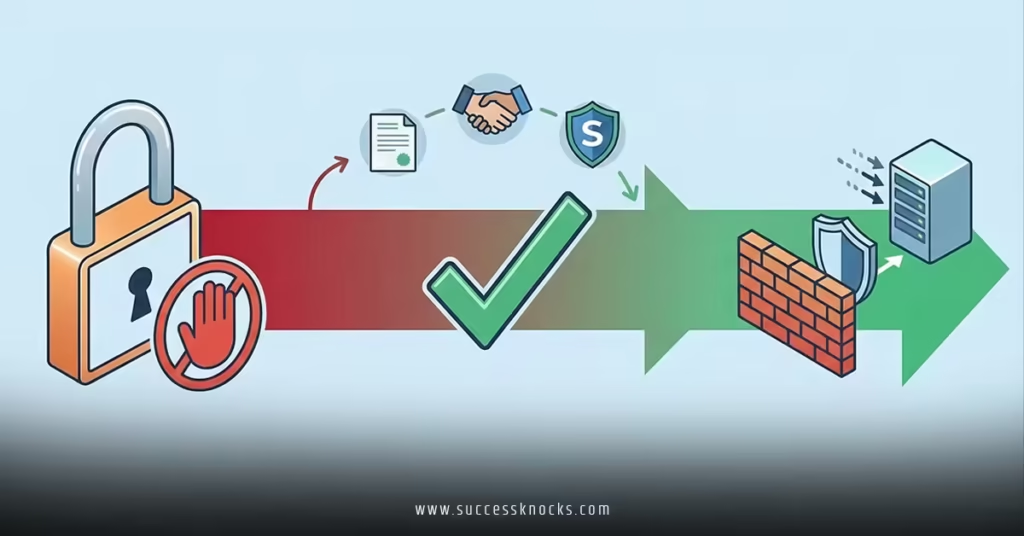
Common Mistakes in Handling Generative AI Data Security Risks B2B and How to Fix Them
Even savvy teams slip up. Here’s a rundown of pitfalls, with quick fixes to keep you on track.
- Overlooking Vendor Vetting: Rushing to adopt AI without checking provider security. Fix: Conduct due diligence, referencing frameworks from the Cybersecurity and Infrastructure Security Agency (CISA).
- Ignoring Employee Training: Assuming staff know AI risks. Fix: Implement mandatory sessions, using real-world scenarios to build awareness.
- Neglecting Audits: Skipping regular checks on AI systems. Fix: Schedule quarterly reviews, logging all data interactions for traceability.
- Weak Access Controls: Allowing broad permissions. Fix: Adopt zero-trust models, verifying every access request.
- Forgetting About Outputs: Focusing only on inputs, not generated content. Fix: Scan outputs for sensitive data before sharing.
Avoiding these can slash your risk profile significantly.
Step-by-Step Action Plan to Mitigate Generative AI Data Security Risks B2B
Ready to act? This beginner-friendly plan gets you from assessment to implementation. Follow it sequentially for best results.
- Assess Your Current Setup: Inventory all generative AI tools in use. Identify data flows and potential weak points. Tools like risk matrices from NIST can help.
- Build a Governance Framework: Draft policies covering data use, access, and compliance. Align with U.S. standards, incorporating elements from the FTC’s AI guidelines.
- Implement Technical Safeguards: Deploy encryption for data in transit and at rest. Use AI-specific firewalls to monitor prompts and outputs.
- Train Your Team: Roll out training programs. Cover basics like secure prompting and advanced topics like threat detection.
- Monitor and Audit: Set up continuous monitoring with alerts for anomalies. Conduct bi-annual audits, adjusting based on findings.
- Test and Iterate: Run simulations of breaches. Refine your approach, staying ahead of 2026 trends like AI-specific regulations.
If I were advising a B2B client, I’d start with step 1 to uncover hidden risks quickly.
Real-World Considerations for U.S. B2B Compliance in 2026
In the USA, AI regulation is ramping up. By 2026, expect mandates from bills like the AI Bill of Rights, emphasizing transparency and accountability.
For B2B, this means documenting AI decisions for audits. Consider how generative tools handle bias—mitigate it through diverse training data to avoid discriminatory outputs.
Cost-wise, investing in security now pays off. A Ponemon Institute study notes proactive firms save millions in breach costs.
Weave in privacy-by-design principles, ensuring AI complies with state laws like New York’s SHIELD Act.
For deeper insights, check the NIST AI Risk Management Framework for voluntary guidelines that many B2B firms adopt.
Advanced Strategies for Intermediate Users
If you’re past basics, layer on these. Use differential privacy techniques to add noise to datasets, protecting info without losing utility.
Integrate AI ethics boards in your B2B operations to review deployments. By 2026, blockchain for data provenance will help track AI inputs securely.
Explore secure multi-party computation for collaborative AI without sharing raw data.
Reference resources like the FTC’s Business Guidance on AI for staying compliant.
Key Takeaways on Mitigating Generative AI Data Security Risks B2B
- Understand core risks like leakage and access issues to prioritize defenses.
- Use assessments and governance to build a strong foundation.
- Train teams and vet vendors to prevent human-error breaches.
- Implement tech like encryption and monitoring for robust protection.
- Stay audit-ready for U.S. compliance, avoiding costly penalties.
- Adopt advanced tools like federated learning for future-proofing.
- Regularly test and iterate your strategies.
- Focus on outputs as much as inputs for comprehensive security.
Conclusion
Mitigating generative ai data security risks b2b boils down to proactive planning, smart tech, and ongoing vigilance. By following this guide, you’ll safeguard your data, ensure compliance, and foster trust in B2B relationships—all while harnessing AI’s power. The main benefit? Peace of mind in a data-driven world, with reduced breach risks and smoother operations. As a next step, audit your current AI setup this week and reach out to a compliance expert if needed.
Read our complete guide on The Real ROI of Generative AI Tools for Mid-Market B2B Companies
FAQs
What are the top generative ai data security risks b2b companies face in 2026?
In 2026, B2B firms grapple with data leakage from AI models, unauthorized access in shared environments, and compliance hurdles under evolving U.S. laws like enhanced CCPA rules.
How can beginners start mitigating generative ai data security risks b2b?
Begin with a simple risk assessment of your AI tools, then add basic safeguards like encryption and employee training to build a secure foundation without overwhelming complexity.
Why is compliance crucial for generative ai data security risks b2b?
Compliance ensures you avoid fines and legal issues, while protecting sensitive data in partnerships—key for maintaining trust and operational continuity in the U.S. market.
What tools help address generative ai data security risks b2b?
Tools like AI governance platforms and encryption software are essential; for guidance, refer to the Cybersecurity and Infrastructure Security Agency’s AI resources.
How do vendor contracts impact generative ai data security risks b2b?
Strong contracts specify data handling and audit rights, sharing responsibility and reducing risks in collaborative B2B AI use.