Godzilla Minus Zero vs Hollywood Godzilla comparison talk has been heating up timelines ever since Toho confirmed the 2023 Oscar-winner was getting a proper sequel. Two very different studios. Two very different budgets. Same giant radioactive lizard. And honestly? The gap between them says a lot about what modern blockbuster filmmaking actually rewards.
If you’re trying to figure out which version of Godzilla deserves your time — or your money — here’s the short version before we get into the weeds.
Quick Overview:
- Godzilla Minus Zero (and its predecessor, Godzilla Minus One) is a Japanese-made, VFX-driven war drama with a fraction of Hollywood’s budget.
- Hollywood’s Godzilla lives inside Legendary’s MonsterVerse — bigger scale, bigger crossovers, bigger marketing spend.
- Minus One won the Academy Award for Best Visual Effects, the first Asian production ever to do so [1].
- Hollywood’s MonsterVerse films consistently out-earn the Japanese films at the global box office, despite the smaller films punching way above their weight.
- The real difference isn’t quality — it’s storytelling philosophy.
For the full lowdown on what’s coming next in this franchise, check out our complete guide to Godzilla Minus Zero in 2026, which covers everything from plot direction to release logistics.
Godzilla Minus One vs Godzilla Minus Zero: Getting the Names Straight First
Quick housekeeping, because this trips people up constantly.
Godzilla Minus One is the 2023 film. Godzilla Minus Zero is its upcoming sequel, premiering at the New York Film Festival on September 26, 2026, before hitting Japanese theaters November 3 and North American theaters November 6, 2026 [2].
Same director. Same VFX philosophy. Same studio, Toho. Different story, timeline pushed slightly forward.
For the purposes of this Godzilla Minus Zero vs Hollywood Godzilla comparison, I’m treating the Minus One/Minus Zero lineage as one continuous creative approach — because tonally and technically, that’s exactly what it is. Yamazaki isn’t reinventing his wheel. He’s refining it.
The Core Godzilla Minus Zero vs Hollywood Godzilla Comparison, Side by Side
Numbers don’t lie, even when marketing budgets try to shout over them. Here’s how the two approaches stack up.
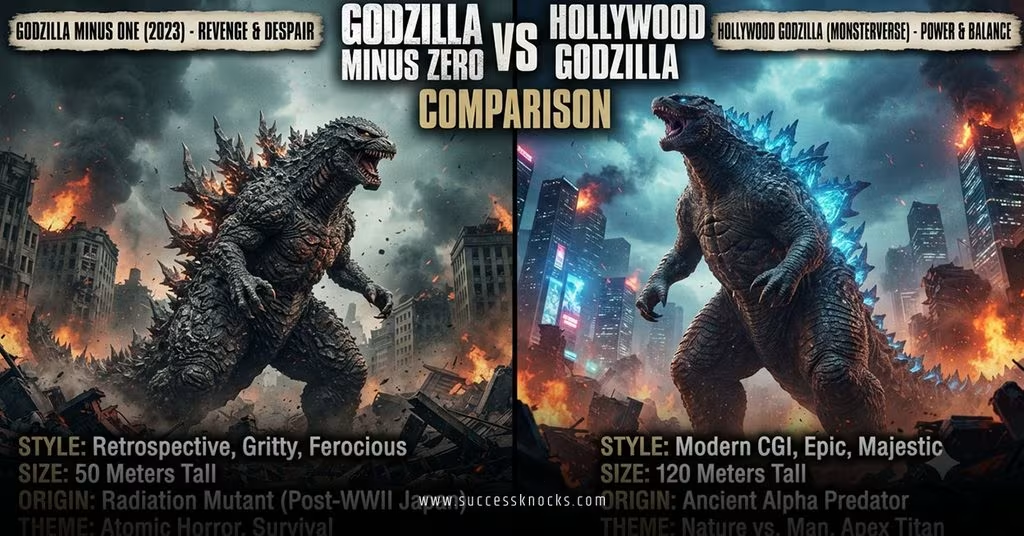
| Category | Godzilla Minus One/Zero (Toho, Japan) | Hollywood Godzilla (Legendary MonsterVerse) |
|---|---|---|
| Production Budget | ~$15 million [3] | $135–$200 million per film [3] |
| VFX Team Size | Roughly 35 artists | Multiple studios, hundreds of artists |
| Worldwide Box Office (Minus One) | $115.8 million [4] | $387M–$568M per film [4] |
| Academy Recognition | Best Visual Effects, 96th Oscars [1] | No Oscar wins to date |
| Tone | Human-scale war drama, grief-driven | Spectacle-driven, franchise-crossover focus |
| Godzilla’s Role | Force of nature, existential threat | Franchise anchor, occasional “hero” |
Notice something? The smaller film wins the artistic hardware. The bigger film wins the box office race. Neither of those facts cancels the other out.
Why the Budget Gap Doesn’t Tell the Whole Story
Here’s the thing everyone gets wrong about this debate — budget size isn’t a quality metric. It’s a resource metric.
Yamazaki’s team built Minus One for about a tenth of what a single MonsterVerse entry costs [3]. That’s not a scrappy indie flex for its own sake. It’s a director who understands exactly where every dollar needs to go, and skips the parts audiences don’t actually need.
Hollywood Godzilla films, by contrast, are built for scale. Multiple monsters. Franchise continuity. Theme-park-ready spectacle designed to sell toys, sequels, and shared-universe momentum.
Think of it like comparing a chef’s tasting menu to an all-you-can-eat buffet. Both can leave you satisfied. They’re just optimized for completely different appetites.
Storytelling Philosophy: Grief and Guilt vs Franchise Continuity
This is where the Godzilla Minus Zero vs Hollywood Godzilla comparison gets genuinely interesting for film nerds.
Minus One is fundamentally about post-war trauma. Godzilla functions as a physical manifestation of guilt, loss, and a nation trying to rebuild from rubble. It’s heavy. It’s intimate. Characters cry in kitchens, not just on battlefields.
Legendary’s MonsterVerse plays a different game entirely. It’s building toward crossover events — Kong, Titans, Monarch lore stacking on itself movie after movie. Character arcs exist, sure, but they’re often secondary to the shared-universe machinery underneath.
Neither approach is “wrong.” They’re just chasing different jobs. One wants you to feel something specific. The other wants you invested in a much longer game.
Step-by-Step: How to Approach Watching Both (For Beginners)
If you’re new to the franchise and don’t know where to start, here’s what I’d actually tell a friend at a barbecue.
- Start with Godzilla Minus One (2023). It’s a self-contained story — no prior Godzilla knowledge required.
- Watch one MonsterVerse film, ideally the original 2014 Godzilla, to understand Legendary’s tonal baseline.
- Compare the pacing. Notice how much longer Minus One spends on human characters before Godzilla even shows up.
- Pay attention to sound design. Both franchises use Godzilla’s roar differently — Toho leans classic, Legendary leans bass-heavy and theatrical.
- Save Minus Zero for theaters if you can. The visual craftsmanship, per early festival buzz, is meant for a big screen.
That order gives you contrast without whiplash.
Common Mistakes People Make in This Comparison (and How to Fix Them)
I see the same handful of errors pop up in forums and comment sections constantly.
Mistake 1: Assuming bigger budget means better movie.
Fix: Judge craft and intention separately from spend. The Oscar win alone disproves the budget-equals-quality myth [1].
Mistake 2: Treating them as competitors in the same lane.
Fix: They’re not chasing the same audience goals. One’s a character drama, one’s a franchise tentpole.
Mistake 3: Ignoring cultural context.
Fix: Minus One’s emotional core is rooted in specific Japanese post-war history. Missing that context flattens the film into “just another monster movie,” which undersells what it’s doing.
Mistake 4: Skipping the box office nuance.
Fix: Raw numbers favor Hollywood, but return-on-investment massively favors Toho’s approach — a detail our breakdown of the box office record covers in more depth.
Visual Effects: The Real Battlefield
Let’s talk brass tacks, because this is where the comparison gets its teeth.
Minus One’s VFX team, led directly by Yamazaki himself, worked with a fraction of the manpower Hollywood typically throws at a tentpole. And they still walked away with the statue [1]. That’s not luck. That’s tight creative control and a director who understands exactly what shots earn their cost.
Hollywood’s approach spreads VFX work across multiple vendor studios simultaneously — efficient for scale, but it can dilute a singular creative vision. More cooks, more consistency issues, occasionally more spectacle fatigue.
Is bigger always better here? I’d argue no. Sometimes constraint breeds sharper choices.
Key Takeaways
- Godzilla Minus One/Zero was made for roughly $15 million; MonsterVerse films run $135–$200 million-plus [3].
- Minus One won the Academy Award for Best Visual Effects — the first Asian production to do so [1].
- Hollywood’s Godzilla films earn significantly more at the global box office in absolute dollars [4].
- Return on investment massively favors Toho’s leaner, tighter production model.
- Tone differs sharply: human-scale grief drama versus franchise-building spectacle.
- Godzilla Minus Zero premieres at NYFF September 26, 2026, hitting North American theaters November 6, 2026 [2].
- Neither version is objectively “better” — they’re solving different creative problems.
Final Thoughts
At the end of the day, this isn’t really a fight. It’s two studios answering the same question — “what is Godzilla for?” — with completely different philosophies. Toho says he’s a mirror for human tragedy. Legendary says he’s the biggest party guest in the room.
Both answers work. Both have earned their audiences. And with Minus Zero landing in theaters this fall, we’re about to get a fresh data point in a comparison that honestly never really gets old.
FAQs
Is Godzilla Minus Zero part of the Hollywood MonsterVerse?
No. Godzilla Minus Zero is a Toho production, entirely separate from Legendary’s MonsterVerse. Any Godzilla Minus Zero vs Hollywood Godzilla comparison is comparing two different studios’ continuities, not two entries in the same franchise.
Which made more money, Godzilla Minus One or the Hollywood Godzilla films?
Hollywood’s MonsterVerse entries earned significantly more in raw worldwide box office, with totals ranging from roughly $387 million to over $560 million per film, compared to Minus One’s $115.8 million [4]. Minus One, however, returned about seven times its production budget.
Why did Godzilla Minus One win an Oscar over bigger-budget films?
The Academy recognized the technical craft and creative execution of its visual effects team, proving that budget size isn’t the deciding factor in effects quality [1]. It marked the first time an Asian production won Best Visual Effects.