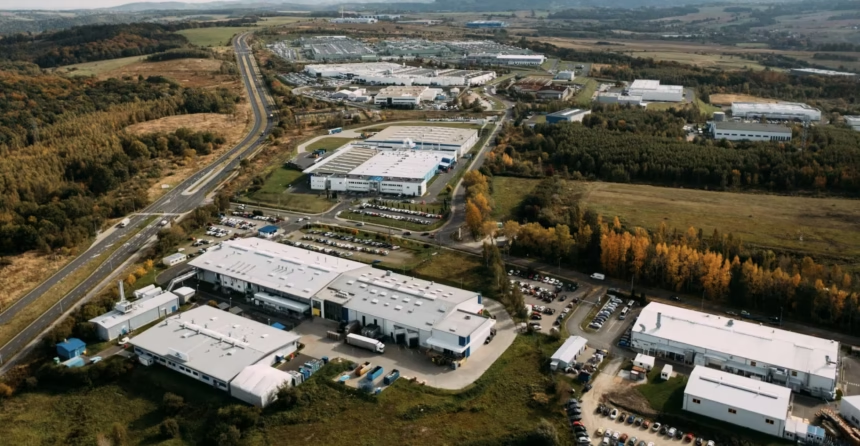
Warehouses play an important part in every supply chain. Get the location wrong when establishing your warehouse, and could end up dealing with shipment delays, extra costs and unhappy customers. But nail it, and you’ll find that everything runs much more smoothly.
In this post, we’ll explore how to find that perfect location, covering everything from whether to choose an existing or custom warehouse to considering how costs may vary by region.
Existing vs custom warehouse
The first important choice to make is whether to lease or buy an existing facility or build your own custom warehouse from scratch.
This will influence where you look, as well as influencing your timeline and the overall costs.
Let’s start by exploring the option of an existing warehouse. These are buildings that have already been used by previous companies as a warehouse. Such buildings are typically already located in industrial parks or logistics hubs with existing infrastructure like loading docks, security systems and shelving. You could find that you’re able to move and get set up quickly, but the layout may not always be optimized for your needs.
A custom build on the other hand can be built to your exact specs – allowing you to fully optimize your workflow and potentially make it as safe and energy-efficient as possible. Experienced design-build contractors can help you to explore all the important details. Location-wise, you meanwhile have much more flexibility as to where you want to put your warehouse. The downside? It will take much longer before your warehouse is up and running, and it could cost you a lot more initially (even if you do save money in the long run).
Proximity to suppliers vs proximity to customers
Location isn’t just about the building, but also connections. A classic dilemma is deciding whether to be closer to suppliers or customers. Striking the right balance can minimize shipping times, reduce costs and boost satisfaction.
Proximity to suppliers could be important for just-in-time inventory models – this allows you to order in supplies quickly based on unpredictable demand and to minimize the amount of stock stored in your warehouse (suitable for smaller warehouses). Industries where this can make a difference include automotive (for ordering in car parts for niche repairs) or food distribution (for prioritizing freshness). If you need to quickly order parts from various factories overseas, positioning your warehouse near a major airport might be worthwhile.
Positioning yourself closer to your end customers could be important if you run an e-commerce business and want to reduce customer shipping times and shipping fees. This is a strategy used by dropshipping warehouses – particularly those selling common items that people might want to order at the last minute like gift hampers and prescription medication.
Some companies have a global customer base or order from suppliers all around the world, in which location may not matter as much (although you could still try to prioritize close proximity to your most common customers or suppliers). For a balance of relatively quick supplier ordering and relatively quick customer delivery, try to locate yourself half-way between your most heavily used suppliers and most popular customers.
Considering transport infrastructure
Trucks need to be able to easily access your warehouse to drop and pick up goods. Placing your warehouse relatively close to a major highway – particularly an established freight corridor – can prevent truck drivers having to make long detours into unfamiliar areas.
That said, you may want to avoid warehouses located within major cities – driving into a city could be stressful and time-consuming for drivers due to congestion and more complex road systems. To avoid this, many companies place warehouses near highways just outside of major cities.
Make sure that the roads leading to your warehouse are wide enough for trucks and that there aren’t any low bridges that could result in drivers having to take longer routes around. Trace the journey from the closest major highway to see if there are any issues.
Proximity to other modes of transport may be important for some companies. If many of your supplies come by sea or you ship most of your customer deliveries by sea, proximity to a nearby port could be important. For quick access to air transport, choose a warehouse near a major airport. For bulk inland freight, consider whether closeness to rail hubs could be useful for transport by train.
Comparing costs by region
Ultimately, location will have one of the biggest impacts on how much your warehouse costs to run.
This is where you may need to consider trade-offs. Unfortunately, locations near major cities and major ports are more expensive – plots of land will cost more to buy, while existing warehouses will cost more to purchase or rent. Less accessible locations in remote and rural areas will be cheaper, but longer and more expensive shipping could make these locations equally costly.
Some businesses reduce costs by finding locations that are convenient but otherwise undesirable. Plots directly near highways or airports for example could be cheaper than those a couple miles away due to noise pollution. Less physically attractive suburban areas may also have cheaper sites available – people may not want to live here, but they could be a good place to base a cheap warehouse.
Make sure to look into local dangers like crime or natural disasters. These can greatly bring down the price of a location, but could put your livelihood at risk – avoid areas with a high rate of commercial burglaries or locations that regularly get flooded or affected by earthquakes, unless you are able to invest in necessary protections such as robust security features or effective flood-proofing.
Finding the right location: a summary
All in all, there is a lot to think about when choosing the right warehouse location. The key is to find somewhere affordable and accessible that fits your purpose and is relatively safe from external local dangers. Research other similar businesses to see where they are based – industrial hubs in towns outside major cities are some of often some of the most popular choices of location.