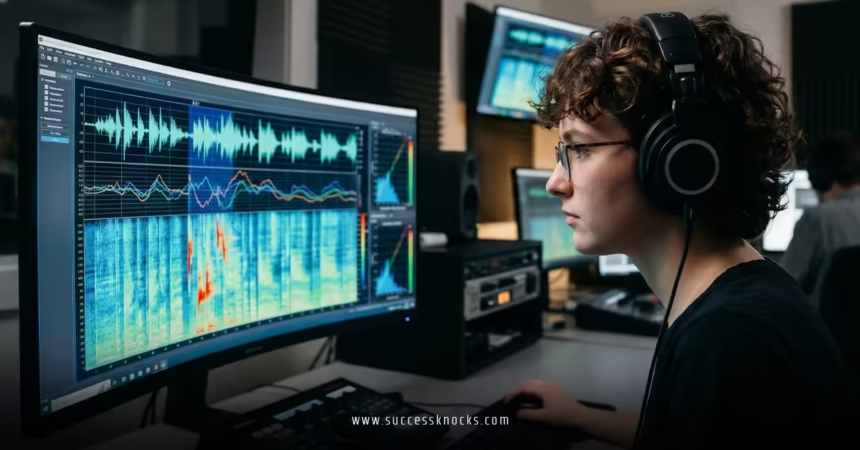
How to Spot Deepfake Voices in 2026 :
Deepfake voices in 2026 sound scarily real. They power everything from family emergency scams to sophisticated AI-generated callback phishing attacks 2026 that trick you into calling fake support lines. Attackers clone a boss’s or bank rep’s voice with just seconds of public audio, then guide you through handing over money or access.
Here’s the reality check:
- AI makes cloning effortless. Tools need minimal samples and generate natural-sounding speech at scale.
- Callback scams explode. Emails push you to call; the voice on the line seals the deal with perfect cadence and personal details.
- Human ears fail often. Studies show people spot fakes only about 73% of the time under pressure.
- Detection tools stepped up. Real-time analyzers now flag artifacts humans miss.
- Why it matters now. Losses from voice fraud hit billions as these attacks bypass email filters entirely.
The kicker? You don’t need fancy gear to start protecting yourself today.
Why Deepfake Voices Pose a Massive Threat in 2026
Voice cloning hit mainstream fast. A short earnings call clip or social video gives attackers enough to mimic tone, accent, and quirks. They pair it with AI-generated emails that create panic: “Your account is locked. Call this number now.”
In callback phishing scenarios, the voice knows specifics pulled from breaches or LinkedIn. It sounds stressed, professional, and exactly like the real person. You comply. Funds vanish or systems get compromised.
Businesses bleed money. One deepfake video call tricked a company into wiring $25 million. Individuals lose savings to fake family emergencies or tech support. Traditional “sounds off” instincts no longer cut it.
Audio Red Flags That Give Away Deepfake Voices
Listen closely. Real voices have natural messiness. Clones often feel too polished.
- Prosody too smooth. Speech flows with unnatural consistency—no random emphasis shifts, micro-pauses, or filler words humans use.
- Breathing anomalies. Breaths appear at wrong moments or repeat identically. Real breathing ties to emotion and sentence length.
- Missing subtle noises. No lip smacks, tongue clicks, or throat clears. Background noise might not match the claimed environment.
- Emotional flatness or mismatch. Responses feel scripted under stress, or tone doesn’t shift naturally with topics.
- Pronunciation glitches. Struggles with uncommon names, acronyms, or rapid unscripted questions.
Rhetorical question: If the voice knows your recent transaction but can’t recall a shared joke from last week’s meeting, what does that tell you?
These signs work best in live calls. Record suspicious audio when possible for later analysis.
Comparison: Real Voice vs. Deepfake Voice in 2026
| Indicator | Real Human Voice | Deepfake Voice (2026) |
|---|---|---|
| Prosody & Rhythm | Irregular emphasis, natural pauses | Too consistent and fluid |
| Breathing Patterns | Tied to emotion and physiology | Artificial placement or repetition |
| Background Consistency | Matches environment realistically | Mismatches or overly clean |
| Response to Challenges | Adapts fluidly to off-script questions | Stumbles or delays unnaturally |
| Spectral Artifacts | Natural formant transitions | Detectable high-frequency irregularities |
| Emotional Range | Full micro-variations | Often flatter or inconsistent |
Use this table during training sessions. It sharpens instincts fast.

Step-by-Step Action Plan to Spot and Stop Deepfake Voices
What I’d do tomorrow if securing a team or family:
- Verify out-of-band. Hang up on any unexpected urgent call. Use a known official number or in-person confirmation. Never trust the provided contact.
- Ask challenge questions. Probe with personal details only the real person would know—recent events, inside jokes, or specific project references.
- Record and analyze. Use free or browser-based detectors on recorded audio. Tools like McAfee Deepfake Detector or Hiya’s extension flag issues quickly.
- Enable real-time protections. Deploy meeting bots or call analyzers (Pindrop, Resemble AI Detect, UncovAI) for Zoom, Teams, and phone systems.
- Limit voice data exposure. Reduce public audio uploads. Watermark your own recordings where possible.
- Train regularly. Run simulated deepfake calls. Review recordings together to discuss what felt off.
Start with the callback verification rule. It blocks most AI-generated callback phishing attacks 2026 cold.
Common Mistakes People Make (And Easy Fixes)
Mistake 1: Relying on sound alone. Voices fool even experts. Fix: Always combine with independent verification.
Mistake 2: Sharing codes or access during the call. Fix: Real support never asks for MFA over the phone. Hang up.
Mistake 3: Ignoring context. A “bank rep” calling about an issue you didn’t report. Fix: Pause and check accounts yourself via the app.
Mistake 4: Skipping tools. Manual listening fails under urgency. Fix: Layer AI detectors that analyze 1,300+ acoustic features.
Mistake 5: Overconfidence after one good call. Attackers iterate fast. Fix: Treat every unsolicited voice request as suspicious.
In practice, teams drilling these habits slash successful incidents sharply.
Tools and Tech to Fight Deepfakes in 2026
Commercial solutions shine here. Pindrop excels for enterprises with forensic-level analysis. Resemble AI Detect offers strong API access and high accuracy on clones. Browser extensions like McAfee’s or Hiya’s provide quick consumer checks.
For broader reading, explore FBI guidance on voice cloning scams and CISA resources on emerging threats. Check Pindrop’s deepfake detection overview for technical depth.
Open-source options help for testing but lag behind commercial tools on latest generators.
Key Takeaways
- Deepfake voices thrive in AI-generated callback phishing attacks 2026 by combining cloned audio with urgent lures.
- Listen for unnatural smoothness, breathing errors, and background mismatches.
- Never act on voice instructions alone—verify through separate channels.
- Challenge the caller with personal knowledge questions.
- Use detection tools for recordings and real-time calls.
- Limit your public voice footprint aggressively.
- Regular simulated training beats one-off awareness.
- Tools like Pindrop and Resemble now deliver reliable enterprise protection.
Stay vigilant. These threats evolve, but consistent habits and the right tech keep you ahead.
Implement one new verification step this week. Share the challenge-question tactic with your team. Small moves compound into serious defense.
FAQs
How reliable are human ears at spotting deepfake voices in 2026?
Not very. Listeners catch them only around 73% of the time, especially in stressful callback scenarios. Always layer in tools and verification processes.
What tools work best for detecting deepfake voices during live calls?
Real-time solutions like Pindrop, UncovAI meeting bots, and Resemble AI Detect analyze audio streams on Zoom, Teams, or phones without interrupting.
Can deepfake voices be used effectively in AI-generated callback phishing attacks 2026?
Absolutely. Attackers combine hyper-personalized emails with cloned voices to bypass filters and build trust quickly on the call, leading to higher success rates.