

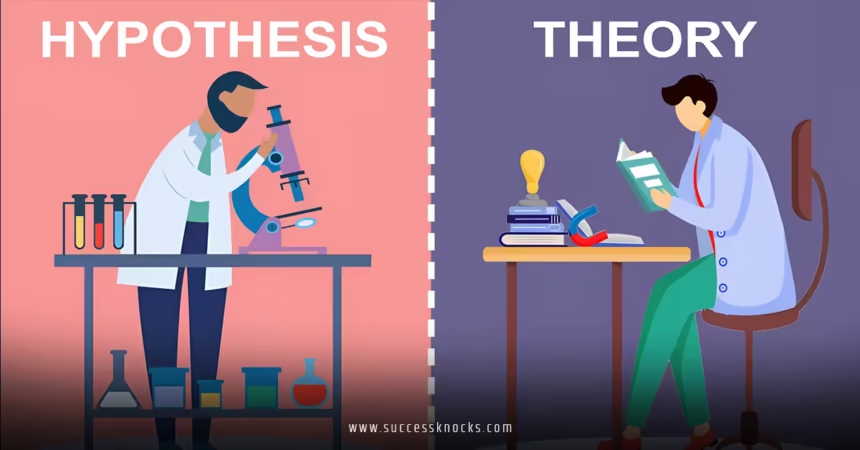
Hypothesis vs theory explained clears up one of the most common mix-ups in science, writing, and everyday arguments. A hypothesis is a testable idea you propose to check. A theory is a well-supported explanation backed by mountains of evidence and repeated testing.
Here’s the fast version:
- A hypothesis is a specific, educated guess or proposed explanation for an observation. It must be testable and can be proven wrong.
- A theory is a broad, well-substantiated framework that explains a wide range of related phenomena. It integrates many tested hypotheses and has strong predictive power.
- Hypotheses come first in the scientific process. Successful ones, after rigorous testing, contribute to building or refining theories.
- In daily life, people say “I have a theory” when they mean a guess — that’s actually closer to a hypothesis.
- Understanding the difference sharpens critical thinking, whether you’re reading news, writing reports, or evaluating claims.
Hypothesis vs theory explained matters because misusing the terms leads to confusion. It weakens arguments and fuels misunderstandings, like dismissing evolution as “just a theory.” Precision here separates solid reasoning from speculation.
What Is a Hypothesis?
A hypothesis is your starting point — a tentative explanation for something you observe. Scientists craft it as an “if…then” statement that’s falsifiable, meaning evidence could disprove it.
Example: You notice plants grow faster near windows. Hypothesis: “If plants receive more sunlight, then they will grow taller because of increased photosynthesis.”
It’s narrow, specific, and designed for testing through experiments or observations. No wild hunches. It builds on existing knowledge but remains unproven until data rolls in.
In practice, researchers often propose multiple competing hypotheses. The goal? Knock them down with evidence until the strongest one stands.
What Is a Scientific Theory?
A theory explains why things happen across many situations. It’s not a guess. It’s a comprehensive, coherent framework supported by facts, tested hypotheses, laws, and repeated verification.
Think of the theory of gravity or the theory of evolution by natural selection. These aren’t shaky ideas. They’ve survived decades (or centuries) of scrutiny, make accurate predictions, and explain broad patterns in nature.
Theories evolve with new evidence — they get refined, not tossed aside lightly. They integrate smaller explanations into something bigger and more powerful.
Here’s the thing: In science, a theory ranks among the strongest explanations we have. Everyday language flips this, treating “theory” like a hunch. That’s where the confusion starts.
Hypothesis vs Theory: Side-by-Side Comparison
| Aspect | Hypothesis | Theory |
|---|---|---|
| Scope | Narrow, specific to one observation or question | Broad, explains many related phenomena |
| Basis | Educated guess based on initial evidence | Extensive tested data, multiple hypotheses, laws |
| Testability | Must be testable and potentially falsifiable | Well-tested over time; generates new predictions |
| Certainty Level | Tentative, unproven until tested | Strongly supported, widely accepted |
| Role in Science | Starting point for investigation | Explanatory framework that unifies knowledge |
| Example | “If fertilizer is added, crop yield increases.” | Theory of natural selection explaining species diversity |
| Can it change? | Often disproven or modified quickly | Refined with new evidence, rarely discarded |
This table makes the split crystal clear. One is the spark. The other is the fire that’s been burning strong.
How Hypotheses Build Into Theories
The process flows like this:
- Observe something puzzling.
- Form a hypothesis to explain it.
- Design experiments or gather data to test it.
- Analyze results — support, refute, or tweak the hypothesis.
- Repeat with more tests, peer review, and independent verification.
- When many related hypotheses hold up consistently, they feed into a broader theory.
No single hypothesis magically “becomes” a theory. Theories emerge from accumulated evidence and consensus. A hypothesis that gains support simply becomes a supported hypothesis. Theories operate at a higher level of generality and explanatory power.
Real-world kicker: The germ theory of disease started with hypotheses about microbes causing illness. After countless tests, it grew into a robust theory that transformed medicine.
Common Everyday Examples
- Hypothesis: “This new app feature will reduce user drop-off by 15%.”
- Theory: The theory of relativity explains how gravity affects time and space across cosmic scales.
Another: You hypothesize that lack of sleep hurts focus. After tracking data for weeks, your findings might contribute to the broader, well-established understanding of sleep’s role in cognitive function (part of established psychological and biological frameworks).
People often say things like “My theory is traffic is worse on Mondays.” That’s not a scientific theory — it’s a casual hypothesis at best.
Link to Theoretically vs Hypothetically
This distinction ties directly into word choice. When you say something is theoretically possible, you’re often appealing to principles within an established theory — logical outcomes based on accepted explanations.
Hypothetically, you’re usually posing a scenario based on an untested assumption — closer to starting with a fresh hypothesis.
Mastering hypothesis vs theory explained helps you pick “theoretically” or “hypothetically” with confidence in writing and speaking. It keeps your points precise and credible.
Common Mistakes People Make
Mistake 1: Calling a wild guess a “theory.”
Fix: Call it a hypothesis unless it’s backed by substantial evidence.
Mistake 2: Saying a theory is “just a theory,” implying it’s unproven.
Fix: Remember — in science, theories are the heavy hitters. Frame it as “a well-supported scientific theory.”
Mistake 3: Thinking one successful test turns a hypothesis into a theory.
Fix: Theories require broad, repeated validation across contexts.
Mistake 4: Confusing prediction with hypothesis.
A prediction flows from your hypothesis (“If X, then Y will happen”). The hypothesis is the underlying explanation.
Quick rule-of-thumb: If it’s narrow and waiting for tests, lean hypothesis. If it’s broad and battle-tested, it’s theory territory.
Step-by-Step Action Plan to Use These Terms Correctly
Follow this whenever you’re thinking, writing, or debating:
- Observe clearly. Note what you’re trying to explain.
- Form your idea as a hypothesis. Make it specific and testable: “If [condition], then [outcome] because [reason].”
- Test it. Gather data honestly — look for ways it could fail.
- Analyze. Does evidence support, refute, or need refinement?
- Scale up. If many tests align across situations, see how it fits into larger explanations (theories).
- Communicate accurately. Use “hypothesis” for early ideas. Reserve “theory” for established frameworks.
- Check context. In science? Stick to definitions. In casual talk? Clarify if needed to avoid confusion.
Practice this on one claim you hear this week. You’ll spot sloppy usage instantly.
Key Takeaways
- A hypothesis is a testable proposed explanation — narrow and provisional.
- A theory is a broad, evidence-backed explanation for wide patterns.
- Hypotheses drive testing; theories unify and predict.
- They differ in scope, support, and role — not just confidence level.
- Everyday “theory” usually means hypothesis.
- Strong hypotheses feed into robust theories over time.
- Precision with these terms boosts clarity in writing and thinking.
- Link it to word choice: theories support “theoretically” statements.
Conclusion
Hypothesis vs theory explained boils down to this: one is your testable spark of an idea, the other is the hard-won map that explains the landscape. Get them straight and your arguments land harder, your reading gets sharper, and you avoid sounding unsure in professional or scientific contexts.
External Links
- Merriam-Webster: Hypothesis vs. Theory – The Difference Explained — Excellent breakdown with clear examples.
- Britannica: Theory vs. Hypothesis – What’s the Difference? — Detailed comparison focusing on scope and evidence.
- Understanding Science (UC Berkeley): Science at Multiple Levels — Addresses common misconceptions about hypotheses, theories, and laws.
- BYJU’S: Difference Between Hypothesis and Theory — Simple table and examples, good for quick reference.
- National Center for Science Education: Misconception Monday – Hypotheses, Theories, and Laws — Focuses on why hypotheses don’t “become” theories or laws.
FAQ :
1. What is a hypothesis?
A hypothesis is a tentative, testable explanation or educated guess for a specific observation or phenomenon. It is proposed early in the scientific process and designed to be tested through experiments or further observations. It can be supported, refuted, or modified based on evidence.
Example: “If plants are exposed to more sunlight, then they will grow faster” (an “if-then” statement that can be tested).
2. What is a scientific theory?
A scientific theory is a well-substantiated, comprehensive explanation of a broad range of natural phenomena. It is built on a large body of evidence from many tested hypotheses, repeated experiments, and observations. Theories are widely accepted in the scientific community but remain open to revision if new evidence emerges.
Example: The theory of evolution by natural selection or the theory of gravity.
3. What’s the main difference between a hypothesis and a theory?
A hypothesis is narrow, preliminary, and unproven — it’s a starting point for investigation.
A theory is broad, robust, and extensively supported by evidence — it explains why phenomena occur and integrates multiple hypotheses and facts.
In everyday language, “theory” often means a guess (like a hypothesis), but in science, a theory is much stronger than a hypothesis.
4. Can a hypothesis become a theory?
Not directly. A single hypothesis does not “turn into” a theory simply by gathering evidence. Instead, if a hypothesis (or set of related hypotheses) is repeatedly supported by rigorous testing and gains broad explanatory power, it may contribute to the development or refinement of a scientific theory. Theories encompass and explain many hypotheses, not just one.
5. Why do people often confuse “theory” with “hypothesis” or think theories are “just guesses”?
This confusion arises because in casual English, “theory” means a hunch or speculation (similar to hypothesis). In science, however, a theory is a highly reliable framework supported by facts — not a guess. This misunderstanding leads to phrases like “evolution is just a theory,” ignoring that scientific theories (like the germ theory of disease) are among the strongest explanations science offers.


