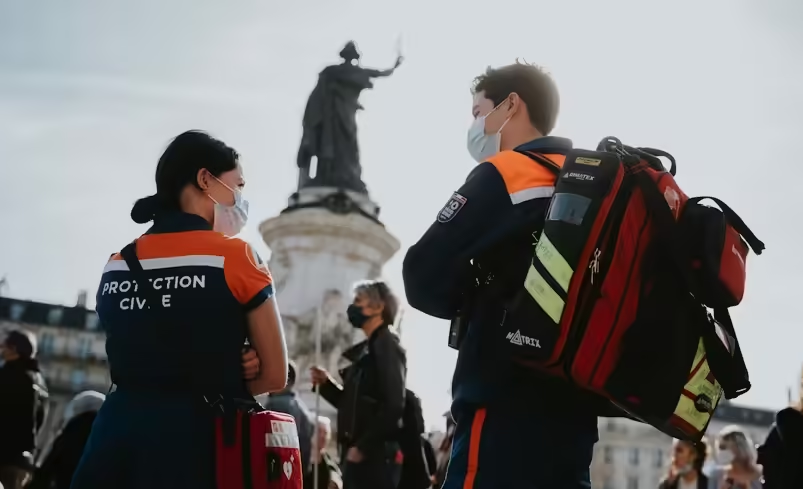
There is a moment in every emergency where the noise drops out. Not for the crowd, not for the cameras, not for the people scrolling past a headline. For the responders. For the nurse who has been on shift since before sunrise. For the firefighter who checks the door with a gloved hand and feels the heat change. For the paramedic who reads a face in half a second and decides what matters most.
From the outside, it can look like bravery is a personal fuel. A quality you either have or do not. But when you step behind the scenes, courage is rarely a solo performance. It is built. Protected. Delivered.
Frontline response is a human story, yes. It is also a logistics story. A story of coordination so quiet you only notice it when it is missing.
The Unseen Coordination Behind The Frontline Response
Before an ambulance siren cuts through traffic, there are other sounds most of us never hear: a radio call acknowledged, a dispatch screen updated, a kit restocked, a rota adjusted, a supervisor making a fast decision with incomplete information. Frontline response depends on a choreography that is both rigid and flexible. Rigid because certain things cannot be negotiated: medications must be within date, sterile supplies must be sealed, vehicles must be maintained, and protective gear must fit. Flexible because emergencies do not respect plans. They arrive early, late, sideways, in clusters, in silence, in chaos.
Behind every “we are on our way” is a network of people who rarely stand in the spotlight. Fleet teams who keep vehicles alive. Procurement officers who fight for better terms, faster delivery, and safer standards. Warehouse staff who know, by memory, where the critical items live. Coordinators who juggle shortages without letting that tension leak into the work on the ground. And the groundwork is hungry not just for equipment, but for time, energy, and calm.
Think about the basics that keep a responder functioning across a long day. Clean gloves, charged devices, spare batteries, functional radios, updated maps. Even the small pieces matter: the right type of tape, the right size bandage, the correct connector. One missing component can turn a practiced routine into a time-consuming improvisation.
Then there is the “after.” The paperwork, the cleaning, the restocking, the debrief, the mental reset that has to happen quickly because the next call is already waiting. Supply chains do not only deliver the first response. They support the second, third, and tenth. They keep people from burning out by removing friction where friction is most dangerous. Coordination is not glamorous. It is also not optional.
Tools, Training, And Trust: The Real Triad Of Readiness
If you want to understand what keeps frontline teams steady, look at three things: what they use, how they train, and who they trust. Tools are the obvious part. We tend to focus on the big-ticket items:
vehicles, defibrillators, monitors, protective gear. But readiness is often made or broken by the ordinary. The tools that are boring until they are not. A properly packed trauma bag. A stocked oxygen supply. A label that is clear in low light. A system that makes it easy to check what was used, what needs replacing, and what is running low.
Training is the part that turns equipment into capability. Tools do not save anyone on their own. They save people in the hands of someone who has practiced the steps until the steps feel like muscle memory. Under stress, you do not rise to your intentions. You fall to your knees.
But training is not only about technical skill. It is also about communication, decision-making, and the quiet discipline of teamwork. The handoff between teams. The way information is shared without ego. The ability to say, “I do not know,” and still move forward responsibly.
And then there is trust, the least measurable and most vital part of the triad.
Trust in the people beside you, that they will do their part. Trust in the systems behind you, that what you need will be there. Trust that if you report a shortage, you will not be punished for it. Trust that the organization values safety over appearances.
In well-run operations, trust is not treated like a motivational poster. It is built into the process. Transparent inventory. Clear maintenance schedules. Honest reporting. Feedback loops that actually close. A culture where someone can say, “This kit layout is slowing us down,” and the response is, “Let us fix it,” not, “That is how we have always done it.”
The New Age Of Rapid Relief
Every emergency has its obvious needs, and then it has its human needs. The needs that keep bodies working and minds clear. One of the most underestimated resources in any crisis is water.
Not just for the people affected, but for the teams responding. Hydration is not a wellness trend when you are in protective gear, moving quickly, speaking constantly, and making decisions with consequences. It is a safety requirement. Dehydration dulls focus. It increases fatigue. It turns small errors into bigger ones.
That is why the idea of “Water on Demand for Heroes” matters, not as a slogan, but as a logistical promise: remove the friction between a responder and the basic resources that keep them capable.
In some operations, this is becoming more sophisticated than a cooler in the corner. Smart replenishment points, mobile distribution units, rapid restock partnerships, and better forecasting based on incident type and environmental conditions. The goal is simple: reduce the gaps. Make it easier to get essentials where they are needed, when they are needed.

Via Unsplash
The next time you see a responder move with calmness in a moment that would make most of us freeze, remember that you are witnessing more than bravery. You are witnessing the outcome of thousands of quiet decisions made long before the crisis: the inventory checked, the kit packed, the training completed, the trust earned, the essentials delivered. That is the supply chain of courage.
And once you notice it, you start to see a question that lingers in the background of every emergency, one that applies to all of us in our own lives too: if the people who run toward danger need systems that support them, what systems are supporting the rest of us when it is our turn to be brave?