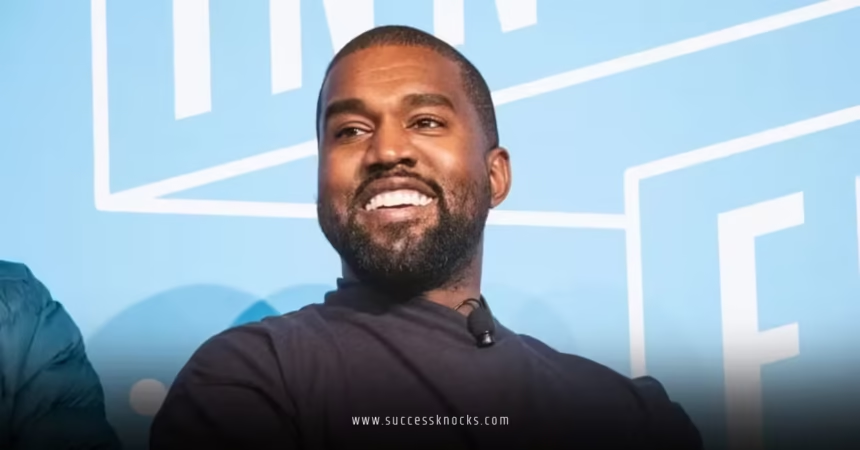
Kanye West apology statement explained — that’s the search bringing you here, and I get why. The guy’s put out more public mea culpas than most rappers have albums, and it’s genuinely hard to keep track of which apology said what.
So let’s cut through the noise.
Quick Summary — What You Need to Know:
- In January 2026, Ye (Kanye West) published a full-page apology titled “To Those I’ve Hurt” as a paid ad in The Wall Street Journal.
- He denied being a Nazi or antisemite, apologized separately to the Jewish and Black communities, and expressed regret to family and longtime friends.
- He attributed his 2025 antisemitic outbursts to bipolar-1 disorder, which he says traces back to an undiagnosed brain injury from a 2002 car crash.
- This is different from his earlier, smaller apologies — including a 2023 statement and a one-line “I’m sorry Jay Z” tweet — which is part of why the internet got confused.
- It matters because it’s the most formal, detailed accounting he’s given, and it directly follows the chaos covered in the full breakdown of Kanye West’s Twitter/X feud saga.
What Is the Kanye West Apology Statement, Exactly?
Here’s the plain-English version. On Monday, January 26, 2026, Ye ran a full-page advertisement in The Wall Street Journal. Not a tweet. Not an Instagram caption. A paid, physical newspaper ad.
The letter was addressed to “those I’ve hurt.” That’s deliberately broad. It covers Jewish people, Black communities, his family, and collaborators he’d burned bridges with over the previous year.
The core line, quoted almost everywhere: “I am not a Nazi or an antisemite. I love Jewish people.” He paired that denial with an admission that his past conduct — the swastika merchandise, the “HEIL HITLER” video, the Twitch livestream salute — was real, indefensible, and something he now regrets.
That combination — deny the label, own the behavior — is the whole engine of this statement.
Why Did Ye Apologize Now? His Own Explanation
This is where the Kanye West apology statement gets more complicated than a simple “sorry.” Ye didn’t just say he was wrong. He gave a medical and personal explanation for it.
He wrote that he went through a four-month manic episode starting in early 2025. During that stretch, he says he “lost touch with reality.” He described disconnected moments he still can’t fully recall, which he blames on bipolar-1 disorder.
Here’s the twist: he claims the disorder itself traces back to a frontal-lobe injury from a 2002 car accident — one that, in his account, went undiagnosed for over two decades. According to background reporting from The Guardian, he also says he was later misdiagnosed as autistic for a period, which led him to stop taking bipolar medication altogether.
He also described a stabilizing stay at a treatment facility in Switzerland after a medication change triggered a depressive episode. That’s the piece that reads less like PR and more like someone actually trying to course-correct.
Now, does a mental health explanation excuse the behavior? Ye himself says no. His exact words: “It does not excuse what I did though.” That line matters — it’s the difference between an explanation and an excuse, and he draws that line himself.
Breaking Down the Apology: Who Got What
Not every group got the same message. Here’s how the statement splits, at a glance.
| Audience | What He Said | Context Given |
|---|---|---|
| Jewish community | “I am not a Nazi or an antisemite. I love Jewish people.” | Direct denial paired with regret over swastika merch and antisemitic posts |
| Black community | “I am so sorry to have let you down.” | Framed as a betrayal of trust from people who supported his career |
| Family & friends | Acknowledged tarnished “lifelong friendships” and family bonds | Blamed impulsive statements made during manic episodes |
| General public | Asked for “patience and understanding as I find my way home” | Positioned as an ongoing process, not a finished apology |
Notice what’s missing? A direct, named apology to Jay-Z and Beyoncé over the earlier comments about their children. That beef got its own separate, much shorter “I’m sorry Jay Z” tweet months prior — and the reaction to that one was, let’s say, mixed. If you want the full play-by-play on how fans responded to these moments in real time, the fan reaction rundown covers that ground well.
Step-by-Step: How to Actually Verify This Kind of Statement Yourself
If you’re new to tracking celebrity apology news, here’s the process I’d use — the same one I’d tell a junior researcher to follow.
- Find the primary source first. In this case, that’s the actual WSJ ad, not a screenshot with a caption slapped on it.
- Check the date and outlet. A full-page ad in a major paper carries more weight than a tweet — it costs real money and goes through editorial ad review.
- Cross-reference with at least two independent outlets. Look for outlets like The Guardian or Variety confirming the same quotes.
- Separate the apology from the explanation. Read what he apologized for versus what he’s attributing it to. They’re not the same thing.
- Check for follow-up interviews. Ye did a follow-up email interview with Vanity Fair clarifying his intent — that context changes how the letter reads.
Doing this takes maybe ten minutes and saves you from repeating a half-true headline.
Common Mistakes & How to Fix Them
Mistake #1: Treating every apology as the same apology. People conflate the 2023 statement, the Jay-Z tweet, and the 2026 WSJ letter like they’re one continuous thing. Fix: always note the date and platform before you cite it.
Mistake #2: Assuming the mental health explanation is a free pass. It isn’t, and Ye explicitly says so. Fix: quote the accountability language alongside the diagnosis language — don’t cherry-pick one without the other.
Mistake #3: Ignoring the commercial timing. His new album, “Bully,” was dropping around the same window. Fix: note the timing as context, not proof of motive — he directly pushed back on that framing in the Vanity Fair interview.
Mistake #4: Missing the Shopify/store angle. The February 2025 swastika T-shirt sales through his online store, which got the store pulled down, is part of the same chain of events the apology addresses. Skipping it makes the timeline feel disconnected.
Key Takeaways
- The 2026 Kanye West apology statement came as a full-page Wall Street Journal ad titled “To Those I’ve Hurt,” published January 26, 2026.
- He denied being a Nazi or antisemite while directly apologizing to Jewish and Black communities.
- He attributed his behavior to bipolar-1 disorder tied to a 2002 car accident brain injury, describing a four-month manic episode in 2025.
- He explicitly stated the diagnosis “does not excuse” his actions — a clear accountability line.
- This is separate from the earlier “I’m sorry Jay Z” tweet, which addressed a different, narrower dispute.
- He followed up with a Vanity Fair interview clarifying the apology wasn’t about reviving his commercial career.
- Skepticism is healthy here — public apologies from repeat offenders deserve scrutiny, not automatic forgiveness or automatic dismissal.
The Bottom Line
A written apology is one data point. What happens next — his public behavior, his treatment, whether the pattern repeats — is the real test. Think of this letter less like a verdict and more like a plea entered into the record. The follow-through decides the sentence.
If you want the wider arc of how this all unfolded on social media before the formal apology, the pillar guide on his X feud saga fills in every gap this piece doesn’t cover.
FAQs
Is the Kanye West apology statement legally binding or just a PR move?
It’s neither, technically. It’s a personal statement with no legal weight, though it may factor into ongoing business relationships and public perception.
Did Kanye West apologize to Jewish people before the 2026 statement?
Yes. He issued a smaller apology in 2023 as well, according to reporting from the American Jewish Committee, which has tracked his statements over several years.
Does the apology statement mention his bipolar diagnosis specifically?
Yes — he directly names bipolar-1 disorder and links it to an undiagnosed brain injury from a 2002 car accident, while stating clearly that the diagnosis doesn’t excuse his actions.