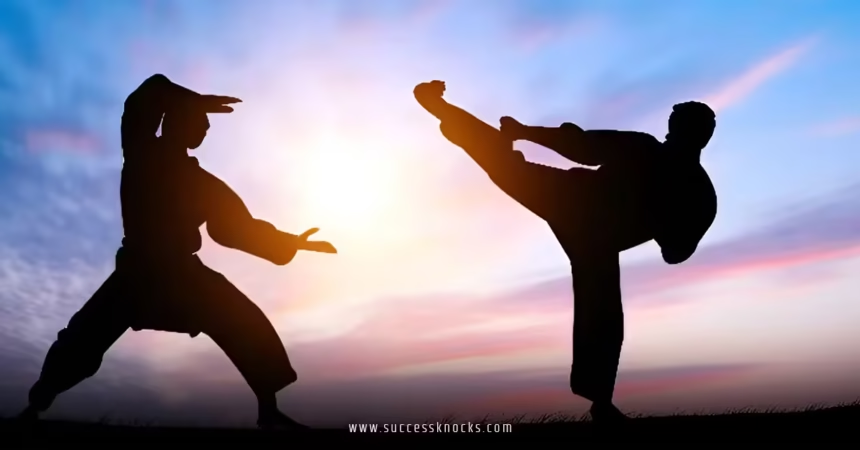
Kung fu vs karate boils down to roots, movement, and mindset. Kung fu (or Chinese martial arts, often called wushu) draws from ancient China with hundreds of styles emphasizing fluid, circular motions inspired by animals and nature. Karate emerged later in Okinawa, Japan, blending local “te” fighting with Chinese influences before formalizing under Japanese discipline—think crisp, linear strikes and explosive power.
Here’s the quick overview:
- Origins: Kung fu traces back thousands of years to China (Zhou dynasty and earlier); karate developed in Okinawa from the 14th–17th centuries with strong Japanese refinement.
- Movement style: Kung fu flows circular and adaptable; karate drives straight, powerful, and direct.
- Focus: Kung fu often mixes strikes, grappling, throws, and internal energy (qi); karate prioritizes precise punching, kicking, blocking, and conditioning.
- Training vibe: Both build discipline and fitness, but kung fu can feel more artistic and varied, while karate often stresses structured sparring and forms (kata).
- Who it’s for: Beginners love karate’s clear progression; intermediate students dig kung fu’s depth and adaptability.
No clear “winner.” It depends on what clicks with your body, goals, and local scene in the USA.
What Is Kung Fu?
Kung fu isn’t one style—it’s an umbrella for countless Chinese systems. Some trace to Shaolin Temple legends, others to military training or Daoist practices. Styles like Wing Chun emphasize close-range efficiency, while Shaolin or animal forms (tiger, crane, snake) play with low stances, wide circles, and whole-body power.
You train forms (taolu), applications, sometimes weapons, and qigong for breath and energy. Uniforms vary—silk jackets with frog buttons or loose pants, often with shoes. In the US, you’ll find everything from traditional schools preserving lineage to modern wushu with acrobatic flair.
The philosophy leans toward harmony, adaptability, and using an opponent’s force against them. Think water shaping around obstacles yet wearing down stone over time.
What Is Karate?
Karate means “empty hand.” It started as Okinawan self-defense under weapon bans, then got systematized in Japan with styles like Shotokan (linear power), Goju-ryu (hard-soft balance), or Wado-ryu (evasion focus).
Training revolves around kihon (basics), kata (pre-set forms), and kumite (sparring). Punches snap back fast, kicks chamber tightly, stances stay upright and stable for quick forward drive. You wear a white gi with colored belts marking rank—no shoes on the mat.
Discipline sits at the core. Many US dojos emphasize respect, focus, and practical self-defense alongside sport competition. Olympic karate boosted visibility, with rules favoring clean, controlled techniques.
Kung Fu vs Karate: Head-to-Head Breakdown
Here’s a clear side-by-side for beginners and intermediates:
| Aspect | Kung Fu | Karate |
|---|---|---|
| Origin | Ancient China (thousands of years) | Okinawa/Japan (centuries, formalized later) |
| Movement | Fluid, circular, continuous | Linear, crisp, explosive with stop-start |
| Key Techniques | Strikes, kicks, grappling, throws, joint locks, animal mimicry | Powerful punches, kicks, blocks; some throws in advanced |
| Stances | Often low and wide (horse stance, etc.) | Upright and stable (zenkutsu-dachi, etc.) |
| Power Generation | Momentum, redirection, internal energy | Muscular tension, hip rotation, focus |
| Uniform | Varied; often colorful silk or loose pants | White gi with belt system |
| Training Emphasis | Forms, applications, adaptability, sometimes weapons/qigong | Kihon, kata, kumite; conditioning and sparring |
| Philosophy | Harmony, flow, strategy | Discipline, precision, directness |
This table cuts through the noise. Pick based on feel—try a class in each. Many US cities have both; check local gyms or community centers.
Kung fu vs karate shines in how they handle a real scrap. Karate’s directness can end things fast with a solid reverse punch or front kick. Kung fu’s circular redirection might let you slip an attack and counter from an angle. Neither replaces awareness or de-escalation, but both beat doing nothing.
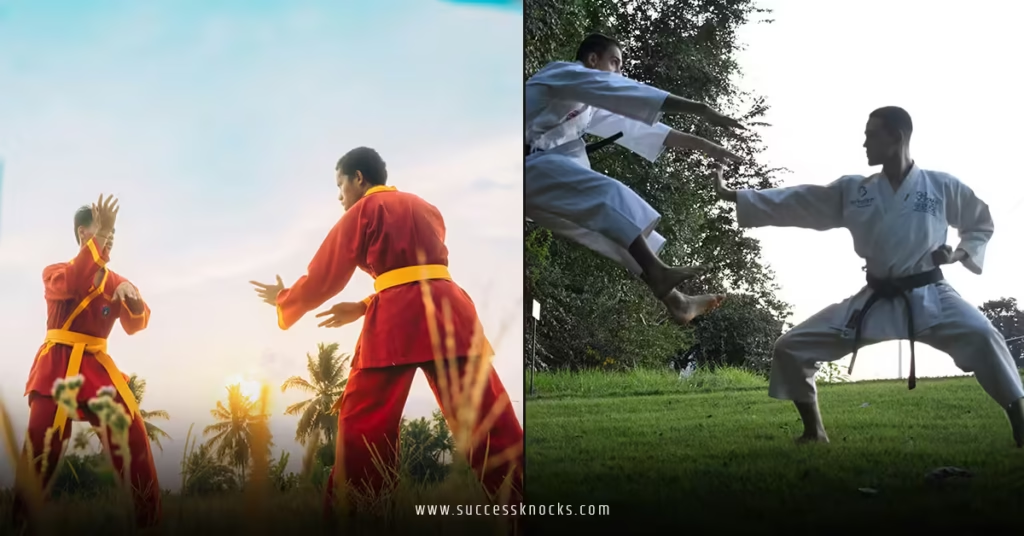
Which One Builds Better Fitness and Self-Defense?
Both deliver serious workouts. Karate often ramps up cardio through repetitive drills and sparring—great for speed and power. Kung fu can improve flexibility, coordination, and endurance via flowing sequences and lower stances.
For self-defense in 2026 America? Context rules. Street scenarios reward what you drill under pressure. Karate’s sport evolution means many practitioners spar realistically. Traditional kung fu schools stress practical applications, though quality varies wildly—some lean performance, others combat.
In my experience training and watching both, karate gives quicker visible progress for beginners. Kung fu rewards patience as layers unfold. Neither is “better” universally. A solid instructor trumps style every time.
Quick rule of thumb: Want structured belts, competition options, and straightforward power? Lean karate. Crave variety, flow, and deeper cultural roots? Explore kung fu.
Real-World Considerations in the USA
Finding good training matters more than the label. Search for schools affiliated with established groups. For karate, look toward the USA National Karate-do Federation or World Karate Federation-recognized programs. For kung fu/wushu, the United States of America Wushu Kungfu Federation offers structure.
Visit multiple dojos. Watch a beginner class. Ask about sparring, injury rates, and how they adapt techniques for adults or kids. Cost runs $100–200/month typically, plus testing fees. Some places offer trial weeks.
Location plays a role—coastal cities or big metro areas have more options. Rural spots might mean driving or starting with online resources (then finding live feedback).
Common Mistakes Beginners Make (and How to Fix Them)
- Choosing by movies alone — Bruce Lee or Karate Kid hype looks cool but skips the grind. Fix: Attend live classes before committing.
- Ignoring instructor quality — A black belt means little without teaching skill. Fix: Observe how they correct students and explain “why.”
- Skipping basics for flashy moves — Kung fu animal forms or karate kata tempt shortcuts. Fix: Drill fundamentals daily for muscle memory.
- Comparing styles instead of training both — Many cross-train later. Fix: Pick one to start, then sample the other after 6–12 months.
- Expecting quick mastery — Both demand years. Fix: Set small goals like consistent attendance and better stance.
- Neglecting conditioning — Weak core or flexibility limits you. Fix: Add targeted strength and mobility work outside class.
- Overlooking safety — Poor warm-ups lead to tweaks. Fix: Prioritize schools with good injury prevention habits.
Your Action Plan: How to Get Started with Kung Fu or Karate
Ready to dip in? Follow this beginner-friendly sequence:
- Clarify your goals — Fitness? Self-defense? Fun? Competition? Write them down.
- Research locally — Google “kung fu classes near me” or “karate dojo [your city]” plus reviews. Check USAWKF or USA-NKF sites for reputable affiliates.
- Visit 2–3 schools — Watch a class. Talk to students. Note the atmosphere—supportive or intense?
- Try a trial period — Most offer intro deals. Commit to 4–8 weeks minimum.
- Focus on consistency — Train 2–3 times weekly. Practice at home 10–15 minutes daily.
- Track progress — Note improved balance, confidence, or energy after one month.
- Reassess at 3–6 months — Stick or switch based on enjoyment and results.
- Supplement smart — Add cardio, strength training, or flexibility as needed.
What I’d do? Start with karate for its clear structure if you’re totally new—build that base, then explore kung fu for variety. Or vice versa if flow calls to you. The best style is the one you’ll actually show up for.
Key Takeaways
- Kung fu vs karate highlights Chinese fluidity and variety against Japanese directness and precision.
- Both excel at building fitness, discipline, and self-defense skills when taught well.
- Movement separates them most: circular/adaptable vs. linear/powerful.
- Instructor and school quality beat style debates.
- Beginners progress faster in structured systems; intermediates enjoy cross-training.
- No martial art replaces real awareness—pair training with smart habits.
- In the US, both thrive through dedicated communities and organizations.
- Your body and goals decide the winner.
Conclusion
Kung fu vs karate isn’t a cage match with one champion. It’s two rich traditions offering paths to stronger bodies and sharper minds. Pick the one that fires you up, train hard, and stay open to learning.
Next step: Find a class this week. Walk in, bow (or greet), and start moving. The mat doesn’t care about debates—it rewards sweat.
FAQ :
Which is better for beginners: kung fu or karate?
Karate often suits absolute beginners better thanks to its structured belt system, clear linear techniques, and straightforward progression in most US dojos. Kung fu offers more variety and flowing movements but can feel overwhelming at first due to the sheer number of styles. The real answer? Try both—many people start with karate for quick wins then explore kung fu for depth.
Is kung fu or karate more effective for self-defense?
Both work well when trained properly with realistic sparring and applications. Karate delivers direct, powerful strikes that can end confrontations quickly. Kung fu excels at redirection, close-range grappling, and adapting to unpredictable angles. In real life, the best choice is the one you practice consistently under pressure—style alone doesn’t win fights.
How long does it take to see results in kung fu vs karate?
You’ll notice better fitness, coordination, and confidence within 4–8 weeks of consistent training in either art. Basic proficiency usually takes 6–12 months, while deeper skill builds over years. Karate often shows faster visible progress in power and form; kung fu rewards patience as layers of movement and strategy unfold.
Can you train both kung fu and karate at the same time?
Yes, and many experienced students do exactly that. Karate builds a strong foundation in linear power and discipline, while kung fu adds circular flow and adaptability. Start with one for 6–12 months to avoid confusion, then cross-train. Just make sure your schedule and recovery allow it—overdoing it leads to burnout or sloppy technique.
What should I wear and bring to my first kung fu or karate class?
For karate, wear comfortable workout clothes (loose pants and t-shirt) and expect to buy a white gi later. For kung fu, loose pants and a t-shirt usually work; some schools use traditional uniforms. Bring water, a towel, and an open mind. Most places let you train barefoot—skip jewelry and eat lightly beforehand.