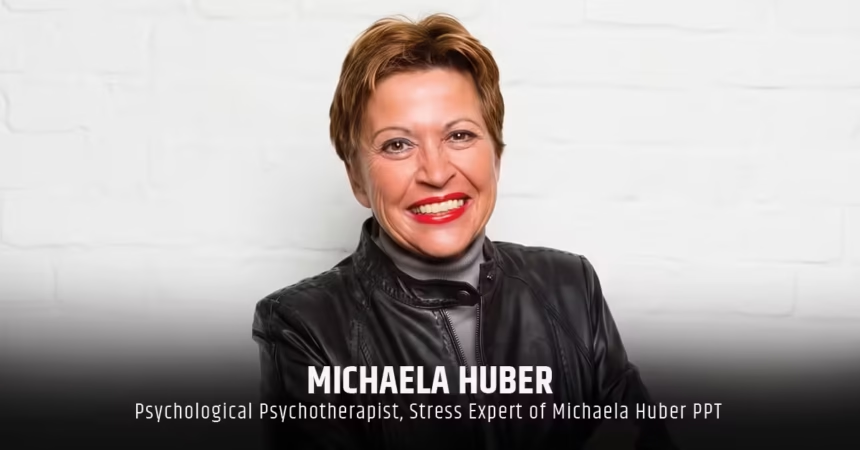
In today’s world, mental health is finally getting the attention it deserves—but when it comes to trauma, there’s still a long way to go. Many people carry emotional wounds that aren’t always visible, shaped by stress, loss, conflict, or difficult life experiences. Healing from these isn’t simple, and it certainly isn’t instant. It requires the right environment, the right approach, and most importantly, people who truly understand what trauma feels like—not just in theory, but in real life.
This growing need for thoughtful, trauma-informed care has led to the rise of organizations that go beyond traditional therapy. These are spaces that don’t just focus on symptoms, but on people—their stories, their pace, and their path to recovery. One such organization that stands out in this space is Michaela Huber PPT.
Founded by Michaela Huber, the organization reflects a lifetime of experience working closely with individuals dealing with deep emotional pain and complex trauma. What makes it different is how naturally it blends professional expertise with genuine human understanding. It doesn’t approach trauma as something to be “fixed” quickly, but as something to be carefully and respectfully worked through over time.
At its core, Michaela Huber PPT focuses on helping people who are dealing with conditions like PTSD, dissociation, and long-term stress. But instead of rushing into intense therapy, the first step is always about creating safety—helping individuals feel stable, grounded, and supported. This approach may seem simple, but it’s often the most important part of the healing process.
Where Therapy Meets Real-World Learning
What truly sets Michaela Huber PPT apart is that it’s not just a place for therapy—it’s also a place for learning. The organization has built a model where treatment and education go hand in hand, creating a space that supports both individuals and professionals.
On one side, there is the therapy practice, where people receive personalized care based on their own experiences and needs. Techniques like EMDR, hypnotherapy, and behavioral therapy are used, but always with flexibility. There’s no one-size-fits-all method here—everything is adapted to the person sitting in the room.
On the other side, the organization offers training programs for professionals such as therapists, psychologists, doctors, and social workers. These programs focus on real-life situations rather than just theory. Participants learn how trauma shows up in everyday behavior, how to respond when someone feels overwhelmed, and how to create a safe space for healing.
There are also supervision sessions where professionals can talk about challenging cases and learn from experienced practitioners. This makes the learning process practical and grounded, ensuring that knowledge can actually be applied in real-world settings.
This combination of therapy and education creates a strong cycle—real experiences shape the training, and trained professionals go on to help many more people. In this way, the organization’s impact continues to grow beyond its immediate work.
Growing Beyond Borders with Digital and Global Work
As the world becomes more connected, Michaela Huber PPT has expanded its reach beyond physical locations. A large part of its work is now available online, making it accessible to people and professionals across different countries.
Through webinars, virtual workshops, and online training programs, the organization has built an international community focused on trauma awareness and healing. This has opened doors for many who might not have had access to such specialized knowledge before, especially those in smaller towns or underserved regions.
The digital approach also makes learning more flexible. People can join sessions from anywhere, revisit materials, and learn at their own pace. At the same time, it creates a sense of connection—bringing together individuals from different backgrounds who share a common goal of understanding and addressing trauma.
Beyond its digital presence, the organization is also deeply involved in humanitarian work. It has contributed to trauma support initiatives in regions affected by conflict and crisis, helping both individuals and communities cope with the long-term effects of trauma.
By working in countries such as Estonia, Portugal, Morocco, and Spain, Michaela Huber PPT focuses not just on short-term support but on building lasting systems. Training local professionals ensures that care continues even after initial interventions, creating a more sustainable impact.
A Lasting Impact That Goes Beyond One Person
While the vision of Michaela Huber is at the heart of everything, Michaela Huber PPT has grown into something much larger than its founder. It has become a platform that spreads knowledge, builds skills, and supports healing on a much wider scale.
Over the years, the organization has earned respect in the field of trauma therapy, not through bold claims, but through consistent and meaningful work. Its approach—practical, compassionate, and deeply human—has helped shape how trauma is understood and treated, especially across Europe.
One of its greatest strengths lies in how it multiplies its impact. Every professional trained through its programs carries that knowledge forward, helping more individuals in different communities. This ripple effect allows the organization to reach far beyond its immediate environment.
In a time when mental health conversations are increasing but not always deep enough, Michaela Huber PPT brings clarity and depth. It reminds us that healing is not about quick solutions or simple answers. It’s about patience, understanding, and the right kind of support at the right time.
More than anything, the organization shows that trauma care can be both professional and deeply human at the same time. And in doing so, it continues to make a lasting difference—not just in how trauma is treated, but in how it is understood.
Michaela Huber: Early Life, Education, and Professional Training
Michaela Huber was born on June 19, 1952, in Munich and spent her early years there before moving to Düsseldorf. She studied psychology at the Universities of Düsseldorf and Münster, building a strong academic foundation for her future work.
Her clinical training included behavioral therapy at the University of Münster, hypnotherapy with the Milton Erickson Society, and EMDR training at the German EMDR Institute led by Arne Hofmann. Today, she is a qualified psychologist, licensed psychotherapist, as well as a supervisor and trainer specializing in trauma treatment.