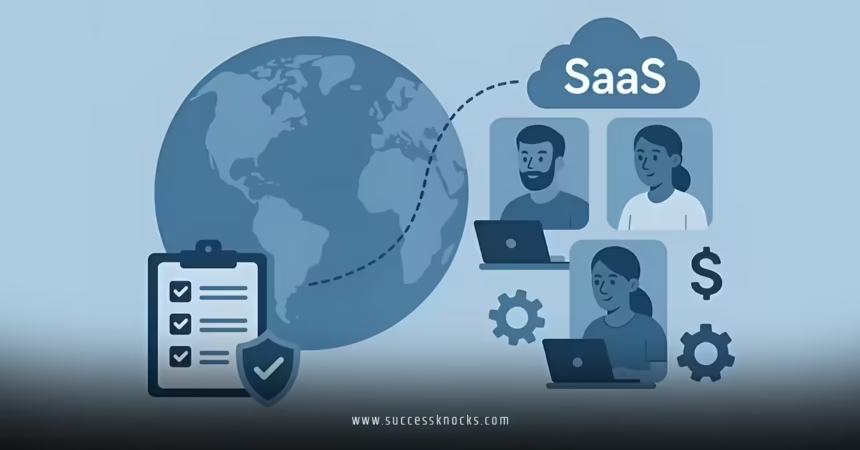
Mitigating SaaS switching costs keeps your organization agile and your budget intact when it’s time to evolve or escape a bad fit. You’ve seen it. A promising tool turns into a money pit with surprise price hikes or feature shifts. Migration looks impossible. Teams resist change. Suddenly you’re trapped paying more for less value.
Here’s the thing: smart mitigation starts long before you even consider leaving. It’s about building escape hatches, minimizing friction, and treating every SaaS decision as potentially temporary. In 2026, with AI-driven tools and usage-based pricing exploding, those who master this save serious cash and headaches.
- It slashes long-term expenses by avoiding inflated renewal traps.
- It speeds up transitions when better options emerge.
- It preserves data control and reduces downtime risks.
- It boosts negotiation power at contract time.
- It aligns tech stack with actual business velocity.
Do this right, and switching becomes a strategic move instead of a last-resort nightmare.
What SaaS Switching Costs Really Include
Switching isn’t just data export. It hits across data migration, retraining, integration rebuilds, productivity dips, and potential legal or compliance work. Mid-market moves often run 2-4x the first-year license savings. Enterprises face even steeper bills when custom workflows and massive datasets are involved.
The kicker? Many costs hide until you’re halfway out the door. Vendors know this and design sticky experiences on purpose. Data accumulation, proprietary formats, and deep process integration all pile on.
What I’d do: Always model a full 3-5 year TCO including realistic exit scenarios. Don’t trust vendor promises—test them.
Why Mitigating SaaS Switching Costs Matters More in 2026
Price spikes, AI feature bloat, and economic pressure make staying put expensive. Organizations that ignore switching costs lose leverage fast. Modular architectures and open standards now make mitigation realistic without sacrificing capability.
Rhetorical question: Why pay premium prices for a tool you can’t realistically leave when a leaner alternative appears?
Early mitigation—tied directly to evaluating vendor lock-in risks before signing an enterprise SaaS contract—prevents these traps from forming.
Key Strategies for Mitigating SaaS Switching Costs
Prioritize Data Portability: Insist on standard formats (JSON, CSV, open schemas) and automated export tools. Test exports during pilots and require post-termination support in contracts.
Adopt Modular and Open Architectures: Favor solutions with strong APIs, webhooks, and containerized components. Avoid over-reliance on proprietary features. Multi-cloud or hybrid setups add flexibility.
Negotiate Strong Exit Clauses: Push for data return timelines, transition assistance, swap rights, and price protections. Include downgrade options and termination assistance fees covered by the vendor.
Implement Regular Audits and Governance: Track usage, licenses, and dependencies quarterly. Tools and processes for rationalization help spot bloat early.
Build Internal Knowledge and Playbooks: Document integrations, customizations, and migration paths. Cross-train teams to reduce human lock-in.
Maintain Multiple Vendor Relationships: Keep alternatives warm. This alone improves your bargaining position dramatically.
Comparison Table: Switching Cost Components and Mitigation Tactics
| Cost Component | Typical Impact | Mitigation Tactics | Expected Savings Potential |
|---|---|---|---|
| Data Migration | High (time + cleansing) | Standard formats, export testing, ETL tools | 40-60% |
| Retraining & Adoption | Medium-High (productivity loss) | Phased rollouts, similar UIs, champions | 30-50% |
| Integration Rebuild | High (custom work) | Open APIs, iPaaS platforms, loose coupling | 50%+ |
| Contract Penalties | Variable | Flexible terms, early exit clauses | Full avoidance |
| Downtime & Risk | High (business disruption) | Parallel runs, staged migrations | Significant |
Use this as a quick reference during procurement and reviews.

Step-by-Step Action Plan for Mitigating SaaS Switching Costs
- Assess Current State. Inventory all tools, map dependencies, and score lock-in levels.
- Define Portability Requirements. Build these into every RFP and contract review.
- Pilot with Exit in Mind. Run full mock migrations on sample data during evaluation.
- Negotiate Flexibly. Secure favorable terms before signing—reference evaluating vendor lock-in risks before signing an enterprise SaaS contract insights here.
- Implement Governance. Set up ongoing monitoring and annual health checks.
- Prepare Migration Playbooks. Document processes, tools, and responsible parties.
- Test Periodically. Run dry-run migrations on non-critical tools to stay ready.
What usually happens is teams treat mitigation as a one-off. Make it continuous.
Common Mistakes and How to Fix Them
Mistake 1: Waiting until renewal panic. Fix: Build exit planning into initial contracts and reviews.
Mistake 2: Over-customizing without portability. Fix: Standardize where possible and isolate custom layers.
Mistake 3: Single-vendor dependency. Fix: Spread critical functions across interoperable tools.
Mistake 4: Ignoring hidden costs. Fix: Use TCO models that include switching scenarios.
Mistake 5: Poor documentation. Fix: Mandate knowledge capture as part of every implementation.
Think of mitigating SaaS switching costs like maintaining an escape pod on a spaceship. You hope you never need it, but when thrusters fail, you’re glad it’s ready.
For solid contract negotiation guidance, check Zylo’s SaaS management resources.
NIST offers practical cloud portability insights worth reviewing.
Key Takeaways
- Mitigating SaaS switching costs protects budgets and agility in volatile markets.
- Start with strong contracts and open standards during procurement.
- Regular audits and playbooks turn potential nightmares into manageable moves.
- Data portability is the foundation—test it relentlessly.
- Modular designs beat monolithic platforms for long-term flexibility.
- Early action linked to evaluating vendor lock-in risks before signing an enterprise SaaS contract delivers the biggest wins.
- Treat every vendor relationship as temporary.
- The real ROI shows up at renewal or when you actually switch.
Mitigating SaaS switching costs puts control back in your hands. You move faster, spend smarter, and sleep better knowing you’re never truly stuck. Review your current stack through this lens today. Build those escape routes now—your future procurement cycles will be far smoother.
FAQs
How does mitigating SaaS switching costs connect to evaluating vendor lock-in risks before signing an enterprise SaaS contract?
They’re two sides of the same coin. Early risk evaluation informs mitigation tactics like portability clauses and modular choices that make future switches affordable and low-risk.
What are the biggest hidden SaaS switching costs enterprises face?
Beyond data migration, expect heavy hits from staff retraining, rebuilding integrations, temporary productivity loss, and potential compliance rework. Modeling these upfront prevents sticker shock.
Can small teams effectively mitigate SaaS switching costs?
Absolutely. Focus on open formats, usage-based pilots, strong contracts, and lightweight governance. Even basic checklists and periodic export tests make a huge difference without heavy resources.