

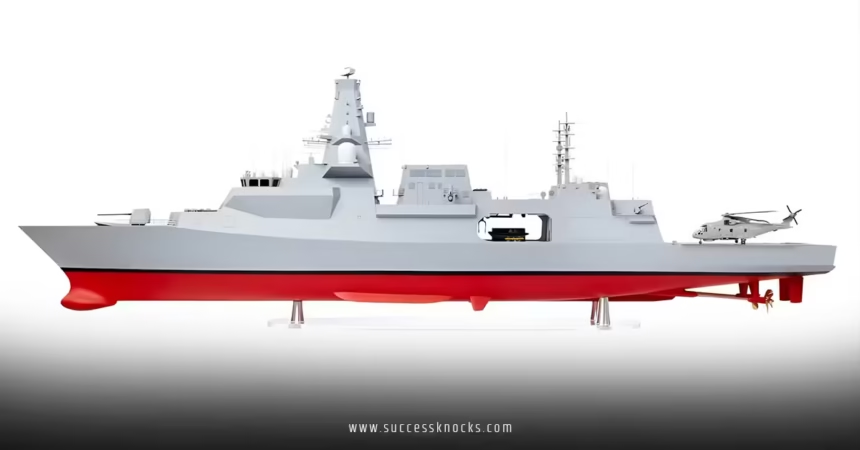
Moudge class frigate specifications reveal a lot about Iran’s naval ambitions: building capable, indigenous ships despite heavy sanctions. These vessels, also called Mowj-class (meaning “wave” in Persian), represent Tehran’s push for self-reliance in blue-water operations.
Today, let’s dive deep into the Moudge class frigate specifications, from hull design to weapons loadout. We’ll keep it straightforward, engaging, and packed with details—because understanding these ships helps explain why events like the iris dena moudge class frigate sunk 2026 hit so hard.
Origins and Development of the Moudge Class
Moudge Class Frigate Specifications:Iran didn’t start from scratch. The Moudge class draws heavy inspiration from the older British-built Alvand-class frigates (originally Saam-class) delivered in the 1970s. After the 1979 revolution cut off Western support, Iran reverse-engineered and upgraded the design domestically.
Construction kicked off in the early 2000s at shipyards like Bandar Abbas and Bushehr. The lead ship, IRIS Jamaran, entered service around 2010. Later units—like IRIS Sahand, IRIS Dena, and others—incorporated incremental improvements in electronics, radar, and weaponry. By 2026, several were active, showcasing Iran’s growing shipbuilding expertise.
Think of it like this: if the Alvand was the classic recipe, the Moudge is the upgraded, home-cooked version with local spices (and some borrowed tech).
Core Dimensions and Performance: Hull, Speed, and Range
At first glance, these aren’t massive destroyers—they’re compact, agile light frigates or large corvettes by Western standards.
- Displacement: Approximately 1,500 tons (full load; some sources cite 1,300–1,500 tons)
- Length: 95 meters (about 312 feet)
- Beam: 11.1 meters (36.4 feet)
- Draught: 3.25 meters (10.7–10.8 feet)
Propulsion comes from two main diesel engines (each around 10,000 hp / 7,500 kW) plus four auxiliary diesel generators (740 hp / 550 kW each). This setup pushes the ship to a top speed of 30 knots (roughly 56 km/h or 35 mph)—solid for quick dashes in confined waters like the Persian Gulf or open-ocean transits.
Crew complement hovers around 140 personnel, making them relatively efficient to operate compared to larger Western frigates.
No hangar means aviation support is limited to a rear helipad for short-term ops with helicopters like the Bell 214 for ASW or utility roles. It’s a trade-off: lighter design, but less persistent air cover.
Sensors and Electronics: Eyes and Ears of the Ship
Modern naval fights are won with information, and the Moudge class packs respectable sensors for its size.
The standout is the Asr 3D phased-array radar—a homegrown PESA (passive electronically scanned array) system for long-range air and surface search. It handles multiple targets, giving decent early warning against aircraft or incoming missiles.
Additional systems include fire-control radars for gunnery and missiles, plus electronic warfare suites for jamming and decoys. Navigation and communication gear round out the package.
While not on par with Aegis-level sophistication, these sensors allow multi-role operations: patrol, escort, anti-surface strikes, and limited air defense.
Armament Breakdown: What Firepower Does a Moudge Carry?
Here’s where the Moudge class frigate specifications get interesting—the ships pack a punch disproportionate to their size.
- Main Gun: 1 × 76 mm Fajr-27 (Iranian copy of the OTO Melara Super Rapid) – rapid-fire for surface and anti-air roles.
- Close-in Defense: 1 × 40 mm Fath-40 (Bofors derivative) or 30 mm Kamand CIWS, plus 2 × 20 mm Oerlikon cannons and 2 × 12.7 mm heavy machine guns.
- Anti-Ship Missiles: 4 × Noor or Qader cruise missiles (Noor derived from Chinese C-802; Qader extends range to 200–300 km). These form the primary offensive punch—capable of threatening larger ships or coastal targets.
- Surface-to-Air Missiles: 4 × Mehrab (naval Sayyad-2 variant) or Sayyad-3—short-to-medium range air defense, often in box launchers.
- Anti-Submarine Weapons: 2 × triple 324 mm torpedo tubes for light torpedoes.
- Other: Some units feature additional launchers or upgraded VLS elements in later variants.
It’s a balanced loadout: strong anti-surface focus, basic layered air defense, and ASW capability. Not carrier-strike-group level, but perfect for asymmetric warfare in regional chokepoints.
Variants and Upgrades Across the Class
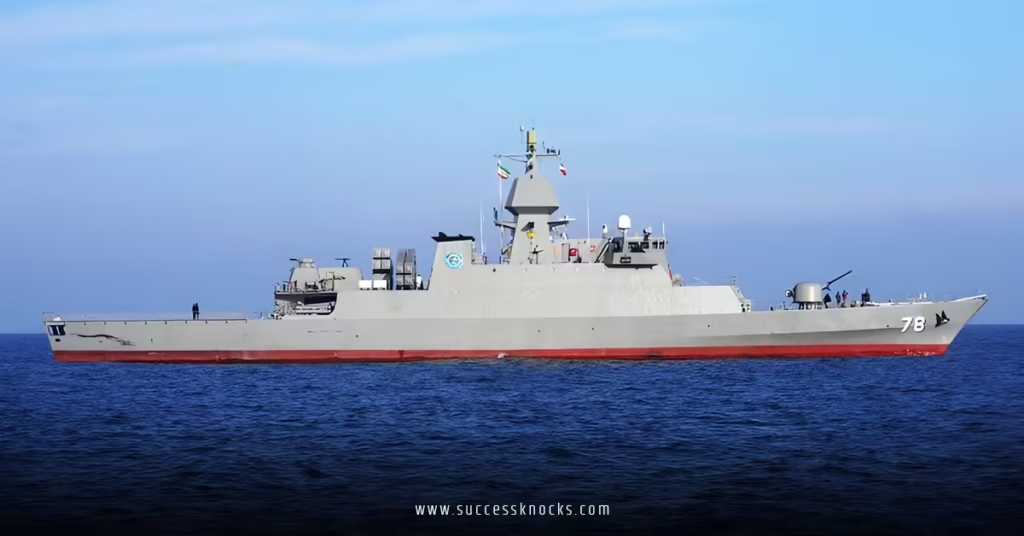
Not all Moudge ships are identical. Early ones like Jamaran stuck closer to the baseline. Later vessels, including IRIS Dena (commissioned 2021), featured upgraded electronics, better integration of indigenous systems, and sometimes refined superstructure for reduced radar signature.
This evolution shows Iran’s iterative approach—test, improve, repeat.
Role in the Iranian Navy and Strategic Importance
The Islamic Republic of Iran Navy (IRIN) deploys these in the Persian Gulf, Gulf of Oman, and farther afield for presence missions. They escort tankers, conduct exercises, and project power.
The class symbolizes defiance against sanctions—proving Iran can build guided-missile warships domestically.
Tragically, this capability came into sharp focus with the iris dena moudge class frigate sunk 2026 event, where IRIS Dena—fresh from multinational exercises—was lost to a submarine attack far from home waters.
Strengths and Limitations of the Moudge Design
Pros:
- Indigenous production = independence
- Good speed and maneuverability
- Potent missile armament for cost
- Multi-role flexibility
Cons:
- Limited air defense against saturation attacks
- No helicopter hangar restricts sustained ASW
- Vulnerability to modern submarines (as tragically demonstrated)
- Smaller size means less endurance for very long deployments
In today’s contested oceans, these trade-offs matter a lot.
Wrapping It Up: Why Moudge Class Specs Still Matter
The Moudge class frigate specifications paint a picture of smart, resourceful engineering—turning limited resources into credible naval assets. From the 95-meter hull slicing through waves at 30 knots to the Qader missiles ready to launch, these ships embody Iran’s naval strategy.
Events like the iris dena moudge class frigate sunk 2026 remind us how even capable platforms face asymmetric threats in modern conflict. If you’re into naval tech, the Moudge class is a fascinating case study in adaptation under pressure.
Got thoughts on how these specs hold up in real-world scenarios? Drop them below—I’d love to hear!
FAQs
What is the displacement of a Moudge class frigate?
Typically around 1,500 tons, making it a light frigate or large corvette by international standards.
How fast can a Moudge class frigate go?
Top speed reaches 30 knots thanks to powerful diesel engines and generators.
What missiles does the Moudge class carry?
Usually 4 × Noor/Qader anti-ship missiles and 4 × Mehrab/Sayyad SAMs for air defense.
Which famous Moudge class ship was involved in the iris dena moudge class frigate sunk 2026 incident?
IRIS Dena (pennant 75), commissioned in 2021, was the vessel tragically sunk in March 2026.
Does the Moudge class have helicopter capabilities?
Yes—a helipad for one medium helicopter like the Bell 214, but no enclosed hangar limits extended aviation ops.


