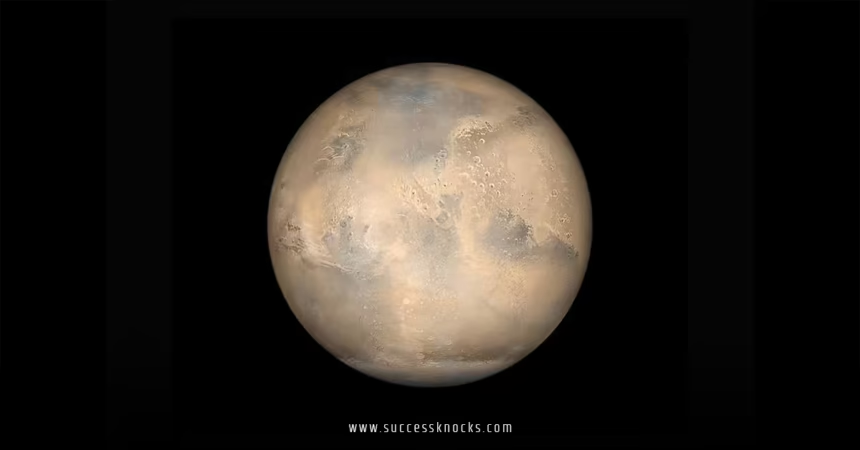
NASA ESCAPADE mission Mars atmosphere 2025 kicks off an exciting new chapter in our quest to understand the Red Planet. Imagine two tiny spacecraft, like curious twins, zooming toward Mars to unravel the mystery of why it lost its thick atmosphere billions of years ago. Launched just last month in November 2025, this innovative mission is already on its way, promising fresh insights into Mars’ space weather and atmospheric escape. Have you ever wondered how Mars turned from a potentially watery world into the dusty desert we see today? That’s exactly what the NASA ESCAPADE mission Mars atmosphere 2025 aims to figure out.
Let’s dive in and explore what makes this mission so groundbreaking. You and I both know space exploration can feel distant, but missions like this bring us closer to answering big questions about our solar system neighbors.
What Is the NASA ESCAPADE Mission Mars Atmosphere 2025?
At its core, the NASA ESCAPADE mission Mars atmosphere 2025 is all about studying how Mars’ thin atmosphere interacts with the relentless solar wind. ESCAPADE stands for Escape and Plasma Acceleration and Dynamics Explorers – a mouthful, right? But it perfectly captures the focus: tracking how particles escape from Mars and how plasma dynamics play a role.
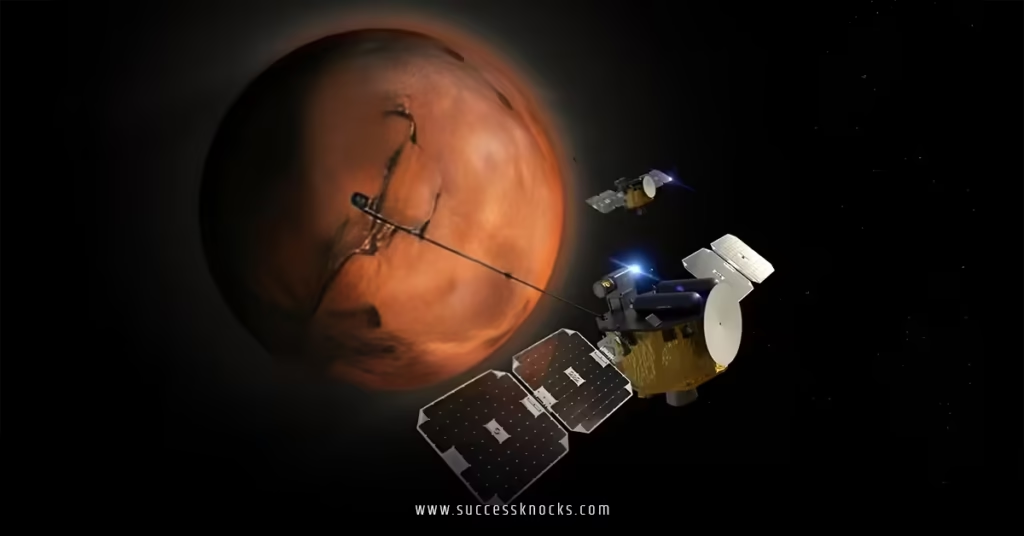
This isn’t your typical single-spacecraft endeavor. The NASA ESCAPADE mission Mars atmosphere 2025 deploys two identical orbiters, nicknamed Blue and Gold. Why two? Think of it like having stereo vision instead of one eye – these twins will observe Mars from different angles simultaneously, giving us a real-time, 3D picture of the planet’s magnetosphere and upper atmosphere. No other mission has done orbital science around Mars with a duo like this before.
Led by experts at the University of California, Berkeley’s Space Sciences Laboratory, with principal investigator Rob Lillis at the helm, the NASA ESCAPADE mission Mars atmosphere 2025 builds on lessons from predecessors like MAVEN. But it’s smarter and more affordable, proving that big discoveries don’t always need massive budgets.
Key Objectives of NASA ESCAPADE Mission Mars Atmosphere 2025
What exactly are these spacecraft chasing? The main goals of the NASA ESCAPADE mission Mars atmosphere 2025 revolve around three big ideas:
- Mapping the structure of Mars’ hybrid magnetosphere and how it directs ion flows.
- Figuring out how energy and momentum transfer from the solar wind into this magnetosphere.
- Pinpointing the processes that push energy and matter out of Mars’ collisional atmosphere.
In simpler terms, the NASA ESCAPADE mission Mars atmosphere 2025 wants to watch solar wind particles slam into Mars and strip away its air, particle by particle. Mars lacks a strong global magnetic field like Earth’s, so it’s vulnerable – kind of like leaving your house windows open in a storm. Over billions of years, this has turned a once-habitable planet into a barren one.
Rhetorical question: If Earth lost its magnetic shield, would we face the same fate? Thankfully, we’re protected, but studying Mars helps us appreciate that.
The Launch and Journey of NASA ESCAPADE Mission Mars Atmosphere 2025
The NASA ESCAPADE mission Mars-atmosphere 2025 blasted off on November 13, 2025, from Cape Canaveral, Florida, aboard Blue Origin’s New Glenn rocket. It was a nail-biter – delays from weather, technical hiccups, and even a massive solar storm pushed things back, but persistence paid off. The booster even landed successfully, showcasing reusable tech in action.
Post-launch, the twins headed to a loiter orbit near the Earth-Sun L2 point, about a million miles away. Here, they’ll hang out until late 2026, gathering bonus data on space weather before the optimal transfer window to Mars opens. Arrival? Expected in 2027, when they’ll slip into elliptical orbits to start their primary science phase.
This clever trajectory is a game-changer for the NASA ESCAPADE mission Mars atmosphere 2025. Traditional Mars missions wait years for perfect alignments, but this flexible path means more frequent opportunities. It’s like taking the scenic route that saves fuel and opens new doors.
Spacecraft Design in NASA ESCAPADE Mission Mars Atmosphere 2025
Each orbiter in the NASA ESCAPADE mission Mars atmosphere 2025 is compact – about fridge-sized, weighing around 535 kg fully fueled. Built by Rocket Lab, they’re packed with sophisticated instruments:
- Magnetometers to measure magnetic fields.
- Electrostatic analyzers for electrons and ions.
- Langmuir probes for plasma density and solar EUV flux.
These tools will probe altitudes from 160 to 10,000 km, capturing how Mars’ crustal magnetic remnants and induced fields create a “hybrid” magnetosphere. The dual setup allows simultaneous measurements, separating spatial changes from temporal ones – crucial for understanding dynamic events.
Why Mars’ Atmosphere Matters: Insights from NASA ESCAPADE Mission Mars Atmosphere 2025
Ever gaze at Mars photos and ponder its ancient rivers? Billions of years ago, Mars had a thick atmosphere, liquid water, maybe even life. Today, it’s 1% as dense as Earth’s. The culprit? Atmospheric escape, accelerated by solar wind.
The NASA ESCAPADE mission Mars atmosphere 2025 targets processes like ion escape and sputtering – where solar particles knock atmospheric atoms into space. By observing calm and stormy space weather days, it’ll quantify how much air Mars loses now, extrapolating back in time.
Analogy time: Picture Mars’ atmosphere as a slow-leaking balloon. The solar wind is the tiny hole, and without a strong magnet to plug it, air just drifts away. The NASA ESCAPADE mission Mars atmosphere 2025 will measure that leak in real time.
This ties into habitability. A thicker atmosphere meant warmer temperatures and stable water. Losing it cooled Mars, freezing or evaporating oceans. Data from the NASA ESCAPADE mission Mars atmosphere 2025 could refine models of planetary evolution, even informing exoplanet searches.
Connection to MAVEN and Future Missions
The NASA ESCAPADE mission Mars atmosphere 2025 complements NASA’s MAVEN orbiter, which has been studying upper atmosphere loss since 2013. MAVEN provided snapshots; ESCAPADE adds stereo views for deeper context.
Looking ahead, insights from the NASA ESCAPADE mission Mars atmosphere 2025 will aid human exploration. Understanding space weather protects astronauts from radiation and helps predict ionosphere effects on communications.
Challenges and Innovations in NASA ESCAPADE Mission Mars Atmosphere 2025
Budget-wise, the NASA ESCAPADE mission Mars atmosphere 2025 shines at around $94 million – a bargain compared to MAVEN’s $600 million. Part of NASA’s SIMPLEx program, it embraces higher risk for faster, cheaper science.
Challenges? Delays shifted from a Psyche rideshare to dedicated New Glenn launch. But innovations abound: commercial partnerships with Rocket Lab, Advanced Space, and Blue Origin streamline development.
The loiter phase is pure genius – turning delay into opportunity by studying Earth-space weather en route.
Scientific Instruments and Data Expectations for NASA ESCAPADE Mission Mars Atmosphere 2025
Let’s geek out on the tech. The NASA ESCAPADE mission Mars atmosphere 2025 instruments include:
- EMAG: Boom-mounted magnetometer for field measurements.
- EESA/IESA: Analyzers tracking electron and ion energies.
- ELP: Probes gauging density and EUV input.
Expect data on bow shocks, magnetotails, and escape plumes. Simultaneous observations will reveal how solar eruptions trigger massive loss events.
Burstiness in data: Calm periods versus storms could show escape rates varying by factors of 10 or more.
Implications for Human Exploration from NASA ESCAPADE Mission Mars Atmosphere 2025
Dreaming of boots on Mars? The NASA ESCAPADE mission Mars atmosphere 2025 data will forecast radiation hazards and ionospheric disruptions. Better models mean safer habitats and reliable comms.
It also advances comparative planetology – using Mars to understand magnetospheres elsewhere, including exoplanets.
Current Status and Future Timeline of NASA ESCAPADE Mission Mars Atmosphere 2025
As of December 2025, the NASA ESCAPADE mission Mars atmosphere 2025 twins are cruising in loiter orbit, sending selfies and health checks. Commissioning is smooth; science ops ramp up soon.
Key milestones:
- Late 2026: Transfer to Mars.
- 2027: Orbit insertion and primary mission start (1 year planned).
Excitement builds – what secrets will the NASA ESCAPADE mission Mars atmosphere 2025 unlock?
In wrapping up, the NASA ESCAPADE mission Mars atmosphere 2025 represents a bold, efficient leap in planetary science. From its twin orbiters probing atmospheric escape to revealing Mars’ climatic past, this mission ties together solar wind dynamics, magnetosphere quirks, and habitability puzzles. We’ve seen how it builds on past efforts while paving roads for human Mars ventures. Ultimately, the NASA ESCAPADE mission Mars atmosphere 2025 reminds us why we explore: to understand our place in the cosmos and protect our future adventures. Stay tuned – the Red Planet’s stories are just beginning to unfold. What do you think we’ll discover next?
FAQs
What is the main goal of the NASA ESCAPADE mission Mars atmosphere 2025?
The primary aim of the NASA ESCAPADE mission Mars atmosphere 2025 is to study how solar wind drives the escape of atmospheric particles from Mars, helping explain the planet’s transition from a potentially habitable world to its current arid state.
When did the NASA ESCAPADE mission Mars atmosphere 2025 launch?
The NASA ESCAPADE mission Mars atmosphere 2025 successfully launched on November 13, 2025, aboard Blue Origin’s New Glenn rocket from Cape Canaveral, Florida.
How does the NASA ESCAPADE mission Mars atmosphere 2025 differ from MAVEN?
While MAVEN provides single-point observations, the NASA ESCAPADE mission Mars atmosphere 2025 uses two identical spacecraft for simultaneous, multi-point measurements, offering a more dynamic view of Mars’ magnetosphere and atmospheric loss.
Why are there two spacecraft in the NASA ESCAPADE mission Mars atmosphere 2025?
The twin design in the NASA ESCAPADE mission Mars atmosphere 2025 allows for stereo observations, distinguishing between spatial and temporal changes in Mars’ space environment for clearer insights into real-time processes.
What happens next for the NASA ESCAPADE mission Mars atmosphere 2025 after launch?
Following launch, the NASA ESCAPADE mission Mars atmosphere 2025 spacecraft are loitering in a distant orbit until late 2026, then transferring to Mars for arrival in 2027 to begin orbital science operations.