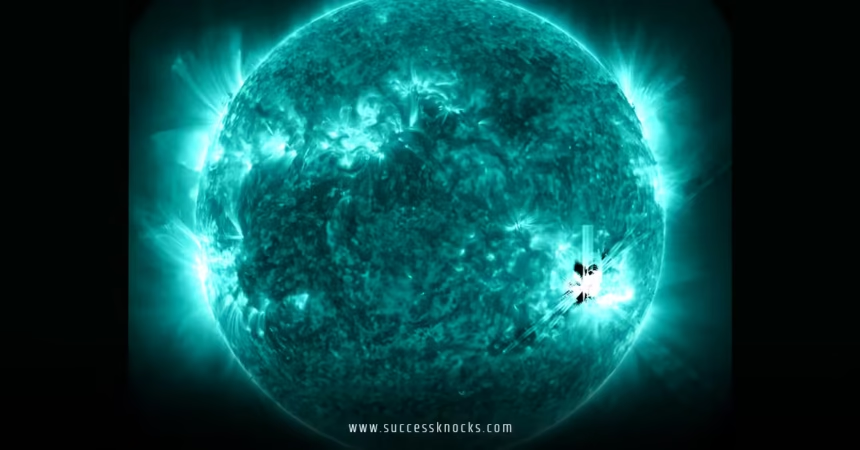
NASA solar storm warnings and space weather alerts spring 2026 are making headlines as our star unleashes a barrage of activity right in the heart of solar maximum. Imagine the Sun as a restless giant, occasionally flexing its magnetic muscles and sending shockwaves across the solar system. In early 2026, particularly around February (which overlaps with the tail end of winter heading into spring in the Northern Hemisphere), we’ve seen intense flares, coronal mass ejections (CMEs), and resulting geomagnetic disturbances. These events have prompted heightened monitoring from NASA and its partners like NOAA’s Space Weather Prediction Center (SWPC). If you’re wondering why this matters—think potential auroras lighting up the skies, but also risks to satellites, power grids, and even airline routes.
Understanding the Surge in NASA Solar Storm Warnings and Space Weather Alerts Spring 2026
Let’s break it down. The Sun follows an roughly 11-year cycle of activity, and we’re smack in the peak of Solar Cycle 25. Forecasts originally pegged the maximum around mid-2025, but activity has stayed robust into 2026, with sunspot numbers exceeding expectations. This means more frequent and powerful eruptions. NASA solar storm warnings and space weather alerts spring 2026 reflect this ongoing intensity, where strong X-class flares from active regions like AR4366 have dominated recent weeks.
These aren’t just pretty light shows. Solar flares release massive bursts of radiation, while CMEs hurl billions of tons of charged particles our way. When they hit Earth’s magnetosphere, we get geomagnetic storms. NASA collaborates closely with NOAA to track this, using satellites like the Solar Dynamics Observatory (SDO) to capture every flare in stunning detail.
What Triggers NASA Solar Storm Warnings and Space Weather Alerts Spring 2026?
Picture this: A sunspot group, complex and magnetically twisted, suddenly snaps. Boom—an X-class flare erupts, the strongest category. In early February 2026, we’ve seen multiple X-flares, including an X4.2 and X1.5 from the same region. These often launch CMEs, which take 1-3 days to reach us.
NASA solar storm warnings and space weather alerts spring 2026 kick in when models predict impacts. NOAA issues scales: R for radio blackouts (from flares), S for solar radiation storms (particle events), and G for geomagnetic storms (from CMEs). Recent examples include G1 watches and even higher levels from earlier events like S4 severe radiation storms in January that carried momentum into the new season.
Why spring specifically? As we transition from winter, longer days and changing ionospheric conditions can amplify effects on communications. Plus, the Sun’s activity doesn’t neatly stop at calendar boundaries—it’s been “exciting” through early 2026.
Key Events Driving NASA Solar Storm Warnings and Space Weather Alerts Spring 2026
Recent activity has been nonstop. Take sunspot region AR4366: It unleashed nine X-class flares in a short span, plus dozens of M-class ones. Some hurled CMEs Earthward, leading to glancing blows and potential G2-level storms.
NASA’s SDO captured these in extreme ultraviolet light, showing bright flashes of superheated plasma. One strong flare peaked in early February, prompting immediate alerts. NOAA’s models forecasted radio blackouts and possible auroras visible farther south than usual.
Earlier in the cycle, severe events like G4 geomagnetic storms and S4 radiation storms highlighted risks—think increased exposure for polar flights and astronauts. Into spring 2026, forecasters expect continued moderate to high activity, with chances for M- and X-class flares.
New tools are coming online too. NOAA’s SOLAR-1 (formerly SWFO-L1) satellite reached its L1 point in early 2026 and is set to provide advanced real-time data starting this spring, enhancing predictions for NASA solar storm warnings and space weather alerts spring 2026.

Impacts of NASA Solar Storm Warnings and Space Weather Alerts Spring 2026 on Earth
So, what happens when these warnings go out? On the fun side, geomagnetic storms supercharge auroras. People in mid-latitudes might catch vivid displays of green, purple, and red dancing across the sky—like nature’s own laser show.
But there’s a serious flip side. Power grids can experience induced currents, risking blackouts (remember the 1989 Quebec event?). Satellites face drag or electronic glitches. GPS and radio signals degrade during strong ionospheric disturbances. Airlines reroute polar flights to avoid radiation spikes.
NASA solar storm warnings and space weather alerts spring 2026 help mitigate this. Operators can put satellites in safe mode, grids adjust voltages, and astronauts on the ISS get shielded warnings.
How NASA and NOAA Collaborate on NASA Solar Storm Warnings and Space Weather Alerts Spring 2026
NASA isn’t the primary issuer of public alerts—that’s NOAA’s SWPC. But NASA provides the eyes: missions like SDO, ACE, and soon enhanced data from partners. They co-chair prediction panels and share research.
In spring 2026, this partnership shines brighter with new assets. Real-time solar wind data helps forecast CME arrivals accurately. Alerts come as watches (days ahead), warnings (hours), or immediate notifications.
Stay informed via NOAA Space Weather Prediction Center for official updates, NASA Science Solar Cycle 25 blog for visuals and explanations, or SpaceWeather.com for community-driven insights.
Preparing for Future NASA Solar Storm Warnings and Space Weather Alerts Spring 2026
What can you do? For aurora chasers, check apps and forecasts—spring’s clearer skies help. Businesses reliant on tech should have contingency plans. Everyone benefits from understanding basics: flares cause instant radio issues, CMEs delayed storms.
As Solar Cycle 25 winds down slowly into late 2026 and beyond, expect lingering surprises. The Sun’s not done yet.
Conclusion
NASA solar storm warnings and space weather alerts spring 2026 highlight a Sun at peak fury, delivering flares, CMEs, and storms that dazzle and challenge us. From vivid auroras to infrastructure safeguards, these events remind us of our connection to cosmic forces. Stay curious, monitor reliable sources, and appreciate the beauty—and power—above. Whether you’re a stargazer or just tech-dependent, being aware turns potential disruptions into opportunities for wonder.
FAQs
What exactly are NASA solar storm warnings and space weather alerts spring 2026?
NASA solar storm warnings and space weather alerts spring 2026 refer to notifications from NASA and NOAA about intense solar activity, including flares and CMEs, observed in early 2026. They warn of potential geomagnetic impacts, radiation risks, and communication disruptions during this active solar maximum phase.
Why have NASA solar storm warnings and space weather alerts spring 2026 been so frequent?
The frequency stems from Solar Cycle 25’s extended peak, with active sunspot regions producing multiple X-class flares in February 2026. This heightened activity has led to ongoing watches for G-level storms and radio blackouts.
Can NASA solar storm warnings and space weather alerts spring 2026 predict auroras?
Yes, they often do! Geomagnetic storm alerts indicate when auroras might appear farther from the poles. In spring 2026, several events promised enhanced northern (and sometimes southern) lights visibility.
How do NASA solar storm warnings and space weather alerts spring 2026 affect everyday life?
They can lead to temporary GPS inaccuracies, radio interference, or power fluctuations. Most people notice little, but critical sectors like aviation and satellites adjust operations based on these alerts.
Where can I track ongoing NASA solar storm warnings and space weather alerts spring 2026?
Visit NOAA’s SWPC site for real-time alerts, NASA’s Solar Cycle 25 updates for imagery, and apps that aggregate space weather data for the latest on current and forecasted activity.