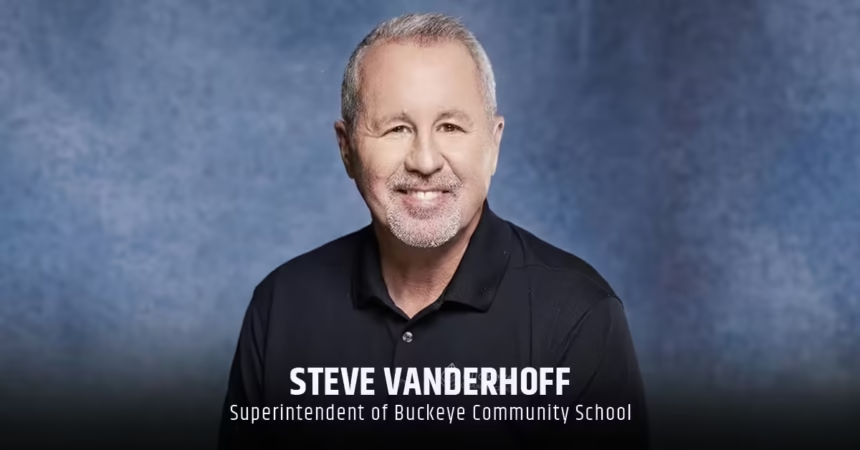
When Steve Vanderhoff talks about success, he doesn’t point to titles or organizational milestones. Instead, he describes the moment a student who has faced countless setbacks walks across the stage and rings the graduation bell.
“That’s what success looks like,” he says. “Their breakthrough is ours too.”
As Superintendent of Buckeye Community Schools under the New Leaf Organization, Vanderhoff leads operational strategy across a rapidly expanding network of campuses serving thousands of students seeking alternative pathways to graduation. His leadership approach is grounded in a simple but powerful question that guides every decision: Is this serving students?
For Vanderhoff, culture begins with example. Expectations around communication, transparency, and accountability are not simply directives passed down through an organizational chart—they are modeled.
“Your actions have to speak louder than your title,” he says. “You need to model what you expect—from the teachers to the custodians.”
At New Leaf Organization, that philosophy translates into an operational framework designed to remove barriers and create opportunities for students whose circumstances often fall outside the boundaries of traditional education.
A Nontraditional Journey Rooted in Servant Leadership
Vanderhoff’s path into education was anything but conventional. After spending more than two decades in the corporate sector, working his way up through distribution management roles, a substitute teaching opportunity unexpectedly shifted the direction of his career. What began as a short-term experience revealed a deeper calling—supporting students who simply needed someone to believe in them.
From there, his journey evolved with intention. He went on to serve as a classroom teacher, co-founded a dropout prevention school, and eventually joined New Leaf, now overseeing operations across multiple campuses. Throughout each chapter, his leadership philosophy has remained rooted in servant leadership. For Vanderhoff, impact is what matters most. In his current role as Superintendent, he focuses on building strong, sustainable systems, empowering his teams, and ensuring that every student has a clear and achievable path to success.
At New Leaf Organization, the work begins and ends with one question: Is this serving students? That principle is not a slogan posted on a wall. It is the filter through which every operational decision is made. From staffing models to scheduling structures, from budget allocations to campus expansion, the central focus remains clear: students come first.
That clarity comes from experience. Having worked in nearly every role within education, from classroom teacher to leadership, there is a deep understanding of how policies feel on the ground. Expectations around consistency, transparency, and accountability are not handed down from a distance. They are modeled. If teams are expected to communicate clearly, lead with integrity, and stay solution-focused, leadership must do the same. Culture does not form through directives; it forms through example.
Flexibility as Equity
At New Leaf, flexibility isn’t just a convenience — it’s a matter of fairness. Many students walk through the doors carrying responsibilities and pressures that don’t fit neatly into a traditional school model. Some are working jobs to support themselves or their families, others are caring for younger siblings, and many are navigating personal challenges that make rigid schedules and standardized instruction unrealistic.
If the goal is truly to serve students, the structure has to adjust when life demands it. That might mean modifying schedules, reallocating staff support, or designing alternative pathways to graduation. The priority is always the same — remove barriers rather than create them. At New Leaf, the system adapts to the student, not the other way around.
Operations as the Backbone of Personalized Learning
Operational leadership at New Leaf is deeply intertwined with the personalized education model. For Vanderhoff, operations are not separate from instruction—it is the backbone that allows instruction to thrive. Every campus must have the right systems, staffing, and support layers to meet students academically, emotionally, and socially. That means investing in more than teachers. It means bringing in student support specialists, career and technical education coordinators, and family engagement staff. Personalized learning requires a coordinated team effort. No single role carries the mission alone.
At the same time, campus leaders are trusted with autonomy. Principals understand their communities best. Clear communication and transparent expectations ensure alignment with the broader mission, but flexibility at the campus level allows leaders to respond to local needs. That balance—structure with autonomy—protects the integrity of the model while allowing it to breathe.
Embedding Wraparound Services into Daily Practice
Wraparound services are a core part of New Leaf’s operational strategy because many students are navigating challenges that go far beyond academics. Transportation barriers, mental health concerns, childcare responsibilities, and the need for employment can easily disrupt even the most determined learner. Instead of viewing these realities as outside the school’s role, New Leaf builds wraparound support directly into daily operations.
Their mindset is simple — “Why can’t we?” If a student needs help getting a driver’s license to secure a job, the focus shifts to how to make it happen. If childcare is preventing consistent attendance, the team looks for partners and practical solutions.
Collaboration with families, local agencies, and community organizations makes this level of support possible. It takes creativity, persistence, and strong relationships, but the long-term impact is clear — when students feel supported as whole individuals, their academic progress naturally follows.
Building Strong Community and Workforce Partnerships
Community partnerships at New Leaf go far beyond basic support services and move directly into workforce development, where education connects to real opportunity. Relationships with local employers and chambers of commerce are built through visibility and trust, not just emails or meetings. Campuses keep their doors open, regularly inviting business leaders to step inside, meet students, and see the programs in action.
When employers watch students building real-world skills, the connection becomes genuine and mutual. Initiatives like the greenhouse and hydroponics programs show how learning can align with actual community needs, giving students meaningful, hands-on experience while employers begin to see future talent taking shape. In that way, the mission stretches beyond earning a diploma and moves toward something bigger — long-term career readiness and sustainable opportunity.
Scaling with Intention and Protecting Culture
Scaling the organization across multiple campuses has brought both opportunity and challenge. Rapid growth is exciting, especially when it reflects increasing demand from families seeking alternative pathways. Yet growth can strain culture if not managed intentionally. Preserving quality while expanding requires deliberate structure.
To maintain alignment, New Leaf has added specialized operational roles, strengthened leadership development pipelines, and instituted consistent communication rhythms. Weekly leadership meetings ensure shared accountability. On-site visits reinforce presence and support. Expansion is not pursued for its own sake; it is pursued because more students need access. The mission drives growth—not the other way around.
Measuring What Truly Matters
Measuring effectiveness at New Leaf goes beyond checking boxes on a report, but results still matter. Graduation rates and credential attainment remain powerful indicators of whether the model is truly working. More than 5,500 graduates have walked across the stage, and over 90 percent have earned industry-recognized credentials alongside their diplomas — a reflection not only of academic progress but of real workforce readiness.
Enrollment and retention tell an equally important story. Many new students arrive through referrals from families and friends, a sign of trust that cannot be manufactured. Word of mouth carries weight because it is rooted in lived experience. This school year alone, more than 3,000 students have enrolled, and behind every number is a personal journey — young people who once felt disconnected finding direction, rebuilding confidence, and rediscovering a sense of purpose.
Driving Efficiency Through Purposeful Innovation
Efficiency at New Leaf doesn’t mean cutting corners — it’s about channeling resources where they have the greatest impact. Every process is reviewed regularly to make sure time, energy, and funding are focused on instruction and student support rather than unnecessary bureaucracy. True innovation often starts with listening, and some of the most successful programs have come directly from ideas raised by front-line educators. When staff feel empowered to ask, “Why can’t we?” creativity becomes part of the culture, not just an occasional initiative.
Data plays a key role in staying agile, with transparent reporting helping leadership spot trends and adjust strategies quickly. Yet numbers alone don’t tell the full story — they are always balanced with conversations, campus visits, and feedback loops that keep decisions grounded in real experiences and the needs of students and staff.
Preparing for the Future of Alternative Education
Looking toward 2026, alternative education is no longer a peripheral conversation. There is growing recognition nationwide that traditional models do not meet the needs of every learner. Workforce alignment will continue to shape the future. Flexible learning environments and stronger partnerships between education and industry are becoming essential, not optional. Programs integrating technical certifications, logistics training, and applied learning experiences will likely expand. Mental health services and career readiness support will also play an increasingly central role.
Vanderhoff believes organizations that thrive will be those able to adapt quickly while maintaining a strong culture and accountability. Adaptability without mission clarity leads to drift. Mission without adaptability leads to stagnation. The balance is critical.
Leadership Rooted in Purpose
For Vanderhoff, leadership is ultimately about transformation. Success is not measured by titles or organizational growth alone, but by moments when students who once felt overlooked discover their potential and step confidently toward their future. And for Steve Vanderhoff, that moment—when a student who has struggled for years walks across the stage and rings the graduation bell—remains the clearest measure of success and the reason the work continues.