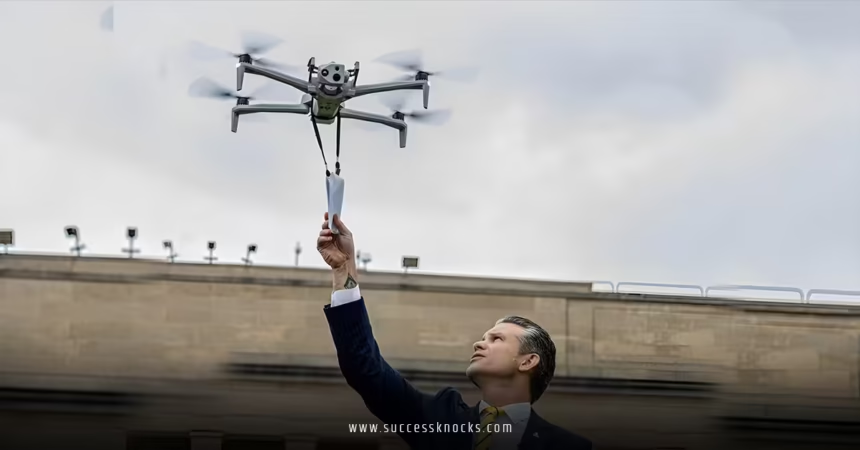
Pentagon drone dominance initiative 2026 is set to transform how the United States approaches modern warfare, pushing the boundaries of technology and strategy in ways we’ve never seen before. Imagine a battlefield where swarms of affordable drones overwhelm enemies, turning the tide without breaking the bank— that’s the vision driving this bold move. As we kick off 2026, this initiative isn’t just talk; it’s a high-stakes sprint to equip our forces with tools that could redefine global power dynamics. But what exactly is it, and why should you care? Let’s dive in and unpack this game-changer, step by step.
Understanding the Pentagon Drone Dominance Initiative 2026
Have you ever wondered why the Pentagon is suddenly all-in on drones? The Pentagon drone dominance initiative 2026 isn’t some pie-in-the-sky idea—it’s a concrete plan born from real-world lessons. Announced in late 2025 by Secretary of War Pete Hegseth, this program aims to flood the U.S. military with cheap, disposable attack drones. Think of it like upgrading from a fancy sports car to a fleet of reliable scooters: they’re not as flashy, but you can deploy way more of them, and losing one doesn’t sting as much.
At its core, the Pentagon drone dominance initiative 2026 focuses on shifting away from expensive, high-end weapons. We’re talking about ditching million-dollar missiles for drones that cost a fraction of that. Why? Because conflicts like the one in Ukraine have shown us that quantity often beats quality in drone warfare. Enemies are using low-cost drones to great effect, and the U.S. can’t afford to lag behind. This initiative is all about catching up—and then surging ahead—with a “fight tonight” mindset that empowers commanders on the ground.
The Origins of the Pentagon Drone Dominance Initiative 2026
Let’s rewind a bit. The seeds for the Pentagon drone dominance initiative 2026 were planted amid growing concerns over asymmetric threats. Back in 2023, the Replicator program hinted at this direction, aiming for thousands of autonomous systems. But by 2025, with tensions rising globally, the Trump administration cranked it up a notch. Hegseth’s announcement came hot on the heels of regulatory reforms in July 2025, stripping away bureaucratic hurdles that had handcuffed drone adoption.
Picture this: the U.S. watching adversaries like Iran and non-state actors churn out drones like candy. We couldn’t keep shooting them down with pricey interceptors—it was like using a sledgehammer to swat flies. So, the Pentagon drone dominance initiative 2026 emerged as a direct response, backed by a whopping $1 billion from the “Big Beautiful Bill.” It’s not just about building drones; it’s about rebuilding America’s industrial base to produce them fast and secure. Hegseth put it plainly: we’re entering an era where disposable tech rules the skies.
Key Goals of the Pentagon Drone Dominance Initiative 2026
What does success look like for the Pentagon drone dominance initiative 2026? First off, production targets are ambitious. The plan calls for tens of thousands of small drones delivered to forces in 2026, ramping up to hundreds of thousands by 2027. That’s not hyperbole—it’s a roadmap to dominance.
Production Milestones in the Pentagon Drone Dominance Initiative 2026
Breaking it down, the first phase kicks off from February to July 2026. Up to 12 vendors will compete to supply 30,000 drones, each capped at $5,000. It’s like a tech gauntlet, where companies prove they can manufacture at scale without compromising security. By emphasizing low-cost, supply-chain-secure small unmanned aerial systems (sUAS), the initiative ensures we’re not reliant on foreign parts that could be vulnerabilities.
Beyond numbers, the Pentagon drone dominance initiative 2026 prioritizes capabilities. These aren’t hobby drones; they’re attack-capable, designed for swarming tactics that saturate defenses. Analogize it to a bee hive— one sting hurts, but a swarm overwhelms. Goals include arming every Army squad with these tools, boosting domestic manufacturing, and integrating AI for smarter operations.
Strategic Shifts Driven by the Pentagon Drone Dominance Initiative 2026
How does this change the game? The Pentagon drone dominance initiative 2026 flips military strategy on its head. Instead of precision strikes with rare, expensive assets, we’re leaning into mass deployment. Commanders get more authority to use drones without endless approvals, fostering a nimble force ready for “fight tonight” scenarios.
Take the Pacific theater, for instance. Admiral Paparo’s talk of turning the Taiwan Strait into an “unmanned hellscape” aligns perfectly with this. The initiative prepares us for peer conflicts with China, where drone swarms could disrupt hypersonic threats or electronic warfare. It’s about deterrence through sheer volume—making aggression too costly for foes.
Industry’s Role in the Pentagon Drone Dominance Initiative 2026
Who’s building these drones? The Pentagon drone dominance initiative 2026 is a golden ticket for industry. Through requests for information (RFIs) and competitive demos, companies like Anduril, Skydio, and traditional players like Kratos are vying for contracts. It’s not just primes; startups get a shot too, thanks to acquisition reforms.
Opportunities and Challenges for Vendors
Vendors must hit strict criteria: low cost, rapid production, and secure supply chains. The “gauntlets” Hegseth mentioned are like boot camps for drone makers—intense tests to weed out the weak. For businesses, this means jobs, innovation, and a slice of that $1B pie. But challenges loom: scaling from prototypes to mass production isn’t easy, and cybersecurity is non-negotiable.
I’ve seen how initiatives like this spark economic booms. The Pentagon drone dominance initiative 2026 could revitalize U.S. manufacturing, creating hubs for drone tech. It’s exciting—think Silicon Valley meets the Rust Belt, all geared toward national security.

Technological Innovations Fueling the Pentagon Drone Dominance Initiative 2026
Tech is the heartbeat here. The Pentagon drone dominance initiative 2026 leverages AI, open software, and commercial off-the-shelf components. Drones will feature first-person view (FPV) for precise strikes, drawing from Ukraine’s playbook where factories churn out thousands daily at rock-bottom prices.
AI and Autonomy in Action
Why AI? It turns drones from remote toys into smart hunters. Swarms coordinate without human input, adapting to threats in real-time. Metaphorically, it’s like a flock of birds dodging a hawk—instinctive, efficient. Batteries from firms like Enovix extend flight times, while sensors from Teledyne make them eagle-eyed.
But autonomy raises questions: How do we ensure ethical use? The initiative includes safeguards, but it’s a tightrope walk between innovation and control.
Potential Hurdles for the Pentagon Drone Dominance Initiative 2026
No plan is perfect. Critics worry about the Pentagon drone dominance initiative 2026 escalating arms races. What if adversaries copy us? There’s also the risk of domestic drone attacks—experts predict one on U.S. soil in 2026, highlighting our vulnerabilities.
Addressing Criticisms and Risks
Bureaucratic inertia could slow things, despite reforms. Budgets are tight; the 2025 DoD allocation for UAS was just $350M, far from what’s needed. Counter-drone tech must evolve too—we can’t dominate if we’re defenseless. Yet, with leaders like Hegseth pushing hard, these hurdles feel surmountable.
Global Impact of the Pentagon Drone Dominance Initiative 2026
On the world stage, the Pentagon drone dominance initiative 2026 sends shockwaves. Allies like Israel and Ukraine watch closely, potentially adopting similar strategies. Foes? They’re scrambling. China, with its drone prowess, might accelerate programs, but our focus on mass and affordability could give us the edge.
Think of it as a new Cold War chapter, but with drones instead of nukes. It reshapes alliances, trade, and even ethics in warfare. Will it prevent conflicts or spark them? Only time will tell, but America’s betting big on aerial superiority.
Conclusion: Embracing the Future with the Pentagon Drone Dominance Initiative 2026
Wrapping this up, the Pentagon drone dominance initiative 2026 is more than a program—it’s a paradigm shift toward smarter, scalable warfare. From ambitious production goals to industry boosts and tech leaps, it’s positioning the U.S. as an unbeatable force. We’ve covered its origins, objectives, challenges, and global ripples, all while highlighting why this matters now. If you’re into defense tech or just curious about tomorrow’s battles, keep an eye on this. It’s time to get excited—or at least prepared—for a drone-dominated world. What role will you play in this evolving story? Stay informed, and let’s see where it flies.
FAQs
What exactly does the Pentagon drone dominance initiative 2026 aim to achieve?
The Pentagon drone dominance initiative 2026 focuses on rapidly producing and deploying low-cost attack drones to enhance U.S. military capabilities, targeting tens of thousands in 2026 alone for strategic superiority.
How will the Pentagon drone dominance initiative 2026 impact U.S. troops on the ground?
By equipping squads with affordable drones, the Pentagon drone dominance initiative 2026 empowers commanders with flexible tools, reducing reliance on expensive weapons and improving real-time battlefield responses.
Are there any risks associated with the Pentagon drone dominance initiative 2026?
Yes, potential risks include escalating global arms races and vulnerabilities to counter-drone tech, but the Pentagon drone dominance initiative 2026 includes measures to secure supply chains and ethical guidelines.
Which companies are involved in the Pentagon drone dominance initiative 2026?
The Pentagon drone dominance initiative 2026 invites multiple vendors through competitive processes, including startups like Anduril and established firms like Kratos, to build scalable drone systems.
When will we see the first results from the Pentagon drone dominance initiative 2026?
Initial deliveries under the Pentagon drone dominance initiative 2026 are slated for mid-2026, with the first phase wrapping up by July and paving the way for broader rollout.