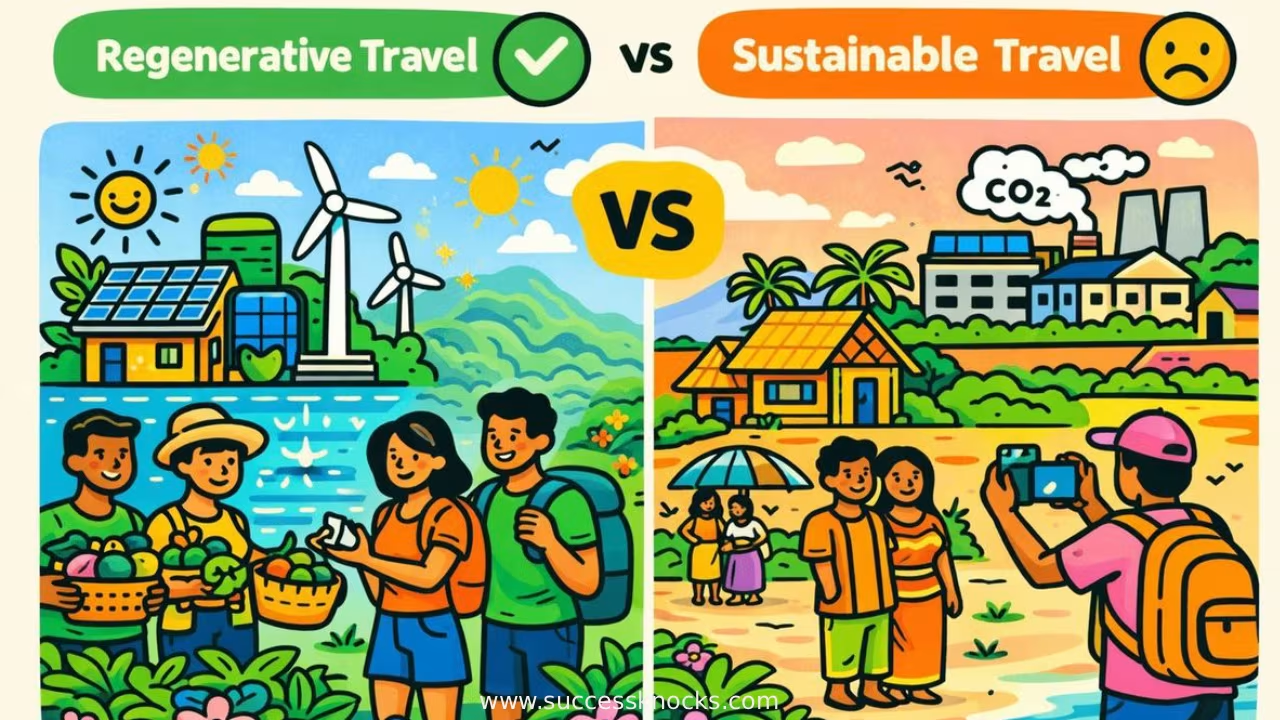
Regenerative travel vs. sustainable travel: key differences come down to direction. One tries to break even. The other aims for a measurable win for the place you visit.
Here’s the quick readout most travelers and operators need right now:
- Sustainable travel focuses on reducing harm—lower emissions, less waste, protected resources—so the destination stays roughly as you found it.
- Regenerative travel goes further: it actively restores ecosystems, builds local ownership, and leaves social and ecological systems stronger.
- Both matter. Sustainability is the non-negotiable floor. Regeneration is the higher ambition that asks, “What does this place actually need to thrive?”
- In 2026 the distinction matters more than ever because greenwashing is rife and travelers (plus operators) are demanding proof, not poetry.
- For U.S.-based planners and guests, the practical difference shows up in trip design, community roles, and what gets measured after the visit.
If you want the bigger picture on how this shift is reshaping operators and destinations, the full guide on regenerative travel business trends lays out the market forces at work.
What each term actually means in practice
Sustainable tourism has a long, solid definition from the UN World Tourism Organization: tourism that takes full account of its current and future economic, social, and environmental impacts while meeting the needs of visitors, the industry, the environment, and host communities.
In the field that usually looks like energy-efficient lodges, reef-safe sunscreen, carbon accounting, local hiring quotas, and waste reduction programs. Success is measured by how little damage you leave behind. Neutral is the target.
Regenerative travel flips the question. Instead of “How do we avoid making things worse?” it asks “What does this place need, and can tourism help supply it?” The goal is net-positive outcomes—restored habitats, stronger local ownership of tourism revenue, revived cultural practices led by the community itself. Guests often move from spectators to participants: planting, monitoring, skill-sharing, or funding projects that continue after they leave.
Think of it like banking. Sustainable travel is careful spending that doesn’t overdraw the account. Regenerative travel deposits more than it withdraws. One keeps the balance stable. The other grows the principal.
In my experience working with operators across the U.S. and outbound markets, the operators who grasp this distinction stop treating sustainability as a checklist and start treating the destination as a living system that can either degrade or improve under tourism pressure.
Regenerative travel vs. sustainable travel: key differences at a glance
The cleanest way to see the gap is side-by-side.
| Dimension | Sustainable Travel | Regenerative Travel |
|---|---|---|
| Core question | How do we do less harm? | How do we leave this place better? |
| Primary goal | Minimize negative impacts; maintain baseline | Create measurable net-positive impact |
| Ecological focus | Conserve, reduce, offset | Restore habitats, rebuild ecological function |
| Community role | Consulted, employed, benefit-sharing | Leading decisions, ownership stakes, capacity-building |
| Visitor role | Responsible consumer | Active participant / co-creator |
| Measurement | Footprint reduction, efficiency metrics | Hectares restored, species recovery, local equity share, long-term place health |
| Mindset | Do no harm / break even | Give back more than you take |
Notice the overlap. Every credible regenerative experience is also sustainable. The reverse is not automatically true. A hotel can run on solar, recycle everything, and still extract value without returning capacity to the surrounding community or ecosystem.

Why the distinction matters for travelers and businesses in 2026
Travelers are tired of vague “eco-friendly” claims. Operators who can show restoration numbers and community equity are winning loyalty. Destinations under pressure—coastal towns, national-park gateways, Indigenous territories—need tourism that rebuilds rather than just slows the decline.
For U.S. travelers planning domestic or outbound trips, the practical test is simple: does the experience fund or participate in work that would not happen at the same scale without visitors? If the answer is only “we use less water and buy local,” you’re in sustainable territory. Solid. Necessary. But not regenerative.
Operators face a different pressure. Marketing language has outrun the evidence. As of 2026 there is still no single official global certification exclusively for regenerative tourism. The Global Sustainable Tourism Council Criteria remain the most widely recognized baseline for verifying sustainability claims. Treat any “certified regenerative” badge with healthy skepticism unless the operator can show transparent, place-specific metrics and independent verification.
Step-by-step action plan for beginners
Regenerative travel vs. sustainable travel: key differences Want to move from theory to practice? Here’s what I’d do if I were starting fresh as a traveler or small operator.
- Audit your current choices. Look at the last three trips or packages you sold. Where did the money go? Who owned the lodge, the boats, the guiding company? What measurable environmental or social outcome was funded? Write it down. Gaps become obvious fast.
- Define the place-specific need. Regeneration is not a template. A coral reef needs different work than a rural farming community or an urban neighborhood recovering from overtourism. Talk to local stewards first. What are they already doing that tourism dollars or volunteer hours could scale?
- Build the net-positive loop. Design the trip so a portion of revenue or guest time flows into restoration or capacity-building that continues after the visit. Track it. Publish the numbers—hectares, jobs created with living wages, skills transferred, species counts.
- Start with sustainability hygiene. You cannot regenerate if you’re still leaking harm. Get the basics tight: energy, water, waste, emissions, fair labor. Use GSTC-aligned standards as the floor.
- Invite guests into the work. Offer optional, well-designed participation—not forced volunteering. Monitoring, planting, cultural knowledge exchange led by local experts. Make the contribution feel meaningful, not performative.
- Close the loop after the trip. Share impact data with guests. Ask for feedback on whether the experience felt extractive or reciprocal. Iterate.
This sequence works whether you’re booking a weekend or redesigning an entire product line. The order matters: diagnose first, then design.
Common mistakes & how to fix them
Mistake one: treating “regenerative” as a synonym for “sustainable with better marketing.” Fix: demand (or publish) specific outcomes tied to the destination itself. Offsets purchased elsewhere do not count as local regeneration.
Mistake two: designing experiences that center the guest’s feelings over the place’s needs. Fix: reverse the design brief. Start with what the community and ecosystem require, then ask how visitors can usefully contribute.
Mistake three: skipping community power. Paying local wages is good. Shared ownership, decision-making seats, and long-term skill transfer are better. Fix: measure equity and agency, not just employment numbers.
Mistake four: claiming regeneration without a baseline. You cannot prove improvement if you never measured the starting condition. Fix: establish simple, transparent indicators before the first guest arrives—then report against them.
In the field I keep seeing operators who do the hard work of restoration but bury the evidence under soft language. Don’t. Numbers cut through the noise.
For a closer look at how one company structured its model around these principles, the case study on a regenerative travel company’s business model is worth reading once you’ve clarified your own starting point.
Putting regenerative travel vs. sustainable travel: key differences into real decisions
When you’re comparing two trips, ask three questions:
- Who owns the enterprise and who decides where the surplus goes?
- What specific ecological or social condition is measurably better because of this tourism activity?
- Can the operator show the before-and-after data or at least a clear pathway to it?
If the answers are solid on the first two and transparent on the third, you’re looking at something closer to regeneration. If the language stays at “we minimize our footprint,” you’re still in sustainable territory—and that’s fine, as long as everyone is honest about it.
The spectrum is useful. Most operators will sit somewhere in the middle for years. Progress is the point.
Key Takeaways
- Sustainable travel minimizes harm and aims for neutral impact; regenerative travel creates net-positive outcomes for ecosystems and communities.
- Sustainability is the required foundation; regeneration is the higher ambition that starts with the place’s needs rather than the visitor’s checklist.
- No universal regenerative certification exists yet in 2026—rely on transparent metrics and GSTC-aligned sustainability standards as the baseline.
- Guests shift from responsible consumers to active participants when experiences are designed around restoration and local leadership.
- Operators win by measuring what improves (hectares, ownership shares, skills, species) rather than only what they reduce.
- Greenwashing thrives on vague language; demand place-specific evidence.
- Start with a clear audit of current practices, then design the net-positive loop before scaling claims.
- Both approaches are needed. The real risk is stopping at “less bad” when “better” is possible.
The practical payoff is straightforward. Travelers who understand regenerative travel vs. sustainable travel: key differences book with clearer eyes and leave places stronger. Operators who internalize the distinction design products that last longer, attract higher-intent guests, and actually improve the destinations they depend on.
Next step: pick one upcoming trip or product and run it through the three questions above. Then adjust. Small, honest moves compound faster than grand claims.
FAQs
What is the simplest way to remember regenerative travel vs. sustainable travel: key differences?
Sustainable travel asks how to visit without making a place worse. Regenerative travel asks what the place needs in order to thrive and whether tourism can help provide it. One targets neutral. The other targets net positive.
Can a trip be both sustainable and regenerative?
Yes. In fact, credible regenerative experiences almost always rest on strong sustainability practices. You cannot regenerate a system while still leaking significant harm. Think of sustainability as the floor and regeneration as the ceiling you keep raising.
Is regenerative travel realistic for regular U.S. travelers in 2026?
It is, once you know what to look for. Start with operators who publish specific outcomes and involve local leadership. Not every trip needs to include hands-on restoration work, but the revenue and design should clearly support it. Ask for the evidence. The best operators are happy to share it.