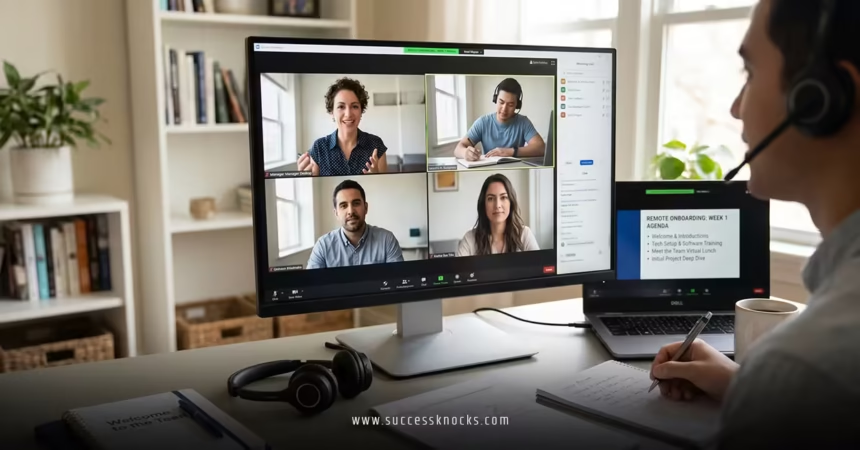
Remote Team Onboarding Best Practices set the foundation for high-performing distributed teams. Get this right and new hires ramp up faster, contribute sooner, and stick around longer.
Remote Team Onboarding Best Practices aren’t about overwhelming someone with logins and links. They’re about creating clarity, connection, and confidence when there’s no desk to sit at or hallway chats to join. In async-first environments especially, strong onboarding directly fuels how to build culture in a 100% remote asynchronous startup.
- Structured yet flexible processes respect time zones and personal workflows.
- Clear ownership and milestones reduce early frustration.
- Intentional culture integration turns new hires into believers within weeks.
- Documentation-first approach creates self-serve success.
Done well, you cut ramp time by weeks and boost early retention. Poor onboarding quietly kills momentum.
Why Remote Onboarding Demands a Different Playbook
Traditional first-day tours and lunch-and-learns don’t work when your team spans continents. New hires often feel lost without visible cues.
The real difference? You must over-communicate context that office life gives for free. What usually happens is companies throw tools and tasks at people and hope for the best. In my experience, that leads to quiet disengagement by week three.
Think of onboarding as the first chapter of your team’s operating system. It either reinforces strong async culture or quietly undermines it.
Step-by-Step Remote Team Onboarding Best Practices
Here’s the exact sequence I’d run if bringing someone new into an async startup tomorrow:
- Pre-Onboarding (Before Day 1)
Send a welcome pack with calendar invites, tool access, and a personalized video from their manager. Include the company handbook and a 30-60-90 day plan. - Day 1 Focus: Welcome and Orientation
Kick off with a short async welcome message in the main channel. Follow with recorded videos covering mission, values, and how decisions get made. Assign a buddy for quick questions. - Week 1: Setup and First Wins
Prioritize tool mastery and one small, visible deliverable. Schedule async 1:1s via Loom or written updates. Share the how to build culture in a 100% remote asynchronous startup playbook so they understand the “why” behind your norms. - Weeks 2-4: Deep Integration
Pair them with projects that touch multiple functions. Run structured feedback loops every Friday. Introduce them to rituals like wins threads and peer recognition. - Month 2+: Ownership and Growth
Transition to full ownership. Review the 30-60-90 plan together. Gather their input on improving the process.
This timeline scales from solo founders adding their first hire to teams of 50+.
| Phase | Key Activities | Owner | Success Metric | Typical Duration |
|---|---|---|---|---|
| Pre-Onboarding | Access + welcome pack | HR/Manager | All logins ready | 1-3 days before |
| Week 1 | Tools, intro meetings, first task | Buddy + Manager | Complete first deliverable | 5 business days |
| Weeks 2-4 | Projects + feedback | Manager + Team | Independent contributions | 3 weeks |
| Month 2+ | Ownership + review | Manager | Full ramp + input on process | Ongoing |
| Check-ins | Weekly async updates | New Hire | 90%+ response quality | Weekly |
Use this table as your ready-made checklist. Customize per role.

Essential Tools for Smooth Remote Onboarding
Stick to battle-tested options. Notion or Confluence for central knowledge bases. Loom for quick explainer videos. Slack or Twist for threaded discussions. Linear or Jira for task visibility. Automate where possible—welcome sequences in your HR tool save hours.
Common Onboarding Mistakes and Fixes
Mistake 1: Information overload on day one.
Fix: Spread it out. Prioritize must-know items and tag the rest as “week two.”
Mistake 2: No clear success criteria.
Fix: Build measurable 30-60-90 day goals tied to business impact.
Mistake 3: Forgetting async-specific training.
Fix: Dedicate time to communication norms, documentation standards, and async meeting etiquette. Link directly to your guide on how to build culture in a 100% remote asynchronous startup.
Mistake 4: Weak buddy systems.
Fix: Give buddies clear guidelines and light incentives for participation.
Mistake 5: No feedback loop on the process itself.
Fix: Survey new hires at 30 and 90 days. Act on patterns fast.
Catch these early and your retention numbers will thank you.
Measuring Onboarding Success
Track time-to-first-contribution, 90-day retention, and new-hire Net Promoter Score. Combine with qualitative signals like participation in team rituals. Leading companies review these metrics quarterly.
For deeper frameworks, check resources from GitLab’s all-remote handbook and Harvard Business Review on remote work.
Key Takeaways
- Remote Team Onboarding Best Practices start before day one and emphasize clarity over volume.
- Documentation and async tools are your biggest levers.
- Tie every step back to core culture—especially how to build culture in a 100% remote asynchronous startup.
- Assign buddies and create early wins to build belonging.
- Measure both speed and quality of ramp-up.
- Iterate based on new hire feedback.
- Strong onboarding turns hires into advocates within their first month. nail your remote onboarding and everything else gets easier—hiring, retention, and growth included.
Start this week: audit your current process against the table above and fix the biggest gap. Your next hire will feel the difference immediately.
FAQs
How long should remote team onboarding last?
Effective programs run 30-90 days with structured check-ins. The goal is full productivity and cultural fit by the end of month three.
What makes remote onboarding different from in-office?
You rely heavily on written context, recorded resources, and async communication instead of casual interactions. This makes intentional design even more important.
How does onboarding connect to building culture in remote teams?
It’s the first real experience new hires have with your values and norms. Great Remote Team Onboarding Best Practices reinforce how to build culture in a 100% remote asynchronous startup from day one.