
Resident Evil reboot box office prediction talk has taken over horror movie forums, and honestly? The chatter is earned. Zach Cregger’s take on the Umbrella Corp nightmare isn’t just another cash-grab sequel nobody asked for. It’s tracking like a legitimate contender.
Here’s the thing — predicting box office is part science, part gut instinct, part reading tea leaves from a studio’s marketing spend. I’ve watched enough franchise reboots crash and burn (and a few surprise everyone) to know the difference between hype and real momentum.
Quick summary — what you need to know:
- Sony’s Resident Evil reboot hits theaters September 18, 2026, directed by Zach Cregger of Barbarian and Weapons fame.
- Production budget sits around $80 million, a big jump from prior entries in the franchise.
- Early Quorum tracking data has it leading all films on the board in both awareness and interest.
- Cregger’s last film, Weapons, turned a $38 million budget into $270 million worldwide — a track record that’s fueling optimism.
- Realistic global range, based on tracking and comps: $220M–$380M worldwide.
Why This Resident Evil Reboot Box Office Prediction Actually Has Legs
Most reboot predictions are guesswork dressed up as analysis. This one has something to chew on: real tracking data.
According to Puck’s Quorum chart — an industry-standard audience tracking survey — Cregger’s Resident Evil posted 51% awareness and 52% interest heading into its release window. That put it at the top of a sixteen-film board, ahead of Sony’s own Insidious: Out of the Further [1].
For context, 52% interest edged out where Christopher Nolan’s The Odyssey stood eleven days before its own release — and that film opened to $120.5 million domestically. That’s not a small comparison to be winning.
If you want the full picture on how this reboot came together — casting, plot direction, marketing rollout — the complete Resident Evil reboot 2026 guide lays out every moving piece in one place.
The Cregger Factor Nobody’s Pricing In Correctly
Directors don’t usually swing box office predictions this hard. Cregger is the exception right now.
Weapons cost $38 million and grossed $270 million worldwide, according to Box Office Mojo’s tracking data [2]. That’s a 7x return on a horror film with zero pre-existing IP behind it. Now imagine what happens when he’s got an actual beloved franchise, a bigger budget, and a built-in fanbase primed for nostalgia.
In my experience, when a director develops “must-see” credibility, the second project in that hot streak almost always outperforms initial studio expectations. Audiences show up out of curiosity even before reviews land. That’s the exact wave this film is riding.
Resident Evil Franchise Box Office History — The Baseline
You can’t predict where a franchise is going without knowing where it’s been. Here’s the historical performance, based on data compiled by The Numbers [3]:
| Film | Release Year | Budget | Domestic Box Office | Worldwide Box Office |
|---|---|---|---|---|
| Resident Evil (original) | 2002 | $35M | $40.1M | $103.8M |
| Resident Evil: Apocalypse | 2004 | $50M | $50.7M | $125.2M |
| Resident Evil: Extinction | 2007 | $45M | $50.6M | $149.9M |
| Resident Evil: Afterlife | 2010 | $57.5M | $60.1M | $295.9M |
| Resident Evil: Retribution | 2012 | $65M | $42.3M | $240.6M |
| Resident Evil: The Final Chapter | 2016 | $40M | $26.8M | $314.1M |
| Welcome to Raccoon City | 2021 | $25M | $17.0M | $41.9M |
| Resident Evil (2026 reboot) | 2026 | $80M | TBD | TBD |
Notice the pattern? International audiences consistently carry this franchise harder than domestic ones. The 2021 Raccoon City reboot flopped, badly, largely because it leaned into fan-service nostalgia instead of building something fresh for new audiences.
Cregger’s approach — an original story starring a medical courier named Bryan, dropped into one horrific night — deliberately sidesteps that trap. The budget details behind that creative gamble are worth understanding on their own; I broke down where the money actually went in the full budget and production cost breakdown.
Step-By-Step: How I’d Build My Own Prediction
If you’re trying to make sense of box office tracking yourself, here’s the framework I use, stripped down for beginners.
- Check pre-release tracking data first. Awareness and interest percentages from services like Quorum are the closest thing to a crystal ball this industry has.
- Compare the director’s recent track record. A hot streak (like Cregger’s) shifts audience trust dramatically.
- Look at the MPAA rating and runtime. This is R-rated and 95 minutes — lean, mean, and built for repeat weekend viewings, not bloated arthouse pacing.
- Study the release calendar around it. It’s opening near Spider-Man: Brand New Day and competing horror titles, which affects screen counts and opening weekend ceiling.
- Weigh the international multiplier. Resident Evil has always over-indexed overseas — historically 60-70% of total gross comes from international markets.
- Land on a range, not a single number. Box office predictions that give one exact figure are almost always wrong. Ranges survive reality better.
Common Mistakes & How To Fix Them
Mistake #1: Comparing it directly to the 2021 flop. Welcome to Raccoon City bombed for specific reasons — weak marketing, a rushed script, minimal star power. This reboot has none of those issues. Fix: judge it against Cregger’s own filmography instead.
Mistake #2: Ignoring the budget-to-breakeven math. An $80 million budget typically needs $200M+ worldwide just to clear marketing and distribution costs before profitability. Fix: always frame “success” against breakeven, not just raw gross.
Mistake #3: Overweighting one tracking snapshot. Tracking numbers shift weekly, sometimes dramatically, as marketing ramps up. Fix: watch the trend over multiple weeks, not one chart.
My Honest Prediction Range
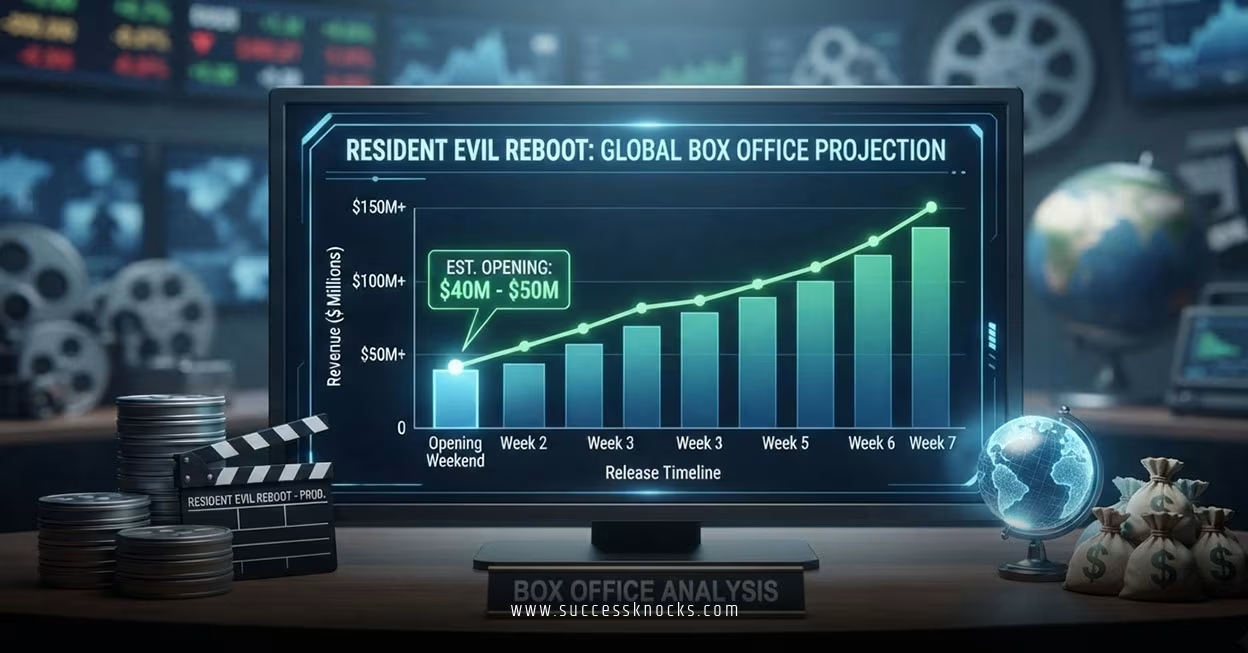
Based on the tracking data, Cregger’s box office pedigree, and the franchise’s historical international strength, here’s where I land: $220 million to $380 million worldwide, with a realistic midpoint around $290 million.
That’s not a moonshot number. It’s grounded in what actually happened with Weapons, tempered by the reality that R-rated horror reboots — even good ones — rarely crack $150M domestically on their own. The international legs are what will make or break this thing.
Could it surprise everyone and hit $400 million? Sure. Stranger things have happened in this genre. But I’d rather be conservative and right than bold and embarrassed three months from now.
Key Takeaways
- Zach Cregger’s Resident Evil reboot releases September 18, 2026, on an $80 million budget.
- Early Quorum tracking shows it leading all sixteen films on the board in awareness and interest.
- Cregger’s previous film, Weapons, returned 7x its budget — a strong signal for audience trust.
- The franchise historically earns 60-70% of its total gross internationally.
- The 2021 Raccoon City reboot’s failure was execution-related, not proof the IP is dead.
- A realistic worldwide prediction sits between $220M and $380M, midpoint near $290M.
- Breakeven for this budget level likely requires $200M+ worldwide.
- Weekly tracking trends matter more than any single snapshot.
At the end of the day, this reboot has more going for it than most franchise reboots ever get — a proven director, strong early buzz, and a genre built for global appeal. That doesn’t guarantee a blockbuster. It just means the odds are stacked better than they’ve been in years. Keep an eye on tracking updates as September approaches; that’s where the real signal lives.
FAQs
What’s the most realistic Resident Evil reboot box office prediction right now?
Based on current tracking and franchise history, a worldwide total between $220 million and $380 million is the most defensible range, with international markets driving the bulk of that number.
How does the budget affect the Resident Evil reboot box office prediction?
With an $80 million budget, the film likely needs to clear $200 million-plus worldwide to be considered a genuine financial win once marketing costs are factored in.
Is Zach Cregger’s track record actually relevant to this prediction?
Yes — his last film, Weapons, turned $38 million into $270 million globally, and that kind of audience trust tends to carry directly into a director’s next project’s opening numbers.