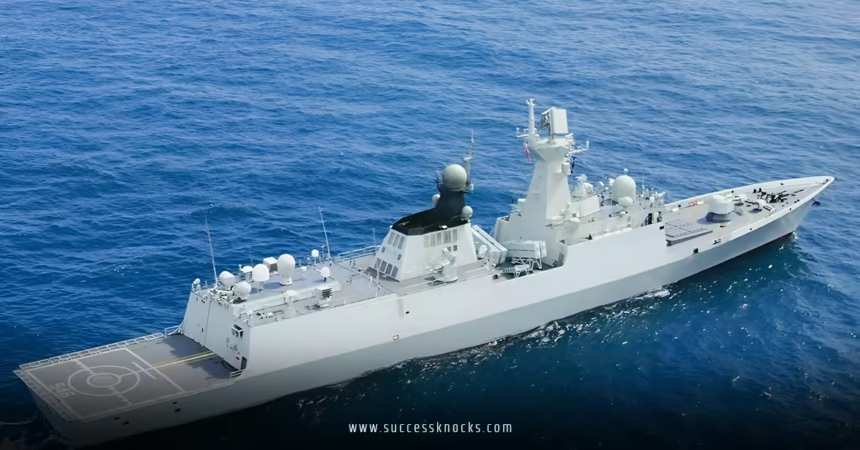
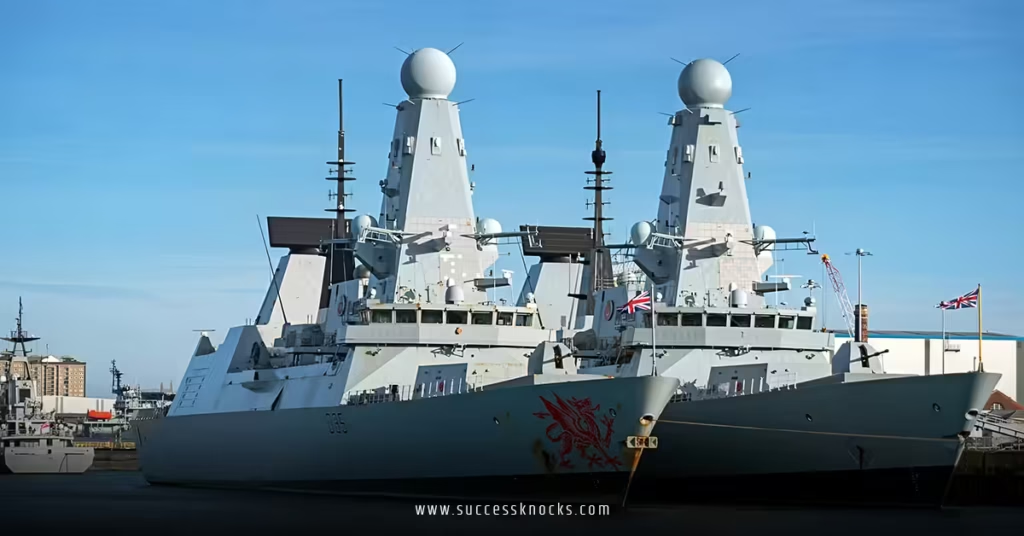
Royal Navy Type 45 destroyer capabilities represent the pinnacle of modern naval air defense technology, with these six sophisticated warships forming the backbone of Britain’s fleet protection strategy. These destroyers—including HMS Dragon, which recently deployed for Cyprus air base protection—combine cutting-edge radar systems, advanced missile technology, and integrated command capabilities to defend against 21st-century threats.
Quick Overview:
- Six Type 45 destroyers provide world-class air defense for Royal Navy operations
- SAMPSON radar system can track 1,000+ targets simultaneously within 400km
- Sea Viper missile system offers unmatched protection against aircraft, missiles, and drones
- Each destroyer costs approximately £1.05 billion and carries 190+ crew members
- Designed primarily for air defense but capable of multi-role operations
What Makes Type 45 Destroyers Unique
Here’s the thing about Royal Navy Type 45 destroyer capabilities: they weren’t built to be generalists. While other nations developed multi-purpose platforms, Britain focused laser-sharp on air defense excellence. The result? Ships that dominate airspace control like no other vessel afloat.
The Type 45’s design philosophy centers on one core principle: nothing gets through the air defense umbrella. This specialization shows in every system, from the distinctive SAMPSON radar arrays to the sophisticated Sea Viper missile systems.
Core Systems Breakdown
SAMPSON Radar: The Eyes of the Fleet
The SAMPSON Active Electronically Scanned Array (AESA) radar system defines Royal Navy Type 45 destroyer capabilities more than any other single component. This isn’t your grandfather’s rotating dish antenna—it’s a fixed-face system that electronically steers beams faster than mechanical systems could ever rotate.
SAMPSON Radar Specifications:
- Simultaneous tracking of 1,000+ targets
- Detection range exceeding 400 kilometers
- 360-degree coverage without mechanical rotation
- Integration with NATO Link systems
- Resistance to electronic warfare countermeasures
Think of SAMPSON as the ultimate air traffic control system—except it’s designed to manage hostile traffic with extreme prejudice. The system can distinguish between genuine threats and false alarms with remarkable accuracy, reducing the fog of war that plagues lesser systems.
Sea Viper Missile System: The Teeth Behind the Bite
Royal Navy Type 45 destroyer capabilities truly shine through the Sea Viper (PAAMS) missile system. This French-Italian collaboration provides two distinct missile types: Aster 15 for close-in defense and Aster 30 for long-range engagement.
| Missile Type | Range | Primary Role | Guidance | Warhead |
|---|---|---|---|---|
| Aster 15 | 1.7-30 km | Point defense | Active radar homing | 20 kg HE fragmentation |
| Aster 30 | 3-120 km | Area defense | Active radar homing | 20 kg HE fragmentation |
| Sylver A50 VLS | 48 cells | Launch system | Vertical launch | Cold gas ejection |
The kicker? These missiles use “hit-to-kill” technology combined with proximity fuses. They don’t just explode near targets—they actively maneuver to achieve direct impact when possible.
The Complete Type 45 Fleet
Royal Navy Type 45 Destroyer Fleet:
- HMS Daring (D32) – Lead ship, commissioned 2009
- HMS Dauntless (D33) – Mediterranean specialist
- HMS Diamond (D34) – Gulf deployment veteran
- HMS Dragon (D35) – Currently protecting Cyprus operations
- HMS Defender (D36) – Black Sea incident veteran
- HMS Duncan (D37) – Fleet flagship capable
Each destroyer brings identical core capabilities but develops operational specializations through deployment experience. HMS Dragon‘s current mission protecting Cyprus air base operations demonstrates how these ships adapt to specific regional requirements.
Beyond Air Defense: Multi-Role Capabilities
Royal Navy Type 45 destroyer capabilities extend well beyond pure air defense, though that remains their primary mission. These ships serve as command platforms, intelligence gatherers, and diplomatic tools.
Secondary Capabilities:
- Command and control for task group operations
- Intelligence, surveillance, and reconnaissance
- Naval gunfire support with 4.5-inch Mark 8 gun
- Anti-submarine warfare (limited, pending upgrade)
- Electronic warfare and communications intelligence
The 4.5-inch gun might seem archaic compared to missiles, but it provides cost-effective solutions for many scenarios. Why fire a million-dollar missile at a small boat when a few shells accomplish the same result?
Technology Integration Challenges
Modern Royal Navy Type 45 destroyer capabilities depend heavily on system integration—and that’s where things get complicated. The UK Ministry of Defence learned hard lessons about connecting different contractors’ systems.
Integration Priorities:
- Radar-missile coordination protocols
- NATO interoperability standards
- Electronic warfare resistance
- Data link management
- Combat system reliability
Early Type 45 operations revealed integration issues that required extensive software updates. The ships work brilliantly now, but getting there required years of refinement and testing.
Power and Propulsion: The Achilles Heel
No discussion of Royal Navy Type 45 destroyer capabilities would be complete without addressing the elephant in the room: power generation problems. The Rolls-Royce WR-21 gas turbines have struggled in warm climates, causing embarrassing breakdowns.
Propulsion System:
- Two Rolls-Royce WR-21 gas turbines (21.5 MW each)
- Two Wartsila diesel generators (2 MW each)
- Integrated electric propulsion system
- Maximum speed: 29+ knots
- Known reliability issues in tropical conditions
The Royal Navy is implementing the Power Improvement Project (PIP) to address these issues. New diesel generators and improved cooling systems should resolve the problems that have plagued these otherwise excellent ships.
Crew Training and Operations
Operating Royal Navy Type 45 destroyer capabilities requires extensive specialized training. The Royal Navy runs dedicated courses for air defense operators, radar technicians, and missile system specialists.
Training Pipeline:
- Basic naval training (30 weeks)
- Specialist trade training (12-26 weeks)
- Ship-specific systems training (8-12 weeks)
- Operational workup period (6 months)
- Continuous professional development
The complexity of these systems means crew training never really ends. Software updates, tactical developments, and new threats require constant learning.
Combat Proven Performance
Royal Navy Type 45 destroyer capabilities have faced real-world testing in various scenarios. From HMS Defender’s Black Sea encounter with Russian forces to multiple Middle Eastern deployments, these ships have proven their worth under pressure.
Notable Operational Successes:
- Counter-piracy operations off Somalia
- Air defense umbrella for carrier strike groups
- Diplomatic presence missions
- Humanitarian operation support
- Intelligence gathering in contested areas
The ships excel at their primary mission: nothing has successfully penetrated a Type 45’s air defense umbrella during operational deployments.
Common Misconceptions About Type 45 Capabilities
Misconception 1: They’re general-purpose destroyers Reality: Type 45s are air defense specialists with limited anti-submarine capabilities.
Misconception 2: They can’t operate independently Reality: While optimized for fleet defense, they regularly conduct solo missions.
Misconception 3: The missile system is purely defensive Reality: Aster missiles can engage surface targets when required.
Misconception 4: They’re too expensive to deploy Reality: Cost per capability hour remains competitive with other advanced platforms.
Misconception 5: Power problems make them unreliable Reality: Issues are being resolved and don’t affect combat systems.
Future Upgrade Programs
Royal Navy Type 45 destroyer capabilities will continue evolving through planned upgrade programs. The service recognizes these ships must remain relevant for another 20+ years.
Planned Enhancements:
- Sea Ceptor missile integration for additional point defense
- Anti-submarine warfare capability restoration
- Hypersonic missile defense upgrades
- Cyber warfare protection enhancements
- Artificial intelligence integration for threat assessment
The Royal Navy is also exploring directed energy weapons and electronic warfare upgrades to maintain technological superiority.
Step-by-Step: How Type 45 Air Defense Works
Phase 1: Detection
- SAMPSON radar continuously scans assigned sectors
- Automatic threat classification based on speed, altitude, and signature
- Integration with external sensors and intelligence feeds
Phase 2: Tracking
- Multiple target tracking with priority assignment
- Trajectory prediction and threat assessment
- Engagement opportunity calculation
Phase 3: Engagement Decision
- Rules of engagement consultation
- Missile selection based on range and target type
- Launch authorization protocol
Phase 4: Missile Engagement
- Vertical launch from Sylver cells
- Mid-course guidance from ship’s systems
- Terminal homing with active seeker
Phase 5: Battle Damage Assessment
- Target destruction confirmation
- Threat reassessment
- System readiness verification
This process happens in seconds, with human operators monitoring rather than controlling every step.
International Comparison
Royal Navy Type 45 destroyer capabilities compare favorably with international equivalents, though each design reflects different operational priorities.
| Class | Nation | Primary Strength | Weakness |
|---|---|---|---|
| Type 45 | UK | Air defense excellence | Limited ASW |
| Arleigh Burke | USA | Multi-mission versatility | Aging radar tech |
| Horizon | France/Italy | Balanced capabilities | Smaller magazine |
| Kolkata | India | Cost-effectiveness | Limited range |
The Type 45’s focused design philosophy delivers superior air defense at the cost of other capabilities—a trade-off the Royal Navy considers worthwhile.
Cost and Value Analysis
Royal Navy Type 45 destroyer capabilities come at a premium price, but cost-per-capability analysis shows reasonable value. Each ship’s £1.05 billion price tag includes development costs amortized across six hulls.
Cost Breakdown Estimates:
- Research and development: ~£3.5 billion total program
- Individual hull construction: ~£500-600 million
- Combat systems integration: ~£300-400 million
- Lifetime support costs: ~£2 billion per ship
Expensive? Absolutely. But compare these costs to losing high-value assets like aircraft carriers or amphibious ships to air attack. The Type 45s pay for themselves by enabling operations that would otherwise be impossible.
Key Takeaways
- Royal Navy Type 45 destroyer capabilities focus primarily on air defense excellence
- SAMPSON radar and Sea Viper missiles create unmatched air defense umbrella
- Six ships provide fleet-wide protection for Royal Navy operations
- Power generation issues are being addressed through comprehensive upgrade programs
- These destroyers enable carrier strike group operations in contested environments
- Crew training requirements are extensive due to system complexity
- Future upgrades will address emerging threats including hypersonic weapons
- Cost-per-capability compares favorably with international alternatives
Operational Lessons Learned
Decade-plus operation of Royal Navy Type 45 destroyer capabilities has revealed important insights. These ships excel in their designed role but require careful operational planning to maximize effectiveness.
The integration challenges experienced early in the program demonstrate the complexity of modern naval systems. Software-hardware coordination isn’t just a nice-to-have—it’s mission-critical for these complex platforms.
The Human Element
No discussion of Royal Navy Type 45 destroyer capabilities would be complete without acknowledging the human factor. These ships require highly trained, motivated crews who understand both the potential and limitations of their systems.
Crew retention remains challenging due to the technical demands and deployment schedules. The Royal Navy continues developing incentives to keep experienced personnel aboard these sophisticated platforms.
Conclusion
Royal Navy Type 45 destroyer capabilities represent a successful, focused approach to modern naval warfare. While these ships faced early challenges with integration and power generation, they’ve matured into formidable air defense platforms that enable Royal Navy operations worldwide.
HMS Dragon’s current deployment for Cyprus air base protection showcases how these destroyers translate technical capability into operational reality. The ship’s advanced systems provide layered defense that protects not just individual assets but entire operational areas.
For naval professionals and defense enthusiasts, the Type 45 program offers important lessons about specialization versus generalization in military procurement. Sometimes doing one thing extraordinarily well beats trying to do everything adequately.
The future looks bright for these destroyers as upgrade programs address current limitations and add new capabilities. Royal Navy Type 45 destroyer capabilities will remain relevant for decades to come.
Want to see these capabilities in action? Follow Royal Navy announcements about Type 45 operations and deployments.
Excellence at sea demands nothing less than excellence in every system.
Frequently Asked Questions
Q: How do Royal Navy Type 45 destroyer capabilities compare to American Arleigh Burke destroyers?
A: Type 45s excel in air defense with superior radar and missile systems, while Arleigh Burkes offer better multi-mission versatility including robust anti-submarine warfare capabilities.
Q: Why were only six Type 45 destroyers built instead of the originally planned twelve?
A: Budget constraints and changing strategic priorities led to the reduced order, though the Royal Navy maintains that six ships meet current operational requirements.
Q: Can Type 45 destroyers protect against hypersonic weapons with their current systems?
A: Current systems provide some capability against hypersonic threats, but planned upgrades will significantly enhance protection against these emerging weapons.
Q: What makes the SAMPSON radar system superior to other naval radars?
A: SAMPSON’s active electronically scanned array technology, combined with sophisticated signal processing, provides unmatched target tracking density and resistance to countermeasures.
Q: How long will Royal Navy Type 45 destroyer capabilities remain relevant?
A: With planned upgrades and modifications, these ships should remain operationally relevant through the 2040s, providing 35+ years of service life.