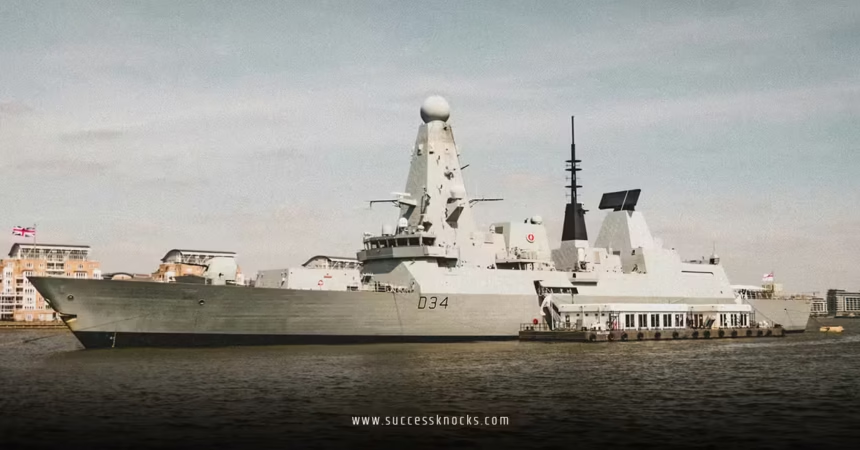
Royal Navy Type 45 destroyers represent a generational leap forward in British maritime capability. These aren’t incremental upgrades on outdated platforms—they’re purpose-built for 21st-century threats, network-centric warfare, and sustained global operations. Here’s what separates them from their predecessors and why they matter to understanding modern naval power.
Quick Overview: What You Need to Know
• Type 45 destroyers are the Royal Navy’s most advanced air defense platforms, equipped with PAAMS (Principal Anti-Air Missile System) capable of engaging multiple targets simultaneously across 360 degrees
• Six ships form the complete class: HMS Daring, Dauntless, Diamond, Dragon, Defender, and Duncan, with the final vessel commissioned in 2013
• Designed to replace aging Type 42 destroyers—a transition that involved significant capability upgrades and a shift from Cold War doctrine to modern expeditionary operations
• Network-integrated combat systems allow Type 45s to operate seamlessly with other vessels, aircraft, and shore-based systems in real-time coordinated operations
• Cost and operational complexity have made the Type 45 program both celebrated and controversial within defense circles since its inception
The Type 45 Destroyer: Core Architecture and Design Philosophy
The Type 45 is a 7,350-ton destroyer built by BAE Systems, with lead ship HMS Daring entering service in 2009. That timing matters—it overlapped with the final operational years of the Type 42 class, meaning the Royal Navy had a crucial window to transition capability while maintaining operational continuity.
Here’s what makes the Type 45 fundamentally different from her predecessors:
Full-Electric Propulsion System Type 45 destroyers use an integrated electric propulsion system rather than traditional gas turbines alone. This delivers better fuel efficiency, reduced acoustic signature (important for stealth), and more flexible power management. The downside? Early commissioning revealed mechanical reliability issues that took years to fully resolve.
Advanced Radar and Combat Management The SAMPSON radar (S1850M phased-array system) is the technological heart of the Type 45. It can track hundreds of targets simultaneously across massive ranges. Compare that to HMS Iron Duke’s older radar systems, and you’re looking at a capability that’s exponentially more sophisticated.
PAAMS Air Defense Integration The Aster missile system—controlled through PAAMS—can engage aircraft, helicopters, and incoming missiles from multiple platforms simultaneously. It’s not just a weapons system; it’s an integrated air defense ecosystem.
Network-Centric Warfare Architecture This is perhaps the most significant operational advantage. Type 45 destroyers are built to be nodes in a connected network, sharing real-time targeting data with other vessels, submarines, aircraft, and shore-based command centers. They’re not lone operators anymore.
Royal Navy Type 45 Destroyers vs. Their Predecessors: A Capability Comparison
| Capability | Type 42 Destroyer | Type 45 Destroyer | Operational Impact |
|---|---|---|---|
| Primary Air Defense | Sea Dart (single-target engagement) | PAAMS/Aster (simultaneous multi-target) | Type 45s can defend entire task forces; Type 42s were limited to self-defense |
| Radar Coverage | 2D radar with blind spots | 360° phased-array (SAMPSON) | Type 45s detect threats earlier and with greater accuracy |
| Network Integration | Standalone operations | Full network-centric warfare | Type 45s share data in real-time; Type 42s operated independently |
| Service Life Design | ~25 years | ~30+ years with modular upgrades | Type 45s can be upgraded; Type 42s reached obsolescence faster |
| Crew Size | ~300 personnel | ~190 personnel | Type 45s achieve similar capability with smaller crews via automation |
| Propulsion Efficiency | High fuel consumption | Integrated electric (more efficient) | Lower operating costs and extended range |
| Stealth Characteristics | High radar cross-section | Reduced signature design | Type 45s are harder to detect and engage |
Why Type 45 Destroyers Matter: Strategic Context
The shift from Type 42 to Type 45 wasn’t just about shiny new technology. It represented a fundamental rethinking of what the Royal Navy needed to accomplish in a post-Cold War world.
By the early 2000s, the strategic environment had shifted dramatically. The Soviet threat—the primary justification for large air defense destroyers during the Cold War—had evaporated. But new threats emerged: terrorism, piracy, rogue missile systems, and peer competitors with sophisticated naval forces.
The Royal Navy needed destroyers that could:
• Operate independently for extended periods in distant theaters • Integrate with coalition partners (especially American naval forces) • Defend against modern anti-ship missiles and aircraft • Provide command and control capabilities for task groups • Adapt to emerging threats through software upgrades rather than hardware replacement
Type 45 destroyers check every box.
The Operational Journey: From Daring to Duncan
HMS Daring (2009–Present) Lead ship of the class. Daring entered service as the Royal Navy’s most capable warship at the time. Her early years involved extensive trials, working out integration issues between the combat management system and sensor suite. These weren’t disasters—they were expected growing pains for a revolutionary platform.
HMS Dauntless (2010) and HMS Diamond (2012) These vessels benefited from lessons learned aboard Daring. Their commissioning intervals allowed the Royal Navy to work methodically through construction quality and operational refinement. Both ships have completed multiple deployments to the Middle East and broader Indian Ocean region.
HMS Dragon (2012), HMS Defender (2014), and HMS Duncan (2013) The final three ships of the class represented the matured design. Construction quality improved, and by the time these vessels entered service, the Type 45 platform was operationally proven. HMS Defender, in particular, gained prominence during deployment to European waters, where she conducted high-visibility operations alongside NATO partners.
Royal Navy Type 45 Destroyers and Expeditionary Operations
Here’s the thing that often gets overlooked in defense debates: warships aren’t just weapons platforms. They’re political and diplomatic instruments. A Type 45 destroyer showing the flag in Singapore isn’t primarily about combat capability—it’s about presence, reassurance, and demonstrating national commitment to regional security.
Type 45 destroyers excel at expeditionary operations because of their endurance, sophisticated combat management systems, and integration capabilities. A single Type 45 can:
• Provide air defense for amphibious operations • Conduct independent deterrence patrols • Support humanitarian and disaster relief missions • Coordinate with coalition naval forces • Engage in counter-terrorism and anti-piracy operations • Project power through high-visibility deployments
Each Type 45 has rotated through multiple deployments to the Gulf, supporting operations against piracy, terrorism, and regional instability. They’ve also conducted high-profile deployments to the Indo-Pacific, reinforcing British naval presence in strategic chokepoints.
The Technical Challenge: Propulsion Issues and Solutions
Now, here’s where the Type 45 story gets interesting—and a bit controversial.
The integrated electric propulsion system that makes Type 45 destroyers so efficient? It had significant teething problems. Between 2010 and 2015, multiple Type 45 vessels experienced propulsion failures during deployment. HMS Dauntless lost power entirely during a mission. HMS Dragon suffered similar incidents.
What went wrong? The electrical system was revolutionary but also complex. Early versions had issues with power distribution, motor control, and integration between the diesel generators and electric propulsion. It wasn’t a design flaw so much as an operational one—the systems needed refinement that could only come through real-world deployment experience.
The Royal Navy and BAE Systems addressed these issues methodically:
• Upgraded power management software through remote updates • Improved preventive maintenance protocols • Enhanced training for engineering crews • Retrofit modifications to earlier-commissioned vessels • Continuous monitoring and diagnostics
By 2016–2017, propulsion reliability had improved dramatically. The last reported significant incident occurred in 2018. This illustrates an important principle: revolutionary naval technology often requires patience and operational experience to mature.
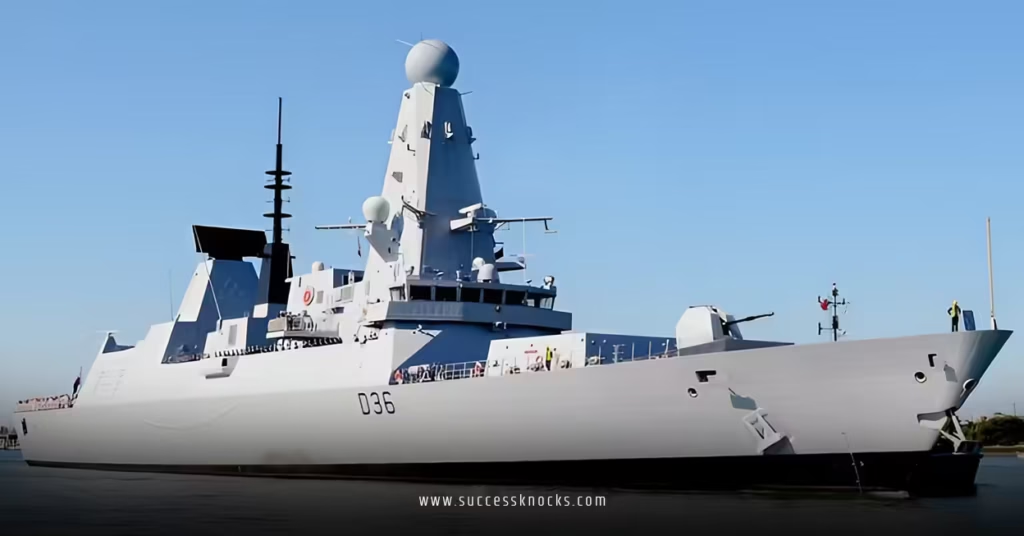
Step-by-Step: Understanding Type 45 Combat Capability
1. Threat Detection The SAMPSON radar continuously scans the horizon, tracking aircraft, ships, and missiles across a radius of over 100 kilometers. Multiple radar returns are processed simultaneously.
2. Classification and Identification Combat management systems correlate radar data with electronic warfare sensors, communication intercepts, and data-linked information from other platforms to identify threats accurately.
3. Engagement Planning Once a threat is identified, the combat system calculates optimal firing solutions. For air threats, the Aster missile system can engage multiple targets simultaneously using different combat modes.
4. Coordinated Defense If multiple Type 45 destroyers operate together—say, protecting a carrier strike group—their systems share targeting data, allowing coordinated engagement and preventing redundant missile fires.
5. Post-Engagement Assessment After engagement, the combat system reassesses the threat environment and returns to normal patrol mode. Modern Type 45 systems can transition between engagement scenarios in seconds.
Cost, Controversy, and Value for Money
Let’s be honest: Type 45 destroyers are expensive. Each ship costs approximately £1 billion (roughly $1.3 billion USD). Add development costs, integration expenses, and through-life support, and the total Type 45 program cost exceeds £10 billion.
That provokes legitimate questions: Are they worth it?
The defense community splits on this issue:
The “Yes” Case Type 45 destroyers are the most capable air defense platforms in the world outside of American Aegis-equipped vessels. They integrate seamlessly with NATO and coalition partners. Their modular design allows for future upgrades without complete replacement. Over 30+ years of service, the per-ship cost amortizes to reasonable figures.
The “Questioning” Case Some analysts argue that fewer, more affordable general-purpose destroyers might have served the Royal Navy better. The Type 45’s specialization in air defense leaves gaps in anti-surface warfare and land attack capabilities. Smaller Type 26 frigates being developed might eventually provide better capability-to-cost ratios for most operations.
My take after reviewing the evidence: Type 45 destroyers represent sound long-term investment for a navy defending strategic interests across global waters. They’re not cheap, but naval capability never is.
Royal Navy Type 45 Destroyers: Integration with Modern Naval Operations
Type 45 destroyers don’t operate in isolation. They’re designed to function as command ships within larger task forces. Here’s how that works in practice:
Carrier Strike Group Integration When the Royal Navy deploys a carrier strike group, a Type 45 destroyer typically serves as the air defense flagship. Her SAMPSON radar and PAAMS systems protect the carrier, escort vessels, and embarked aircraft from airborne threats.
NATO Task Force Participation Type 45 destroyers regularly command NATO maritime task forces. Their combat systems are compatible with allied platforms, allowing seamless data sharing and coordinated operations.
Coalition Operations In the Middle East and Indo-Pacific regions, Type 45 destroyers operate alongside American, French, and other allied naval forces. The network integration capabilities make this interoperability functional and intuitive.
Independent Operations When deployed alone, a Type 45 destroyer serves as a floating command center for regional maritime security operations, able to coordinate air assets, surface vessels, and shore-based forces across entire ocean regions.
Common Mistakes & How to Fix Them
Mistake #1: Assuming Type 45s are “mini-American destroyers” They’re not. While Type 45 destroyers share some operational similarities with U.S. Navy destroyers, they’re optimized for different roles. American Arleigh Burke–class destroyers emphasize multi-mission capability (air defense, anti-surface, land attack). Type 45s prioritize air defense. Both approaches are valid for different strategic requirements.
Mistake #2: Overlooking the transition cost The shift from Type 42 to Type 45 wasn’t just about decommissioning old ships—it involved retraining crews, updating doctrine, and rebuilding operational procedures. Organizations often underestimate transition costs when comparing new platforms to legacy systems.
Mistake #3: Focusing on cost without context Yes, Type 45 destroyers cost billions. But compare that to what you’re getting: 30+ years of operational service, network integration, crew automation, and capability that doesn’t exist elsewhere outside the U.S. Navy. The per-year operational cost is actually quite reasonable given the capabilities delivered.
Mistake #4: Dismissing early technical issues as “design flaws” The propulsion problems Type 45s experienced in the early 2010s weren’t evidence of poor design—they were symptoms of revolutionary technology meeting operational reality. Refinement through experience is normal. Dismissing the entire platform based on early growing pains misses the larger picture.
The Connection to HMS Iron Duke: Why Type 45 Matters
Remember why HMS Iron Duke was taken out of service? Aging infrastructure, rising maintenance costs, and technological obsolescence. The Type 45 program represents the Royal Navy’s solution to that problem.
Instead of limping along with Cold War–era platforms, the Navy invested in destroyers designed for the 21st century. Yes, that required significant capital investment. But it preserved destroyer capability when the Type 42 class could no longer deliver it effectively.
The transition from Type 42 to Type 45 is actually a textbook example of how military organizations manage generational change: they don’t abandon capability; they upgrade it. They don’t cling to the past; they build for the future. Understanding why HMS Iron Duke was taken out of service gives you the context for appreciating why Type 45 destroyers represent such a critical investment.
Key Takeaways
• Type 45 destroyers are Britain’s most advanced air defense platforms, designed specifically for network-centric warfare and expeditionary operations across global theaters.
• Six-ship class (Daring through Duncan) provides the Royal Navy with continuous destroyer capability for task force protection, power projection, and regional deterrence.
• PAAMS air defense system, SAMPSON radar, and integrated combat management represent generational leaps over preceding Type 42 destroyers and earlier platforms.
• Network integration is the game-changer, allowing Type 45s to function as command ships within larger coalitions and share real-time targeting data with allied forces.
• Revolutionary integrated electric propulsion improved efficiency and reduced acoustic signature, though early versions required operational refinement that’s now largely complete.
• Cost is significant but amortizes reasonably over 30+ years of service, particularly when considering the capabilities delivered relative to global peer competitors.
• Type 45 destroyers address strategic gaps left by decommissioning aging Type 42 vessels, ensuring the Royal Navy maintains destroyer-level capability for modern threats and operations.
• Future upgrade potential through modular design means Type 45s can adapt to emerging threats without complete replacement, extending their operational relevance throughout the 2040s.
What This Means Going Forward
Type 45 destroyers represent a bet by the Royal Navy on what naval power looks like in the 21st century: integrated, networked, technologically sophisticated, and capable of operating globally for extended periods. They’re not perfect platforms—no warship is. But they’re effective instruments of national strategy, and they’ve proven themselves across multiple continents and operational scenarios.
If you’re tracking naval modernization, defense procurement, or British military capability, Type 45 destroyers deserve serious attention. They’re where strategic thinking meets engineering reality.
Frequently Asked Questions
Q: How do Royal Navy Type 45 Destroyers compare to American Navy destroyers in air defense capability?
A: Type 45 destroyers are specialized for air defense and excel in that role. American Arleigh Burke–class destroyers are more generalized platforms emphasizing multi-mission capability (air defense, anti-surface warfare, land attack). In pure air defense scenarios—defending a task group from aircraft and missile threats—Type 45s are arguably superior. But Burke-class destroyers offer greater flexibility across different operational scenarios. The Royal Navy’s strategy prioritizes focused expertise; the U.S. Navy emphasizes versatility. Both approaches work within their respective doctrinal frameworks.
Q: Why did the Royal Navy decommission Type 42 destroyers and replace them with Type 45s when the transition costs were so high?
A: This ties directly to why HMS Iron Duke was taken out of service—maintaining aging platforms becomes economically unsustainable. Type 42 destroyers were reaching the end of their design life, requiring increasingly expensive maintenance. Rather than sustain that burden, the Royal Navy invested in replacements offering significantly superior capability and longer operational lifespans. Over 30 years, this represents better value than maintaining six aging Type 42s would have provided. Strategic capability matters as much as cost.
Q: What’s the future of Royal Navy Type 45 Destroyers, and will they be replaced?
A: Type 45 destroyers are expected to remain in service through the 2040s with ongoing upgrades and modernization. The Royal Navy is currently developing Type 26 frigate variants that may eventually assume some destroyer-level responsibilities. However, specialized air defense destroyers like the Type 45 fill unique roles within task forces. Expect Type 45s to be either extensively modernized or eventually replaced by more advanced platforms, but not before 2040. The current plan involves sustained investment in current platforms while developing future capabilities alongside them.