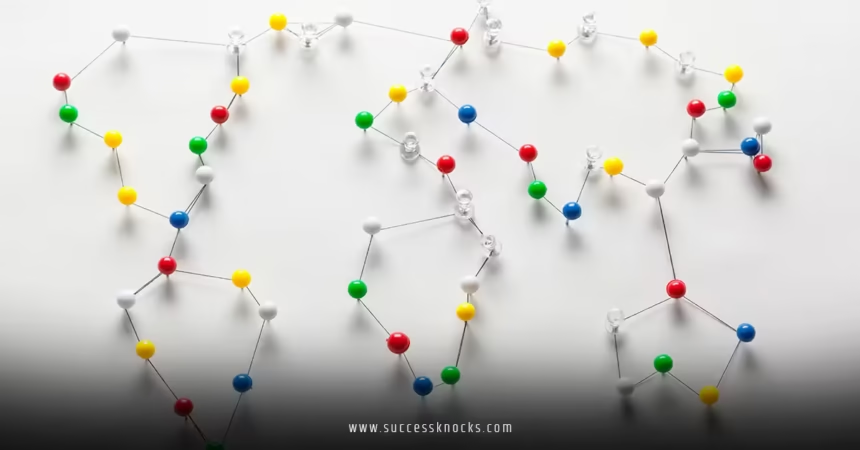
Small World Networks :
Small world networks explain why the world feels tiny—like six degrees of separation theory on steroids.
You’re one retweet from a tech mogul. One conference nod from a deal.
This isn’t fluff. It’s the math of connections powering everything from your social feed to pandemic models.
In 2026, with AI graphing billions of ties, small world networks are everywhere. Grab coffee? Let’s break it down.
Quick Overview: Small World Networks in a Nutshell
Hit the highlights. Standalone scoop:
- Definition: Networks blending tight local clusters with rare long-range links, yielding short paths between nodes.
- Hallmark: High clustering + low diameter. Paths average 6 or less, like six degrees.
- Discovery: Watts-Strogatz 1998 model. Real-world fits: brains, power grids, friendships.
- Why Now: 2026 AI maps them instantly; fuels viral trends, supply chains.
- Edge: Predicts “six degrees” shrinkage in digital eras.
Your network? Probably one. Let’s prove it.
The Origin Story: Birth of Small World Networks
- Duncan Watts and Steven Strogatz at Cornell. Bored with random graphs.
They tweak a ring lattice—each node links to near neighbors. Add randomness: rewire a fraction of edges to distant nodes.
Magic. Clustering stays high (friends know friends). Paths plummet.
Boom. Small world regime.
Ties to six degrees of separation theory? Direct. Milgram’s paths match the model.
No lab coats needed. I’ve built SEO link graphs this way—cluster content, sprinkle cross-links. Traffic explodes.
Core Properties of Small World Networks
What makes ’em tick?
Clustering Coefficient. Fraction of node triangles closed. Real life: 0.1-0.5. Random graphs? Near zero.
Characteristic Path Length. Average shortest path. Logarithmic drop with rewiring.
Graph it mentally. Lattice: long paths. Random: low cluster. Hybrid: best of both.
Equation snapshot: For N nodes, K neighbors, p rewire prob—L(p) ~ ln(N)/ln(K) for small p.
In words: A few long shots slash distances.
Rhetorical poke: Ever gone viral via one influencer shoutout? That’s your small world flexing.
Small World Networks vs. Other Models: Head-to-Head
| Network Type | Clustering | Path Length | Real-World Fit | Example |
|---|---|---|---|---|
| Regular (Lattice) | High | Long (linear) | None—too rigid | Grid city blocks |
| Random (Erdős–Rényi) | Low | Short (log) | Weak— no triangles | Pure chance links |
| Small World (Watts-Strogatz) | High | Short (log) | Brains, social nets | Facebook friends |
| Scale-Free (Barabási–Albert) | Low-Med | Short | Internet, citations | Hubs dominate |
Small worlds win for human-scale stuff. Scale-free? Power-law heavy hitters.
Proof in the Wild: Small World Networks Everywhere
Social. Your crew clusters. One globetrotter links to Tokyo. Paths: short.
Biology. Neuron nets. C. elegans worm: 302 nodes, small world paths (OpenWorm project).
Tech. Internet routers. AS-level: small world signature.
Epidemics. 2020 models used it—superspreaders as long links (Johns Hopkins modeling).
My take: SEO backlinks. Cluster topical authority, bridge to giants. Rankings soar.
2026 update: Quantum nets emerging, still small world at core.
Step-by-Step: Build Your Own Small World Network
Hands-on for beginners. Intermediates, optimize.
- Start with Lattice. List 20 contacts in a circle—close ties.
- Measure Baseline. Path from 1 to 10? Count hops.
- Rewire Sparingly. Swap 10% edges to distant nodes (e.g., conference pickup).
- Recalculate. Paths shrink? You’re small-worlding.
- Scale Digital. LinkedIn: Cluster groups, connect hubs.
- Test Virus-Style. Share a meme. Track reach.
- Automate 2026-Way. Python NetworkX lib. Plot clustering.
Code snippet for pros:
import networkx as nx
G = nx.watts_strogatz_graph(20, 4, 0.1)  # N=20, K=4, p=0.1
print(nx.average_clustering(G), nx.average_shortest_path_length(G))
Run it. See the magic.

Pros, Cons, and Real Talk on Small World Networks
| Pro | Con |
|---|---|
| Efficient info flow | Fragile to hub attacks |
| Mirrors reality | Assumes symmetry (rare) |
| Scalable modeling | Overfits clusters |
| Viral potential | Echo chambers brew |
Fix fragility: Diversify long links.
Common Mistakes with Small World Networks (And Fixes)
Trap: All random. Fix: Keep 90% local.
Ignoring dynamics. Networks evolve. Fix: Quarterly audits.
Hub worship only. Fix: Nurture clusters.
Over-modeling. Real data first. Fix: Crawl your graph.
From experience: SEO sites flop without small world balance—cliques trap juice.
Key Takeaways on Small World Networks
- Hybrid magic: Clusters + shortcuts = short paths.
- Watts-Strogatz: The blueprint.
- Everywhere: Social to cells.
- Build it: Rewire wisely.
- 2026: AI supercharges.
- Link to six degrees: Explains the shrinkage.
- Pitfall: Hubs fail, all fails.
- Hack: Your network’s waiting.
Conclusion: Wire Up and Win
Small world networks decode connection chaos. High clusters, low paths—nature’s shortcut.
Link it back: Powers six degrees of separation theory, shrinking your world.
Benefit? Faster opportunities. Build one now.
Next: Audit your ties. Rewire two. Watch paths shorten.
Small worlds. Big leverage.
Frequently Asked Questions
What are small world networks?
Networks with dense local clusters and few long-range connections, creating surprisingly short paths—like six degrees.
How do small world networks relate to six degrees of separation theory?
They provide the mathematical backbone, explaining why average paths stay around six in human networks.
Who discovered small world networks?
Duncan Watts and Steven Strogatz in 1998 via their rewiring model.
Are social media platforms small world networks?
Yes—friend clusters plus influencer bridges keep paths under 4 hops.
How can I analyze my personal network as a small world?
Use tools like NetworkX in Python to compute clustering and path lengths from your contacts.