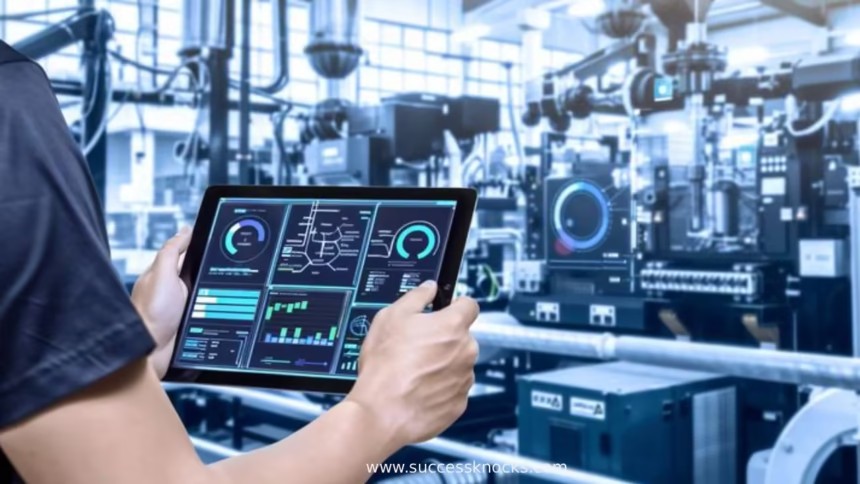
Best smart manufacturing platforms 2026 deliver the connective tissue that turns disconnected machines into a responsive production system. They pull real-time data from PLCs, sensors, and legacy equipment, then layer analytics, AI, and execution tools so plants can cut downtime, raise OEE, and respond faster to demand swings.
- Leading options combine IIoT connectivity, MES capabilities, and AI-driven insights for both discrete and process plants.
- Siemens, Rockwell, PTC/Velotic ThingWorx, AVEVA, and Ignition dominate enterprise and mid-market deployments in the U.S.
- Choice hinges on existing automation stack, speed-to-value needs, and whether you prioritize custom apps or out-of-the-box workflows.
- Proper selection and phased rollout typically yield measurable gains in visibility and uptime within months, not years.
- These platforms sit at the core of broader digital transformation—see the bigger picture in the full smart manufacturing adoption guide.
In my experience working with U.S. plants ranging from automotive suppliers to mid-size food processors, the platforms that win are the ones that respect the OT reality on the floor. Fancy dashboards mean nothing if the data never leaves the PLC cleanly. The kicker is integration friction—get that wrong and you burn budget without moving the needle.
What Makes a Platform Stand Out in 2026
Best smart manufacturing platforms 2026 Smart manufacturing platforms have matured past pure connectivity. Today they must handle edge processing, unified namespaces, digital twins, and increasingly agentic AI that can recommend or even trigger actions. NIST has long emphasized reference architectures and standards for interoperable smart manufacturing systems, and the platforms that align with those principles reduce lock-in risk.
Look for strong protocol support (OPC UA, MQTT, EtherNet/IP, Modbus), scalable edge-to-cloud architecture, and native analytics that speak the language of OEE, predictive maintenance, and quality. Hyperscaler options like AWS IoT SiteWise or Azure IoT Operations appeal when cloud is already the backbone. Traditional industrial players still dominate when plants run heavy Siemens or Rockwell hardware.
Top Contenders Among Best Smart Manufacturing Platforms 2026
Here’s a practical comparison of platforms that consistently surface in 2026 evaluations for U.S. manufacturers. Rankings reflect deployment speed, ecosystem fit, and real-world usability rather than pure feature count.
| Platform | Best For | Strengths | Typical Deployment | Key Limitation |
|---|---|---|---|---|
| Siemens Insights Hub / Xcelerator + Opcenter | Siemens-heavy or complex discrete/process plants | Deep digital twin, native PLC integration, full MOM suite | 6–18 months | Steep learning curve and cost outside Siemens ecosystem |
| Rockwell FactoryTalk / Plex | Allen-Bradley plants, discrete mid-to-large | Native EtherNet/IP, strong MES + analytics, cloud options | 3–12 months | Less flexible with multi-vendor equipment |
| PTC ThingWorx (Velotic) | Custom IIoT apps, AR, multi-vendor connectivity | Rapid app building, Kepware protocol breadth, digital twin | 3–9 months | Requires development resources for full value |
| AVEVA PI System | Process industries needing historian backbone | High-fidelity time-series, asset framework, broad interfaces | 2–6 months for core | More data foundation than full application suite |
| Inductive Automation Ignition | Unlimited SCADA/IIoT/MES on one license | Cost predictability, MQTT/Sparkplug, web-based flexibility | Weeks to months | More DIY than turnkey enterprise suite |
| Tulip | Frontline ops, no-code digitization of manual processes | Fast app creation, operator-centric, quick ROI on quality/training | Weeks | Lighter on deep machine-level control |
Siemens still leads when the plant already runs their automation and needs a true digital thread from design through production. Rockwell owns a large share of North American discrete manufacturing for the same reason. ThingWorx shines when you need to build custom applications or layer AR work instructions on mixed equipment. AVEVA remains the historian of choice for continuous process plants. Ignition wins on licensing simplicity and flexibility for teams that want to own the stack. Tulip fills the gap for shops still running paper or tribal knowledge on the floor.
McKinsey research on digital and AI in manufacturing underscores that technology alone rarely delivers; the operations model around it determines whether pilots scale into sustained performance.

How to Choose and Deploy: Step-by-Step Action Plan
Start here if you’re evaluating best smart manufacturing platforms 2026 for the first time or upgrading an older system.
- Map your current OT landscape. List PLCs, protocols, existing historians or SCADA, and the three biggest pain points (downtime, quality escapes, or visibility gaps). Without this, every demo looks impressive.
- Define success metrics before talking to vendors. Target specific OEE lifts, MTTR reductions, or scrap percentage drops. Vague “digital transformation” goals invite scope creep.
- Shortlist two or three platforms that match your dominant automation brand or cloud strategy. Run a 30–60 day proof-of-value on one production line or cell. Measure data latency, user adoption, and actual insight quality.
- Stress-test integration. Demand native drivers or proven connectors for your top machines. Budget time and money for the brownfield reality—most U.S. plants are not greenfield.
- Plan the people side early. Train operators and supervisors on the new interfaces. The best platform fails if the floor ignores the alerts.
- Phase the rollout. Connect and visualize first. Add predictive models and closed-loop actions only after the data foundation proves reliable. Expand site-by-site once one cell shows clear ROI.
What I’d do if I walked into a mid-size discrete plant tomorrow: start with Ignition or a lightweight IIoT layer for rapid visibility, prove the business case, then decide whether to layer a full MES like Plex or Opcenter. Jumping straight to the heaviest enterprise suite is how projects stall.
Common Mistakes & How to Fix Them
Buying the platform that looks best in a polished demo. Fix it by insisting on a real plant-floor pilot with your actual equipment and data volume.
Ignoring total cost of ownership. License fees are only the start. Factor in integration services, edge hardware, ongoing data storage, and internal resources. For a clearer picture of overall investment, review the practical breakdown in smart manufacturing implementation cost.
Treating IT and OT as separate worlds. Platforms that force heavy middleware or constant custom coding create permanent friction. Choose solutions with strong native protocol support and clear OT-friendly interfaces.
Over-customizing early. Build only what you need. Custom apps feel powerful until version upgrades break them. Prefer configurable over coded whenever possible.
Skipping change management. Operators who don’t trust the system will work around it. Involve them in the pilot and show how it makes their shift easier, not just how it generates reports for management.
Putting Best Smart Manufacturing Platforms 2026 to Work
The platforms themselves are mature. The differentiator in 2026 is how cleanly they fit your existing equipment and how quickly your team can act on the data. Think of the platform as the nervous system of the plant: it has to sense accurately, transmit without lag, and enable the right response. A nervous system that only works on brand-new machines leaves the rest of the body numb.
Deloitte’s recent manufacturing outlook notes that the majority of executives plan significant continued investment in smart manufacturing tools precisely because the competitive pressure is real.
Key Takeaways
- Match the platform to your dominant automation stack first—Siemens, Rockwell, or multi-vendor.
- Prioritize time-to-value and clean OT connectivity over feature checklists.
- Run a limited pilot on real equipment before committing.
- Treat data quality and operator adoption as first-class requirements.
- Phased rollouts beat big-bang implementations almost every time.
- Total cost includes integration, training, and ongoing operations—not just licenses.
- The right platform turns machine data into decisions that move OEE and reduce unplanned downtime.
Pick the platform that solves your top three pain points with the least friction, prove it on one line, then scale. That’s how U.S. plants actually capture the upside of smart manufacturing in 2026.
FAQs
What should beginners look for in the best smart manufacturing platforms 2026?
Focus on ease of connecting existing machines, clear OEE and downtime visibility out of the box, and a vendor that supports a realistic pilot. Avoid platforms that require a full ERP overhaul just to get started.
Are cloud-based platforms safer or riskier for U.S. manufacturers?
Modern platforms offer strong edge processing so sensitive control stays local while analytics can live in the cloud. Evaluate the vendor’s OT security posture and your own network segmentation. Many plants run hybrid models successfully.
How do the best smart manufacturing platforms 2026 handle mixed equipment from different vendors?
Look for broad protocol libraries (Kepware-style connectivity, OPC UA, MQTT) and edge gateways. Platforms strong in multi-vendor environments reduce the need for custom drivers and keep data flowing even when the plant is not single-brand.