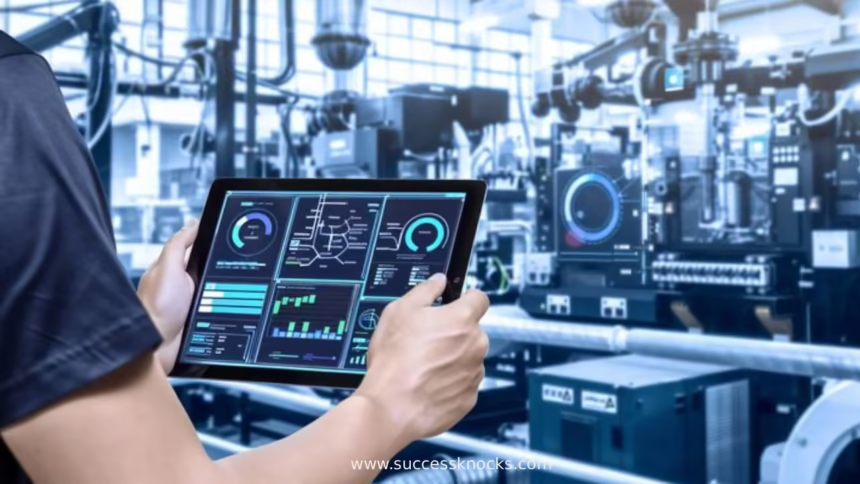
What is smart manufacturing explained simply is the practice of connecting machines, sensors, software, and people so a factory can sense what’s happening right now, decide what to do next, and act—often automatically—without waiting for the next shift report or weekly meeting.
Here’s the quick overview:
- It turns raw machine data into real-time decisions that cut waste, downtime, and quality issues.
- Core tools include industrial IoT sensors, AI analytics, digital twins, and cloud platforms that talk to each other.
- The result is a plant that adapts to demand swings, supply hiccups, and equipment wear instead of fighting them after the fact.
- NIST frames it as fully integrated systems that respond in real time across the factory, supply network, and customer needs.
- For U.S. manufacturers in 2026, it’s less about buying every shiny gadget and more about closing the loop between data and action.
Think of a traditional factory like a car with the dashboard covered up. You drive until something breaks or the fuel light finally forces a stop. Smart manufacturing rips the cover off. Sensors stream continuous signals—vibration, temperature, energy draw, scrap rates—into systems that flag problems early and adjust settings on the fly. The difference is night and day.
For the bigger picture on how companies are actually rolling this out across the U.S. right now, see the full guide on smart manufacturing adoption in 2026.
What Is Smart Manufacturing Explained Simply: The Core Idea
What is smart manufacturing explained simply comes down to one loop: sense → analyze → act → improve. Sensors and industrial IoT devices collect data from every critical asset. Analytics and AI turn that stream into usable insights. Software or operators then trigger changes—rerouting jobs, ordering parts, slowing a line before a bearing fails. The loop repeats.
The National Institute of Standards and Technology (NIST) definition still holds in 2026: fully-integrated, collaborative manufacturing systems that respond in real time to meet changing demands and conditions in the factory, in the supply network, and in customer needs. That language matters. It’s not just “more robots.” It’s systems that stay synchronized with the rest of the business.
In my experience, the plants that get this right treat data like a production input, not an after-the-fact report. They stop waiting for the end-of-shift spreadsheet and start treating live signals as the primary source of truth.
How Smart Manufacturing Actually Works on the Floor
What is smart manufacturing explained simply Start with connectivity. Machines, tools, and even some finished goods carry sensors that feed a common data layer—often called a unified namespace or digital thread. That layer sits above the old siloed PLCs and MES systems so everyone sees the same numbers.
Next comes intelligence. Edge devices handle simple decisions locally (shut down if vibration exceeds threshold). Cloud or hybrid platforms run the heavier analytics—predictive maintenance models, quality prediction, dynamic scheduling. Digital twins let teams test a change in software before they risk the physical line.
Finally, action. The system can auto-adjust parameters, alert a technician with the exact part number and procedure, or push a revised schedule to the ERP. Humans stay in the loop for judgment calls; the machines handle the repetitive sensing and reacting.
What usually happens when this lands well? Unplanned downtime drops because problems surface hours or days earlier. Scrap rates fall because quality checks move inline instead of end-of-line sampling. Changeovers get faster because the software already knows the next product recipe.
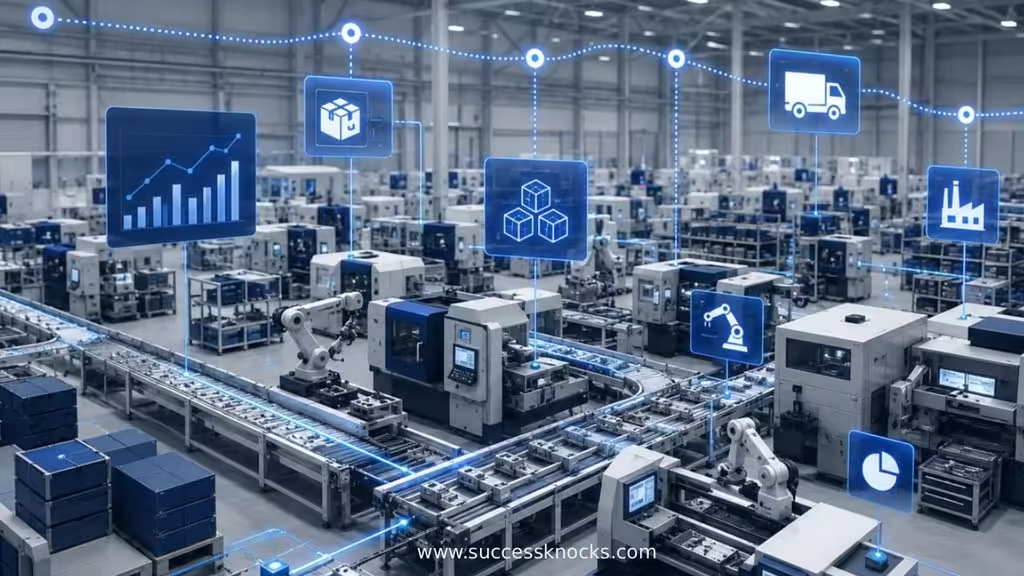
Smart Manufacturing vs Traditional Manufacturing: Side-by-Side
The contrast is sharpest when you line up the habits.
| Aspect | Traditional Manufacturing | Smart Manufacturing |
|---|---|---|
| Data collection | Manual logs, end-of-shift reports | Continuous sensors and IIoT streams |
| Decision speed | Hours to days | Minutes to seconds |
| Maintenance | Time-based or run-to-failure | Condition-based and predictive |
| Quality control | Sampling and final inspection | Real-time, closed-loop detection |
| Flexibility | Long changeovers, fixed recipes | Software-driven adjustments, smaller lot sizes |
| Visibility | Siloed systems, delayed reports | Shared real-time view across operations |
| Response to disruption | Reactive firefighting | Anticipatory adjustments |
This table is the practical version of what is smart manufacturing explained simply. Traditional plants react. Smart ones anticipate. For a deeper side-by-side, the comparison of smart manufacturing versus traditional manufacturing walks through the operational and cost implications.
Key Technologies That Make It Possible
What is smart manufacturing explained simply You don’t need every technology on day one. The usual stack looks like this:
- Industrial IoT sensors and edge devices for local data capture.
- Connectivity layer (OPC UA, MQTT, or proprietary protocols) that moves data without constant custom coding.
- Analytics and AI/ML models for prediction and anomaly detection.
- Digital twins for simulation and what-if testing.
- Cloud or hybrid platforms that store history and run heavier models.
- Integration with existing MES, ERP, and quality systems so the new data actually drives decisions.
Additive manufacturing and collaborative robots often join later once the data foundation is solid. The order matters. Skip the sensing and analytics layer and the fancy robots just become expensive isolated machines.
Step-by-Step Action Plan for Beginners
If I were starting a mid-size U.S. plant tomorrow, here’s the sequence I’d follow.
- Pick one high-pain process. Unplanned downtime on a bottleneck line or scrap on a high-value product are good candidates. Avoid “boil the ocean” pilots.
- Instrument that process. Add the minimum sensors needed for vibration, temperature, or throughput. Make sure the data lands in a place operators and engineers can actually see.
- Define the decision loop. Who acts when a threshold is crossed? Does the system auto-adjust or just alert? Write it down.
- Run a 60–90 day pilot with clear metrics. Track downtime hours, scrap rate, and response time. Compare against the old baseline.
- Expand only after the loop works. Use the same data layer and governance rules so the next cell or line doesn’t reinvent the wheel.
- Train the people who will live with it. Operators need to trust the alerts; maintenance needs to trust the predictions. Skip this and the system gets ignored.
The goal is a working feedback loop, not a perfect technology stack. Most plants that stall do so because they buy tools before they decide what decisions those tools should improve.
Common Mistakes & How to Fix Them
I’ve watched the same three errors kill momentum.
First, treating smart manufacturing as a pure IT project. Manufacturing owns the outcomes. Pull operations and maintenance into the design from day one or the system will sit unused. Fix: make the plant manager the co-owner of the pilot metrics.
Second, collecting data without a clear use case. Sensors generate noise if no one has defined the decisions they support. Fix: write the “if this, then that” rule before the first sensor is installed.
Third, underestimating change management. Operators who have run the line for twenty years will resist new alerts that feel like second-guessing. Fix: involve them early, show the wins in their language (fewer fire drills, less scrap they have to rework), and keep the first alerts simple and high-confidence.
One more that surfaces in 2026: chasing full autonomy too early. Most plants still need people in the loop for judgment. Build the sensing and recommending layer solidly before you hand over control.
Why It Matters for U.S. Manufacturers Right Now
Labor shortages, supply volatility, and customer demand for smaller, more customized runs are not going away. Plants that can sense problems early and adjust without weeks of meetings hold a real edge. Energy costs and sustainability reporting add pressure; real-time visibility helps on both fronts.
Authoritative sources keep reinforcing the same point. NIST continues to publish roadmaps and frameworks that treat real-time response and digital thread continuity as foundational. Industry platforms from established vendors emphasize closed-loop operations over isolated gadgets. The technology has matured enough that the limiting factor is rarely the tools—it’s the discipline to define the decisions and close the loop.
External references worth bookmarking include the NIST smart manufacturing overview at nist.gov/smart-manufacturing, the detailed NIST definition and related research available through their publications, and the practical technology framing from established industrial software providers such as the SAP resource on smart manufacturing in the cloud.
Key Takeaways
- What is smart manufacturing explained simply is a closed loop of sensing, analyzing, and acting on real-time data so the plant adapts instead of reacts.
- NIST’s definition remains the cleanest: integrated systems that respond in real time to factory, supply network, and customer conditions.
- Start with one painful process, instrument it, define the decision rule, and measure results before expanding.
- Connectivity and a shared data layer matter more than any single AI model or robot.
- Common failure points are IT-only ownership, data without purpose, and skipping operator buy-in.
- The payoff shows up as lower downtime, less scrap, faster response to demand changes, and better use of scarce skilled labor.
- In 2026 the tools are ready; the competitive gap is opening between plants that close the loop and those still driving with the dashboard covered.
Master the basics of what is smart manufacturing explained simply and you give your operation a durable edge. The next practical step is to map your highest-cost disruption, instrument that single process, and run a short pilot with clear metrics. Once that loop works, the rest of the plant becomes a lot easier to bring along.
FAQs
What is smart manufacturing explained simply for someone new to the plant floor?
It’s machines and systems that tell you what’s wrong—or about to go wrong—before the scrap pile grows or the line stops, then help you fix it faster.
Is smart manufacturing the same as Industry 4.0?
Not exactly. Industry 4.0 is the broader vision of connected industrial systems. Smart manufacturing is the practical application of those ideas on the production floor and across the immediate supply network.
How long does it take to see results from a smart manufacturing pilot?
Most focused pilots on a single bottleneck show measurable reduction in downtime or scrap within 60–90 days if the decision loop is defined up front and the data is trusted by the people who act on it.