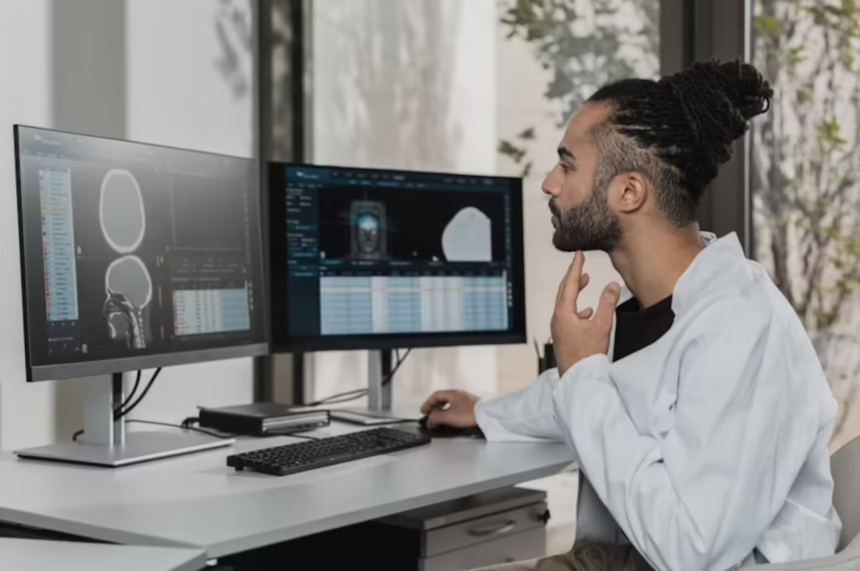
The administrative load of clinical documentation has long been a major cause of physician burnout and inefficiency in healthcare. Doctors often spend two hours on paperwork and updating electronic health records (EHRs) for every hour they spend with patients. This imbalance takes away from patient care and also creates significant operational problems. Now, artificial intelligence is set to change this by offering a future where documentation is automated, accurate, and not intrusive. This shift should free up valuable time for healthcare professionals by reducing manual documentation and administrative tasks.
Evolution of Medical Record Keeping
Medical records have slowly but steadily adopted technology over time. For centuries, patient information was kept in handwritten paper charts. While simple, this system was prone to errors, hard to share, and inefficient for data analysis. Moving from paper to digital promised to fix these issues with Electronic Health Records.
However, many early EHR systems created new problems. Clinicians found themselves tied to computers, navigating complex interfaces and clicking through endless checkboxes during patient visits. Instead of making workflows better, these systems often added to the administrative workload, shifting the burden from filing paper to tedious data entry. This clearly showed a need for a smarter, more automated solution that could work with clinicians, not against them.
How AI is Reshaping Scribing
Artificial intelligence is now automating the most time-consuming parts of clinical documentation. AI-powered scribes can listen to, transcribe, and intelligently summarize doctor-patient conversations into structured clinical notes. This lets the clinician focus entirely on the patient instead of a computer screen. The technology can pick out key medical terms, diagnoses, and treatment plans from natural conversation.
This automation greatly reduces the time spent on administrative tasks after hours, directly addressing a main cause of burnout. As healthcare organizations adopt AI-assisted documentation to improve efficiency and reduce administrative burdens, selecting the best AI medical scribe has become an important operational decision. These tools are no longer new; they are now an essential part of modern, efficient clinical practice aimed at improving both doctors’ well-being and the quality of patient care.
Ambient Listening Technology in Practice
Ambient listening technology is a key innovation driving this change. Unlike traditional dictation software that needs a user to actively speak into a microphone, ambient AI works quietly in the background during a patient visit. Using advanced microphones and natural language processing, the system captures the whole conversation.
After the appointment, the AI processes the dialogue, automatically transcribing conversations and finding the clinically relevant information. It then creates a structured note in the right medical format, like a SOAP (Subjective, Objective, Assessment, Plan) note. The doctor just needs to review the note for accuracy, make any necessary changes, and sign off. This turns a long administrative task into a quick verification step, saving valuable time.
EHR Integration for Seamless Workflows
For any AI documentation tool to work well, it must fit smoothly with existing Electronic Health Record systems. Without proper integration, AI-generated notes would have to be manually copied and pasted into the patient’s chart, creating another tedious step and defeating the purpose of automation.
Modern AI scribing platforms are built with this in mind. They connect directly with major EHR systems, allowing the finished notes to be moved into the correct patient file with one click. This direct connection ensures data accuracy, lowers the risk of manual errors, and keeps a single source of truth for patient information. A well-integrated system makes sure the workflow is continuous, from the patient conversation all the way to the final, signed record in the EHR.
The ongoing development of AI in clinical settings promises a future where technology supports, rather than hinders, the practice of medicine. By automating documentation, these tools allow clinicians to put their focus back on what matters most: their patients.