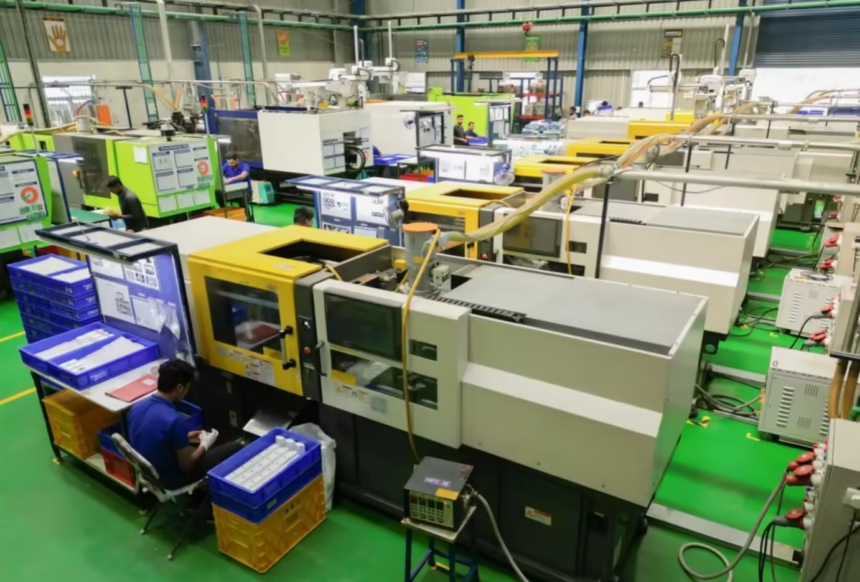
In today’s fast-paced manufacturing environment, companies depend on production methods that deliver accuracy, efficiency, and scalability. One of the most effective and widely adopted manufacturing technologies is plastic injection molding, which enables the creation of durable, high-quality plastic components in large quantities. This process supports a broad range of industries, including automotive, healthcare, electronics, and consumer goods manufacturing. Due to its reliability and cost-effectiveness, it has become a fundamental part of modern industrial production.
Manufacturers continue to invest in advanced molding technologies because they provide consistent product quality while supporting large-scale production requirements. The ability to create complex components with precision makes this process an essential solution for businesses worldwide.
What Is Plastic Injection Molding?
Plastic injection molding is a manufacturing technique that involves melting plastic material and injecting it into a specially designed mold under high pressure. Once the material cools and solidifies, the finished product is removed from the mold cavity. This method allows manufacturers to produce highly detailed and accurate components repeatedly with minimal variation.
The process is especially valuable for companies that require high-volume production. Since the same mold can be used thousands or even millions of times, manufacturers can maintain excellent consistency while reducing the cost per unit over time. This combination of efficiency and precision has contributed to the widespread adoption of injection molding across numerous industries.
How the Injection Molding Process Works
The injection molding process involves several carefully controlled stages designed to ensure product quality and manufacturing efficiency. The first stage involves designing and producing a mold that matches the exact specifications of the desired component. Engineers use advanced software and precision machining techniques to create molds capable of producing highly accurate parts.
Once the mold is ready, plastic pellets are loaded into a machine where they are heated until they become molten. The melted plastic is then injected into the mold cavity under controlled pressure. After filling the mold, the material is allowed to cool and harden before the finished part is ejected.
Modern manufacturing facilities often integrate automation and robotic systems into the production process. These technologies improve speed, reduce errors, and ensure consistent quality throughout production runs. Sophisticated monitoring systems also help manufacturers optimize temperature, pressure, and cycle times to maximize efficiency.
Advantages of Plastic Injection Molding
The popularity of injection molding stems from its ability to deliver high-quality products efficiently and economically. Several advantages make this manufacturing process highly desirable for businesses operating in competitive markets.
Exceptional Precision and Consistency
One of the greatest strengths of injection molding is its ability to produce components with exceptional dimensional accuracy. Once a mold is properly designed and calibrated, manufacturers can create thousands of identical products with virtually no variation. This consistency is particularly important in industries such as medical device manufacturing, automotive production, and electronics.
Cost-Effective Mass Production
Although mold development requires an initial investment, the overall production costs decrease significantly as manufacturing volume increases. This makes injection molding one of the most economical production methods for large-scale manufacturing operations. The ability to produce high volumes efficiently helps businesses reduce overall manufacturing expenses.
Design Flexibility
Injection molding offers tremendous design flexibility, allowing manufacturers to create products with complex geometries, intricate details, and specialized features. Engineers can develop innovative designs while maintaining product strength, durability, and functionality. This flexibility enables companies to meet evolving market demands and customer expectations.
Material Versatility
A wide variety of plastic materials can be used in injection molding applications. Manufacturers can select materials based on specific performance requirements, including durability, flexibility, heat resistance, and chemical resistance. This versatility allows businesses to produce products suited to diverse industrial and commercial applications.
Industries That Depend on Injection Molding
Many industries rely heavily on injection molding to manufacture essential products and components. The automotive industry uses this process to produce dashboard components, interior panels, connectors, clips, and numerous structural parts. The medical sector utilizes injection molding for syringes, diagnostic equipment, and specialized medical devices.
Electronics manufacturers depend on injection molding to create housings, connectors, switches, and protective enclosures for various devices. Additionally, consumer products, household goods, packaging materials, toys, and industrial equipment components are frequently produced using this manufacturing technique.
The packaging industry also benefits significantly from injection molding because it enables the production of lightweight, durable, and cost-effective products at extremely high volumes. This capability supports the growing global demand for efficient packaging solutions.
Innovation and Sustainability in Injection Molding
The injection molding industry continues to evolve through ongoing technological advancements and sustainability initiatives. Manufacturers are increasingly adopting automation, artificial intelligence, and advanced monitoring systems to improve operational efficiency and product quality. These technologies help reduce waste, optimize production cycles, and increase overall profitability.
Environmental sustainability has also become a major focus within the industry. Many manufacturers now utilize recycled materials, energy-efficient equipment, and waste reduction programs to minimize their environmental impact. Additionally, ongoing research into biodegradable plastics and sustainable manufacturing practices continues to support greener production methods.
As industries place greater emphasis on environmental responsibility, injection molding companies are adapting their operations to meet sustainability goals while maintaining high levels of productivity and performance.
Choosing the Right Manufacturing Solution
Selecting the best manufacturing process depends on factors such as production volume, product complexity, material requirements, and budget considerations. For companies seeking a manufacturing method that offers scalability, precision, and long-term cost efficiency, plastic injection molding remains one of the most effective solutions available.
As manufacturing technologies continue to advance, injection molding will remain a critical component of industrial production worldwide. Its ability to combine precision, efficiency, versatility, and cost-effectiveness ensures that it will continue to support innovation and product development across numerous industries for many years to come.