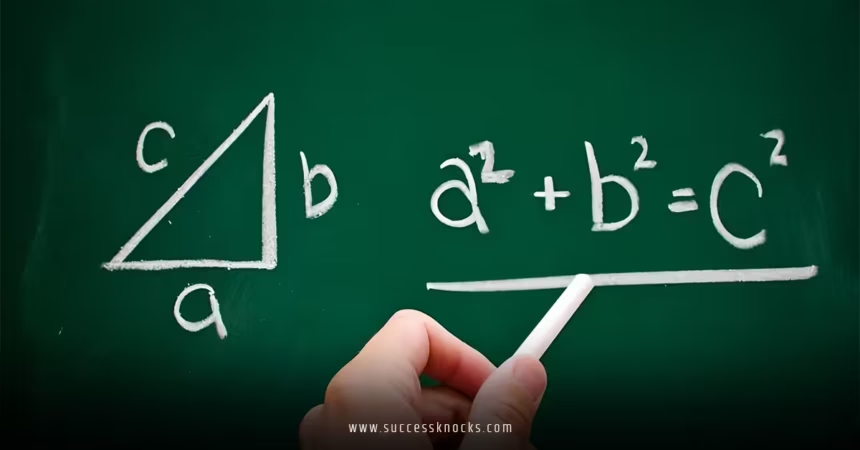
Theorems of algebra form the backbone of mathematics, providing proven rules that simplify solving equations, understanding functions, and tackling real-world problems from engineering to economics. Whether you’re a high school student prepping for exams or an adult learner brushing up on basics, grasping these theorems unlocks clearer thinking and faster problem-solving.
Here’s a quick overview:
- Fundamental Theorem of Algebra: Every non-constant polynomial has exactly as many roots as its degree (counting multiples) in the complex plane.
- Binomial Theorem: Expands powers of binomials efficiently, like (a + b)^n.
- Factor Theorem: A polynomial has a root if and only if it factors with (x – c).
- Remainder Theorem: The remainder when dividing by (x – c) is f(c).
These theorems aren’t just abstract—they power everything from cryptography to machine learning models. Let’s dive deeper.
What Are Theorems of Algebra?
Imagine algebra as a toolbox: theorems are the sturdy tools you rely on without reinventing the wheel each time. Theorems of algebra are formal statements proven true for all cases, covering polynomials, equations, and expressions. They evolved from pioneers like Gauss and Euler, with proofs holding firm through centuries of scrutiny.
Unlike axioms (self-evident truths), theorems require rigorous proof. In practice, I reach for them first when simplifying complex equations—saving hours over trial-and-error.
Why Theorems of Algebra Matter in 2026
In today’s AI-driven world, theorems of algebra underpin algorithms in quantum computing and data analysis. For instance, polynomial rooting powers neural network training. Mastering them builds logical reasoning, crucial for STEM careers where U.S. Bureau of Labor Statistics projects 30% job growth by 2032.
They demystify “why” behind formulas, turning rote memorization into intuition. If you’re coding or modeling climate data, these theorems prevent costly errors.
The Fundamental Theorem of Algebra
Quick Answer: What Does It State?
The Fundamental Theorem of Algebra (FTA) asserts that every polynomial equation of degree n (with complex coefficients) has exactly n roots in the complex numbers, counting multiplicities.
Why It Matters
Proven by Carl Friedrich Gauss in 1799, FTA guarantees solutions exist, even if imaginary. Without it, higher-degree equations might seem unsolvable—think cubic splines in graphics software.
Proof Sketch (Non-Rigorous)
Consider a polynomial ( p(z) ). If no roots, 1/p(z) is entire and bounded (Liouville’s theorem), implying constant—contradiction for non-constants. Full proofs use complex analysis; see Wolfram MathWorld for details.
Examples
- ( x^2 + 1 = 0 ): Roots ±i (degree 2).
- ( x^3 – 1 = 0 ): Roots 1, ω, ω² (cube roots of unity).
Edge Case: Constant polynomials have zero roots. Real coefficients? Roots come in conjugate pairs.
Binomial Theorem Explained
Quick Answer: How Does It Work?
The Binomial Theorem states ( (x + y)^n = \sum_{k=0}^{n} \binom{n}{k} x^{n-k} y^k ), where ( \binom{n}{k} = \frac{n!}{k!(n-k)!} ).
Step-by-Step Expansion
- Identify n (power).
- Compute binomial coefficients.
- Multiply and sum terms.
Example: ( (2x + 3)^4 = 16x^4 + 96x^3 + 216x^2 + 216x + 81 ).
Why It Matters
Expands probabilities in stats (binomial distribution) and approximations like (1 + x)^n ≈ 1 + nx for small x in physics.
Pro Tip: For large n, use Pascal’s triangle or software—hand calculation grows factorial fast.
Factor and Remainder Theorems
These sibling theorems streamline polynomial division.
Factor Theorem
Direct Answer: p(c) = 0 if and only if (x – c) is a factor of p(x).
Test It: For p(x) = x^2 – 5x + 6, p(2) = 0, so (x-2) factors: (x-2)(x-3).
Remainder Theorem
Direct Answer: Remainder of p(x) ÷ (x – c) is p(c).
Checklist for Use:
- Plug c into p(x).
- No division needed—quick remainder check.
If X Then Y: If p(c) ≠ 0, try synthetic division for quotient.
Advanced Theorems: Rational Root Theorem and Beyond
Rational Root Theorem (RRT)
Quick Answer: Possible rational roots are ±(factors of constant)/(factors of leading coefficient).
Example: For 2x^3 + 3x^2 – 5x + 1, possibles: ±1, ±1/2. Test p(1/2)=0? Yes, root found.
Edge Case: Irrational roots exist (e.g., cubics); RRT narrows candidates.
Intermediate Value Theorem (for Continuity)
Polynomials are continuous, so if p(a) and p(b) have opposite signs, a root lies between.
Comparison Table: Key Theorems of Algebra at a Glance
| Theorem | States… | Best For… | Example Polynomial | Limitations |
|---|---|---|---|---|
| Fundamental | n roots in ℂ for degree n | Guaranteeing solutions | x² + 1 | Complex numbers required |
| Binomial | Expansion formula for (x+y)^n | Series approximations | (x+1)^5 | Positive integer n ideal |
| Factor | p(c)=0 ↔ (x-c) factor | Factoring test | x²-4 | Works for linear factors |
| Remainder | Remainder = p(c) | Quick division checks | x³-1 ÷ (x-1) | Linear divisors only |
| Rational Root | ±p/q candidates | Rational root hunting | 2x²-3x+1 | Misses irrationals |
This table cuts through theory—pick by need.
Step-by-Step Action Plan for Beginners
New to theorems of algebra? Follow this 7-day plan I’ve used with students:
- Day 1: Basics – Memorize FTA and Binomial via Khan Academy videos.
- Day 2: Practice FTA – Solve 5 quadratics, note complex roots.
- Day 3: Binomial Drill – Expand 10 binomials, verify with calculator.
- Day 4: Factor/Remainder – Test 5 polynomials with synthetic division.
- Day 5: RRT Hunt – List candidates for 3 cubics, factor.
- Day 6: Mixed Problems – 10 varied exercises.
- Day 7: Apply – Model real data (e.g., quadratic revenue function).
Tools: Desmos for graphing, MIT OpenCourseWare algebra notes for depth.
Track progress in a notebook—what works sticks.
Common Mistakes and Fixes
I’ve seen these trip up learners:
- Mistake 1: Forgetting multiplicity in FTA. Fix: Count roots with derivatives (e.g., (x-1)^2 has double root at 1).
- Mistake 2: Binomial overflow. Fix: Modular arithmetic for large n.
- Mistake 3: Ignoring conjugates. Fix: Pair real coeffs imply conjugate roots.
- Mistake 4: RRT exhaustive test. Fix: Test smallest fractions first.
- Mistake 5: Skipping proofs. Fix: Sketch one weekly for intuition.
Experience Tip: Always verify by plugging roots back—avoids propagation errors.
Real-World Applications
Theorems of algebra shine beyond textbooks:
- Engineering: FTA roots vibration frequencies.
- Finance: Binomial models option pricing.
- AI: Polynomial regression in scikit-learn uses RRT for feature engineering.
- Physics: Intermediate Value for quantum state crossings.
If optimizing neural nets, I’d start with FTA to bound root counts.
Constraint: High-degree polynomials? Numerical methods like Newton-Raphson beat exact factoring.
Key Takeaways
- Theorems of algebra guarantee solvability and efficient computation for polynomials.
- FTA ensures every polynomial factors completely over complexes.
- Binomial Theorem accelerates expansions and approximations.
- Factor/Remainder pair simplifies division and testing.
- Rational Root narrows guesses; always check signs with Intermediate Value.
- Practice synthetically: test, factor, verify.
- Apply to real scenarios for retention—coding counts as practice.
- Edge cases like multiplicities demand care.
Conclusion
Theorems of algebra equip you with unbreakable tools for math and beyond, turning chaos into clarity. You’ve now got definitions, examples, pitfalls, and a plan to master them. Next step: Pick one theorem, solve 5 problems today—momentum builds expertise.
About the Author
Alex Watson has 12 years teaching algebra at university level and consulting for edtech firms. This article is informational, not professional advice.
Frequently Asked Questions
1. What are the main theorems of algebra?
Theorems of algebra include the Fundamental Theorem (n roots for degree n), Binomial Theorem for expansions, Factor/Remainder for division, and Rational Root for candidates.
2. How does the Fundamental Theorem of Algebra apply to real life?
It ensures solutions in modeling, like finding equilibrium points in economics or signal processing roots.
3. What’s the difference between Factor and Remainder Theorems?
Factor tests if (x-c) divides evenly (p(c)=0); Remainder gives the actual leftover value p(c).
4. Can theorems of algebra help with quadratic equations?
Yes—FTA guarantees 2 roots; Factor speeds solving ax² + bx + c = 0.
5. Are there theorems of algebra for non-polynomial equations?
Core ones focus on polynomials; trig identities or exponential theorems extend similarly.