
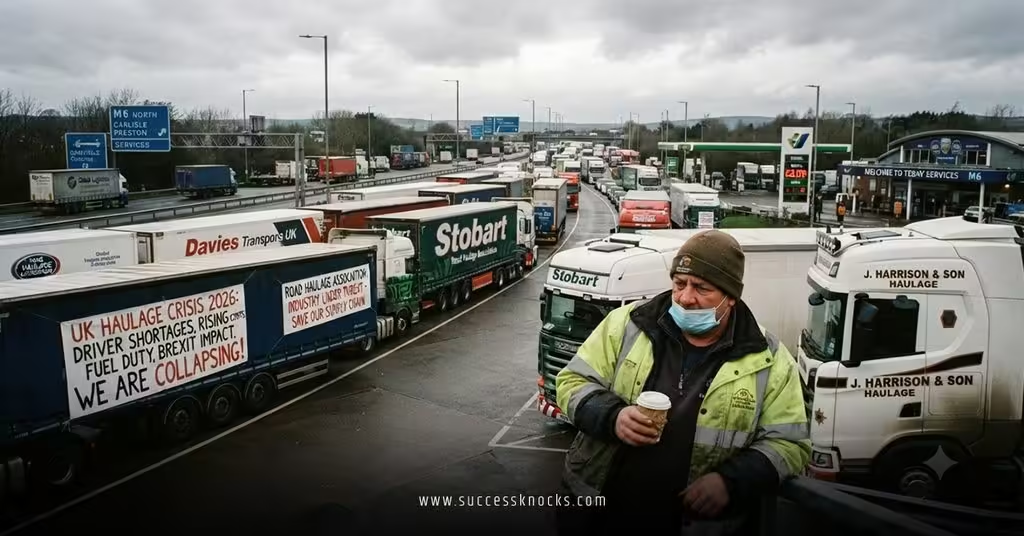
The UK haulage industry crisis 2026 isn’t a headline exaggeration. It’s a slow-motion collapse playing out one insolvency notice at a time. Drivers are losing jobs. Family firms that survived recessions, fuel shocks, and Brexit are finally running out of road. And the numbers back it up.
Here’s the quick version before we get into the weeds.
Fast facts on the UK haulage industry crisis 2026:
- Over 1,300 UK haulage firms have vanished in the past three years, according to industry reporting on Road Haulage Association figures [1].
- Road freight and removal insolvencies hit 226 between January and July 2026 in England and Wales [2].
- Roughly 400 haulage firms closed in 2025 alone, per RHA-cited data [1].
- Recent high-profile closures include the VG Mathers Kintore haulage firm liquidation, seven jobs lost 2026, a case that shows exactly how these numbers translate into real families and real payrolls.
- Fuel costs, insurance premiums, and compliance burdens are the recurring culprits across nearly every case.
That last point is the whole story in miniature. Different companies, same three killers.
What’s Actually Driving the UK Haulage Industry Crisis 2026
Let’s cut through the noise. This isn’t one bad year. It’s a five-year erosion that’s finally hitting bedrock.
Parliamentary data shows 2,051 road haulage insolvencies between 2021 and 2025 — almost double the 1,068 recorded in the previous five-year stretch [3]. That’s nearly eight haulage firms going under every single week for half a decade.
Think of the industry like a rope under constant tension. Fuel spikes, insurance inflation, driver shortages — each one adds strain. Eventually, even a strong rope frays and snaps. That’s what’s happening across UK logistics right now.
The Numbers Behind the UK Haulage Industry Crisis 2026
Here’s where it gets granular, and where beginners often get confused by conflicting headlines.
Road freight and removal insolvencies actually dipped slightly year-on-year through mid-2026 — 184 cases from January to June 2026, down from 220 in the same period of 2025 [4]. Sounds like good news, right?
Not quite. July 2026 alone saw 42 insolvencies, a 20% jump from June, and the highest monthly figure since April’s 45 [2]. The trend is choppy, not steadily improving. One good quarter doesn’t undo a five-year slide.
UK Haulage Industry Crisis 2026: Year-by-Year Insolvency Snapshot
Numbers tell the story better than adjectives ever could.
| Year | Road Haulage Insolvencies (England & Wales) | Notes |
|---|---|---|
| 2021 | 265 | Post-Brexit adjustment period begins [3] |
| 2022 | 411 | Fuel prices surge sharply [3] |
| 2023 | 503 | Series peak — worst year on record [3][4] |
| 2024 | 471/472 | Still elevated, marginal improvement [1][4] |
| 2025 | 400–407 | RHA cites ~400; official data shows 407 [1][4] |
| Jan–Jul 2026 | 226 | Down 13% year-on-year, but volatile month to month [2] |
The takeaway? 2023 was the worst year in recorded history for this sector. 2025 and 2026 look “better” only by comparison to that disaster.
Real-World Casualties: From VG Mathers to Sunhill Transport
Numbers on a page don’t hit the same as names on a door.
Take the VG Mathers Kintore haulage firm liquidation, seven jobs lost 2026. A 58-year-old family business, founded in 1968, gone. Owner Colin Mathers publicly cited fuel costs, insurance, compliance, and maintenance expenses as the compounding pressures that finally sank the company.
That’s not an outlier story — it’s the template. Sunhill Transport Ltd, a Deeside haulier trading since 1972, entered administration in 2026 with around 32 redundancies, also linked to sharp fuel cost increases. Martyn Barratt Transport Limited, a Nottinghamshire firm with 55 staff, went into administration despite its last filed accounts showing positive net assets.
Here’s the thing — solvent-looking balance sheets aren’t protecting anyone anymore. That should worry every small operator reading this.
What Beginners Should Understand About This Wave of Closures
If you’re new to freight or logistics news, here’s the plain-English version.
Haulage runs on razor-thin margins even in good years. When diesel prices, insurance premiums, and regulatory costs all climb together, there’s no buffer left. Companies that look financially healthy on paper can still collapse within months.
Step-by-Step: How to Read Haulage Insolvency Data Like a Pro
Confused by conflicting stats in the news? Here’s how I’d approach it if I were briefing a client.
- Check the source period. Monthly figures swing wildly — always compare year-to-date or 12-month rolling totals.
- Separate “road freight and removals” from “transport and storage.” The broader category includes rail, air, and warehousing, which skews comparisons.
- Cross-reference official Insolvency Service data with trade body commentary. The RHA often frames numbers differently than raw government tables.
- Look for named case studies. Stats explain scale; cases like VG Mathers explain cause.
- Track compulsory liquidations vs. creditors’ voluntary liquidations. A rising compulsory liquidation share often signals HMRC or creditor-driven collapses, not managed wind-downs.
Common Mistakes & How to Fix Them
Operators and observers both trip up on the same handful of errors.
Mistake 1: Assuming a “declining insolvency” headline means the crisis is over.
Fix it: Always check the monthly volatility underneath the annual trend — July 2026’s 20% spike proves headlines can mislead.
Mistake 2: Treating every closure as management failure.
Fix it: Look at the cited causes. Fuel, insurance, and compliance costs show up in nearly every case, including firms with positive net assets on paper.
Mistake 3: Ignoring smaller regional firms in favor of national headlines.
Fix it: Local closures like VG Mathers in Kintore often reveal the real-world mechanics behind national statistics better than aggregate data alone.
Mistake 4: Failing to build a cost-shock buffer.
Fix it: If you run a haulage business, build reserves specifically for fuel and insurance volatility — not general “rainy day” funds that get raided for other things.
FAQs on the UK Haulage Industry Crisis 2026
Q: How does the VG Mathers Kintore haulage firm liquidation connect to the broader UK haulage industry crisis 2026?
A: VG Mathers is a direct case study within the wider crisis — the same fuel, insurance, and compliance pressures cited in its collapse are named repeatedly across hundreds of other 2026 haulage insolvencies.
Q: Is the UK haulage industry crisis 2026 getting better or worse?
A: It’s mixed. Year-to-date insolvencies through mid-2026 were down compared to 2025, but individual months, like July’s 20% jump, show the situation remains volatile rather than resolved.
Q: What’s the single biggest cause behind the UK haulage industry crisis 2026?
A: No single cause — it’s compounding pressure from fuel costs, insurance premiums, and regulatory compliance hitting thin-margin operators simultaneously, exactly as seen in the VG Mathers case.
Key Takeaways
- The UK haulage industry crisis 2026 is a continuation of a five-year insolvency surge, not a new or isolated problem.
- Over 1,300 haulage firms have closed in the past three years alone.
- 2023 remains the worst year on record for road haulage insolvencies at 503 cases.
- Year-to-date 2026 figures show improvement over 2025, but monthly volatility (like July’s spike) tells a messier story.
- The VG Mathers Kintore haulage firm liquidation, with seven jobs lost in 2026, is a real-world example of the exact pressures driving national statistics.
- Fuel, insurance, and compliance costs are the three recurring causes across almost every documented closure.
- Solvent-looking balance sheets no longer guarantee survival in this market.
This crisis isn’t abstract, and it isn’t over. Every insolvency notice represents payrolls, families, and decades of work disappearing almost overnight — VG Mathers is proof of that, not an exception to it.
If you operate in logistics or freight, don’t wait for your own numbers to tell the story after the fact. Review your fuel and insurance cost exposure this quarter, talk to an insolvency advisor before things get tight, and watch the monthly Insolvency Service data, not just the annual headlines.
FAQ
Q: How does the VG Mathers Kintore haulage firm liquidation connect to the broader UK haulage industry crisis 2026?
A: VG Mathers is a direct case study within the wider crisis — the same fuel, insurance, and compliance pressures cited in its collapse are named repeatedly across hundreds of other 2026 haulage insolvencies.
Q: Is the UK haulage industry crisis 2026 getting better or worse?
A: It’s mixed. Year-to-date insolvencies through mid-2026 were down compared to 2025, but individual months, like July’s 20% jump, show the situation remains volatile rather than resolved.
Q: What’s the single biggest cause behind the UK haulage industry crisis 2026?
A: No single cause — it’s compounding pressure from fuel costs, insurance premiums, and regulatory compliance hitting thin-margin operators simultaneously, exactly as seen in the VG Mathers Kintore haulage firm liquidation, seven jobs lost 2026 case.