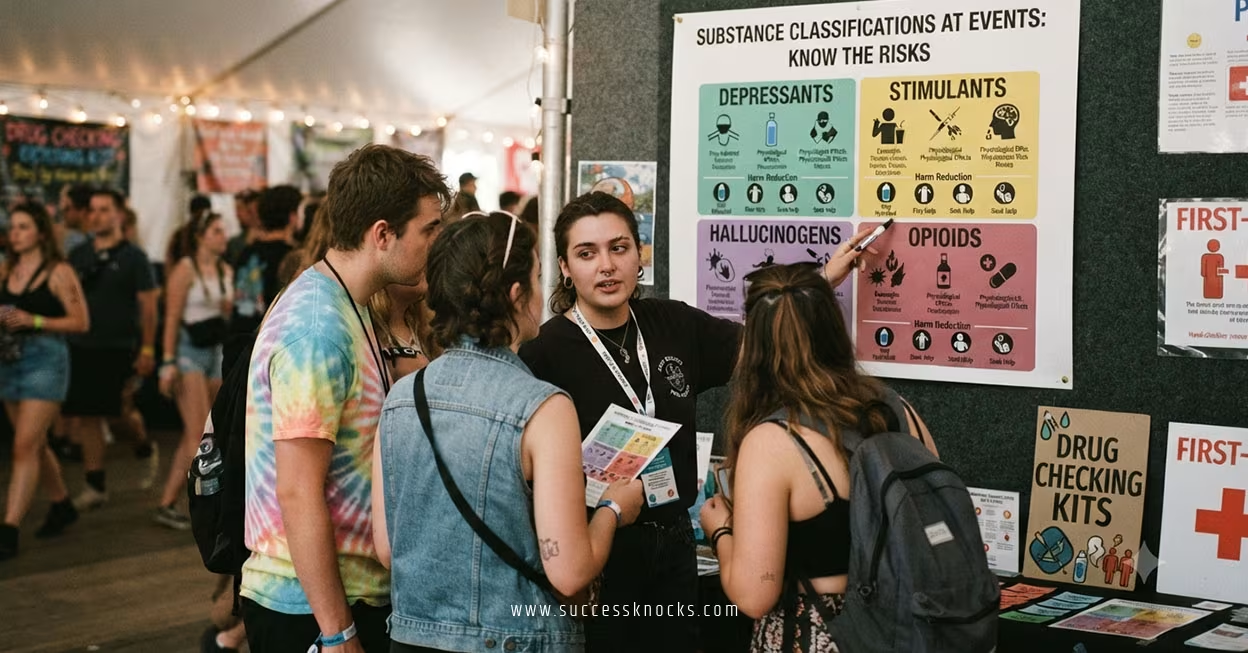
Understanding drug classifications at events starts with one hard fact: the labels on a substance dictate the legal risk long before anyone reaches the festival gates. Whether you are heading to a UK dance weekender or a major US multi-day event, knowing the difference between Class A and Schedule I—or Class B and Schedule III—shapes every security interaction that follows. The recent recovery of buried packages at Creamfields shows exactly why these categories matter in practice.
- UK law sorts controlled substances into Class A, B and C under the Misuse of Drugs Act 1971, with penalties scaling by class.
- US federal law uses five schedules under the Controlled Substances Act; most festival-relevant compounds sit in Schedule I or III.
- Ecstasy/MDMA ranks as Class A in the UK and Schedule I in the US.
- Ketamine sits in Class B (UK) and Schedule III (US).
- Nitrous oxide became a Class C drug in the UK in late 2023; US treatment is more fragmented and often state-driven.
- Festival organisers and police apply zero-tolerance policies that treat all controlled substances as prohibited items, regardless of personal-use quantities.
These distinctions are not academic. They determine maximum prison terms, the likelihood of arrest versus caution, and how aggressively search teams prioritise certain finds.
Why Understanding Drug Classifications at Events Matters Right Now
Festival security operates on fixed legal frameworks. When Cheshire Police recovered large bags of tablets and 204 nitrous oxide canisters in the lead-up to Creamfields, officers described the haul as Class A, B and C substances. That phrasing is deliberate. It signals the full range of potential offences and the seriousness of the operation.
In my experience watching these events, the people who get caught out are rarely the ones who studied the schedules. They are the ones who assumed “personal amount” softened the rules. It does not. Possession is an offence. Quantity and context decide whether the charge escalates to intent to supply.
The same logic applies across the Atlantic. US festivals lean on federal schedules plus state law and private-property rules. A Schedule I substance triggers the strictest controls; a Schedule III item still lands you in trouble at the gate.
UK Classifications in Plain Language
The Misuse of Drugs Act 1971 groups substances by assessed harm to the user and to society.
Class A carries the heaviest penalties. MDMA (the active compound in most ecstasy tablets) sits here, alongside cocaine, heroin and LSD. Maximum sentence for simple possession: seven years. Supply or intent to supply can mean life.
Class B includes ketamine. An Advisory Council on the Misuse of Drugs review published in January 2026 confirmed ketamine should remain Class B rather than move upward. Possession maximum: five years. Supply: 14 years.
Class C covers a wider set of substances. Nitrous oxide was brought under Class C control in November 2023. Possession maximum: two years. Supply still reaches 14 years.
These ceilings are upper limits. Courts weigh quantity, previous record, and circumstances. At a festival the presence of multiple bags or concealment often pushes the case toward the higher end.
For official UK listings, the Home Office maintains an updated controlled drugs list on GOV.UK.
US Schedules: A Parallel but Different System
The Controlled Substances Act places substances into five schedules based on accepted medical use, abuse potential and safety under medical supervision.
Schedule I substances have no currently accepted medical use and high abuse potential. MDMA remains Schedule I. Possession and distribution carry federal felony exposure; penalties vary by quantity and prior record.
Schedule III substances have accepted medical uses and moderate-to-low potential for physical dependence. Ketamine falls here. It is still tightly controlled and illegal to possess without a valid prescription.
Nitrous oxide sits outside the main scheduling system in most federal contexts. States regulate it through inhalant or consumer-product laws, and many festivals ban canisters outright under their own rules.
The practical festival outcome looks similar on both sides of the ocean: controlled substances are prohibited items. Search teams, sniffer dogs and bag checks exist to enforce that prohibition.
How Classifications Shape Festival Security Decisions
Police and event organisers do not invent the categories. They apply them. When specialist teams dig up buried packages—as they did ahead of Creamfields—they are looking for anything that falls under those legal headings. The recent case involving police dig up buried drugs Creamfields 2026 ecstasy MDMA ketamine illustrates the point perfectly: the recovered tablets and canisters spanned multiple classes, triggering a full disruption operation.
Security priorities follow the classifications. Class A / Schedule I finds draw the strongest response. Larger quantities or evidence of distribution raise the stakes further. Even small amounts can lead to ejection, arrest, or both.
In practice this means:
- Gate searches and K9 units target the highest-risk categories first.
- Pre-event ground sweeps aim to remove advance caches before crowds arrive.
- On-site policing supports event staff to prevent crime and disorder once the festival is live.
US promoters follow a comparable playbook, often coordinated with local law enforcement and federal agencies where appropriate.
Comparison Table: Key Substances at Events
| Substance | UK Classification | Max Possession Penalty (UK) | US Schedule | Common Festival Treatment |
|---|---|---|---|---|
| MDMA / Ecstasy | Class A | 7 years | Schedule I | Zero tolerance, high priority |
| Ketamine | Class B | 5 years | Schedule III | Zero tolerance |
| Nitrous oxide | Class C | 2 years | Variable / state | Banned by most organisers |
| Cannabis | Class B | 5 years | Schedule I (federal) | Zero tolerance at most events |
The table is simplified. Always check current official sources, because classifications can shift after formal review.
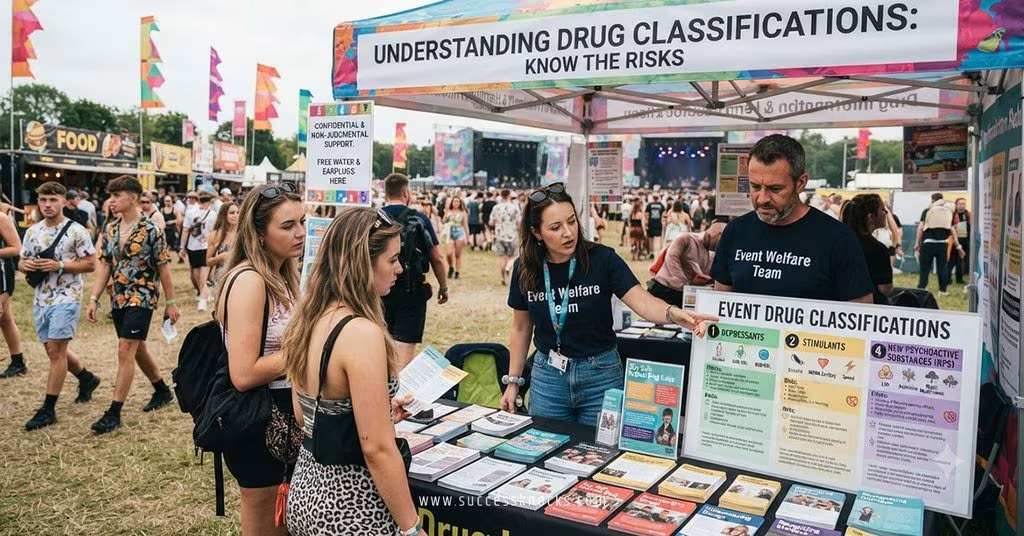
Step-by-Step Guide for Anyone Attending an Event
- Look up the official prohibited-items list for the specific festival. Organisers publish these for a reason.
- Cross-reference the substances that most commonly appear at electronic and multi-day events against the classification tables above.
- Treat every controlled substance as a prohibited item, regardless of personal-use claims.
- If you are travelling internationally, remember that UK Class A maps roughly to US Schedule I in risk level, even if the statutes differ.
- Use amnesty bins at the gate if the event provides them. They exist to let people dispose of items without immediate prosecution in many cases.
- Report anything that looks like a hidden cache or unattended bag to security or police. Early information protects the wider crowd.
Follow the sequence and you remove most of the avoidable friction.
Common Mistakes and How to Avoid Them
Mistake: assuming “everyone does it” softens the law. Reality: classifications and penalties remain fixed. Fix: read the official guidance before you pack.
Mistake: thinking a small quantity equals a free pass. Reality: possession is the offence; quantity influences charging decisions. Fix: leave controlled substances at home.
Mistake: confusing UK classes with US schedules. Reality: the systems are parallel but not identical. Fix: check both if you travel between the two jurisdictions.
Mistake: ignoring secondary rules. Many festivals ban nitrous oxide canisters under site policy even where local law is less clear. Fix: read the event’s full terms.
One useful analogy: drug classifications function like the weight classes in combat sports. The label tells everyone the rules of engagement before the first exchange. Pretending the label does not apply rarely ends well.
For further reading on how UK forces apply these rules at large events, the GOV.UK controlled drugs guidance remains the authoritative starting point. US readers can consult the DEA’s current scheduling materials for the federal baseline.
Key Takeaways
- Understanding drug classifications at events reduces the chance of walking into an avoidable legal problem.
- UK Class A (MDMA) and Class B (ketamine) carry significant possession penalties; Class C now includes nitrous oxide.
- US Schedule I (MDMA) and Schedule III (ketamine) produce similar zero-tolerance outcomes at festivals.
- Festival security applies these categories through searches, pre-event sweeps and on-site enforcement.
- Quantity and context can escalate a possession case toward supply charges.
- Official government lists, not social media, are the reliable source for current status.
- The safest practical approach remains the simplest: arrive without controlled substances.
Knowing the classifications does not change the law, but it does change how prepared you are when you reach the gate. Check the latest official sources for the specific event you plan to attend, pack accordingly, and keep the focus on the music rather than the search line.
FAQs
Why do festival police refer to Class A, B and C when talking about recovered substances?
Those are the formal categories under the UK Misuse of Drugs Act. The labels immediately communicate the potential seriousness of the finds to both the public and the courts.
Is ketamine still Class B in the UK after the 2026 review?
Yes. The Advisory Council on the Misuse of Drugs advised in January 2026 that ketamine should remain Class B.
Do US festivals follow the same classification system?
No. They operate under the federal Controlled Substances Act schedules plus state law and private event rules. The practical effect—zero tolerance for controlled substances—is broadly comparable.