

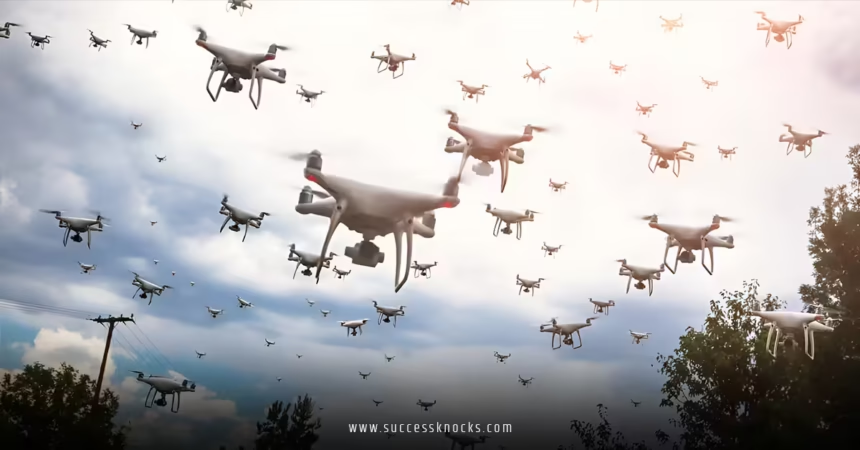
US military drone swarms are reshaping how we think about battlefield dominance. Imagine hundreds—or even thousands—of small, intelligent drones working together like a flock of birds, overwhelming enemies with sheer numbers and smart coordination. These aren’t just remote-controlled gadgets; they’re autonomous teams that adapt in real-time, making decisions faster than any human pilot could. If you’re wondering whether the future of warfare is already here, you’re not alone—US military drone swarms are leading the charge.
Think about it: traditional fighter jets or missiles cost millions, and losing one hurts. But with US military drone swarms, you get affordable, expendable assets that saturate defenses. It’s like trading a single expensive sword for a storm of razor-sharp arrows. The Pentagon is pouring resources into this tech because adversaries like China are doing the same. Have you ever pictured a sky filled with coordinated drones executing flawless maneuvers? That’s the reality US military drone swarms are building toward.
What Exactly Are US Military Drone Swarms?
At their core, US military drone swarms involve groups of unmanned aerial vehicles (UAVs) that operate collaboratively. These drones share data, make collective decisions, and execute missions without constant human input. Picture a hive mind in the air—each drone is simple on its own, but together, they form something incredibly powerful.
US military drone swarms draw inspiration from nature, like how ants or bees achieve complex tasks through simple rules. In military terms, this means swarms can scout vast areas, jam enemy communications, or launch coordinated strikes. The beauty? They overwhelm high-cost defenses economically. Why spend millions shooting down one threat when a swarm forces the enemy to waste resources on dozens?
Early experiments showed promise, with demonstrations of over 100 drones flying in formation. Today, advancements in AI allow these US military drone swarms to adapt dynamically—dodging threats or reallocating tasks if some drones are lost.
How Do US Military Drone Swarms Work Technically?
The magic happens through swarm intelligence algorithms. Each drone has sensors, communication links, and onboard processing. They “talk” to each other via mesh networks, sharing real-time info.
- Autonomy Levels: From basic flocking to full AI-driven decisions.
- Coordination: Leaderless designs ensure the swarm survives even if parts are destroyed.
- Payload Variety: Some carry cameras for recon, others explosives for attacks.
It’s fascinating—US military drone swarms turn quantity into a qualitative edge.
Key Programs Driving US Military Drone Swarms Forward
The U.S. has invested heavily in specialized initiatives to make US military drone-swarms operational.
DARPA’s OFFSET and Early Innovations
DARPA pioneered much of this with the OFFSET program, testing swarms of up to 250 air and ground robots in urban environments. They demonstrated tactics like building searches and artifact detection, proving swarms could support infantry units.
Building on that, Perdix drones—tiny, expendable micro-UAVs—were dropped from fighters in swarms of over 100, showcasing collective intelligence.
The Replicator Initiative: Scaling Up US Military Drone Swarms
Launched to counter China’s buildup, Replicator aims for thousands of low-cost, attritable drones. It focuses on all-domain systems, including software for networking swarms. Recent transitions have fielded capabilities, with more coming soon.
Service-Specific Efforts in US Military Drone Swarms
- Air Force: Planning experimental units for one-way attack swarms, targeting peer threats like China.
- Navy: Testing ship-launched kamikaze drones and super swarms for overwhelming defenses.
- Army: Exploring ISR swarms for sustainment and combat.
These programs ensure US military drone swarms integrate across branches.

Advantages of Deploying US Military Drone Swarms
Why the hype? US military drone-swarms offer game-changing benefits.
Overwhelming Enemy Defenses
A single expensive missile might miss, but a swarm saturates radars and interceptors. It’s cost-effective asymmetry—cheap drones versus pricey defenses.
Enhanced Situational Awareness
Swarms cover huge areas, providing persistent surveillance. Lost a few? The rest adapt seamlessly.
Reduced Risk to Human Life
No pilots in harm’s way. US military drone-swarms handle dangerous missions like deep strikes or electronic warfare.
Flexibility and Scalability
From small recon teams to massive assaults, US military drone-swarms adjust on the fly.
Rhetorical question: Wouldn’t you rather face one predictable threat than an unpredictable cloud of them?
Challenges Facing US Military Drone Swarms
No tech is perfect—US military drone-swarms have hurdles.
Technical and Operational Challenges
Communication jamming disrupts swarms. Autonomy in contested environments remains tricky—GPS denial or cyber attacks could scatter them.
Countermeasures like high-power microwaves threaten entire swarms at once.
Ethical and Legal Concerns
Who’s accountable if an autonomous swarm errs? International laws lag behind US military drone swarms’ capabilities.
Proliferation Risks
As tech spreads, adversaries—or non-state actors—could field their own swarms, escalating conflicts.
Scaling production while maintaining quality is another bottleneck for widespread US military drone-swarms deployment.
The Future Outlook for US Military Drone Swarms
Looking ahead, US military drone-swarms will dominate multi-domain operations. Expect swarms-of-swarms, integrating air, sea, and ground assets.
By the late 2020s, units dedicated to swarm tactics could be standard. AI advancements will push toward fully autonomous operations, with human oversight for critical decisions.
In potential conflicts, like over Taiwan, US military drone-swarms could create “hellscapes” deterring invasions through mass and unpredictability.
Analogy: Just as smartphones revolutionized communication, US military drone-swarms will redefine airpower—cheaper, smarter, deadlier.
The Pentagon’s push, including massive procurements, signals commitment. But success depends on overcoming challenges and ethical integration.
Conclusion
US military drone-swarms represent a pivotal shift in warfare—from isolated platforms to collaborative, intelligent networks. We’ve explored their mechanics, key programs like Replicator and OFFSET, undeniable advantages in overwhelming foes and saving lives, alongside real challenges in tech reliability and ethics. As investments grow, these swarms promise to enhance deterrence and battlefield effectiveness.
The key takeaway? Embracing US military drone swarms isn’t optional—it’s essential for staying ahead. Whether you’re a defense enthusiast or just curious about tomorrow’s battles, keep watching this space. The swarm is coming, and it could decide future conflicts. Are you ready for a world where the sky buzzes with coordinated intelligence?
FAQs
What makes US military drone swarms different from regular drones?
US military drone swarms operate as coordinated groups with shared intelligence, adapting autonomously unlike individually piloted drones.
How are US military drone swarms being used in current operations?
Primarily in testing and limited fielding for ISR and strikes, with expanding roles through programs like Replicator.
Can enemies easily counter US military drone swarms?
Challenges exist with jamming or microwaves, but swarms’ redundancy and numbers make complete neutralization tough.
Are US military drone swarms fully autonomous?
Not yet—most require human oversight, but future versions aim for higher autonomy in decision-making.
Why is the US investing heavily in military drone swarms now?
To counter peer adversaries’ advancements and achieve cost-effective overmatch in contested environments.


