Vision-Language-Action (VLA) Models Explained :
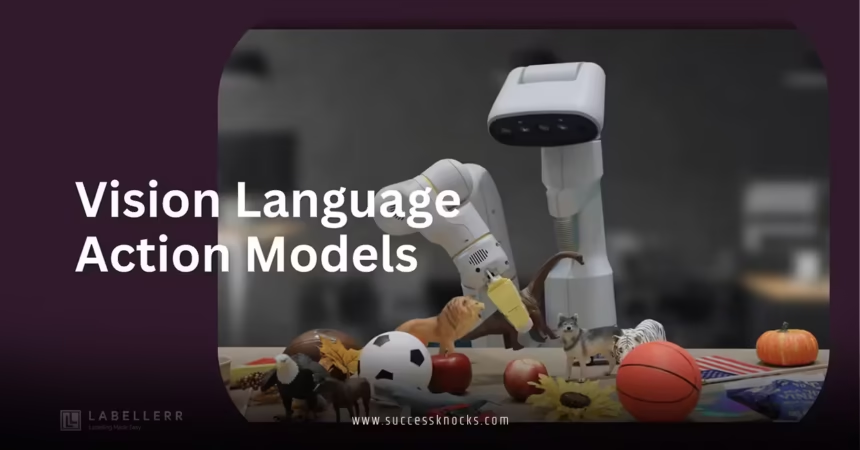
Vision-language-action (VLA) models are the reason robots in 2026 can hear “pick up the blue mug and put it in the sink” and actually do it — without a programmer hardcoding a single line for that specific mug. That’s the whole pitch in one sentence, and it’s not marketing spin. It’s a genuine architectural shift in how robots get built.
Here’s the quick rundown before we go deep:
- A VLA model fuses three things into one neural network: vision (cameras), language (instructions), and action (robot motor commands).
- It replaces the old “perception → planning → control” pipeline with one unified model trained end-to-end.
- VLAs generalize to new objects, phrasing, and sometimes new robots — something rule-based robotics never managed.
- Big names driving this space in 2026: RT-2, OpenVLA, Octo, and Physical Intelligence’s π0.7 compositional generalization zero-shot cross-embodiment model, which pushes generalization even further across different robot bodies.
- Most production teams today pair a VLA “brain” with a smaller, precise action-execution model for the fine motor work.
Let’s unpack how this actually works, because the mechanics matter more than the buzzword.
What Exactly Is a Vision-Language-Action Model?
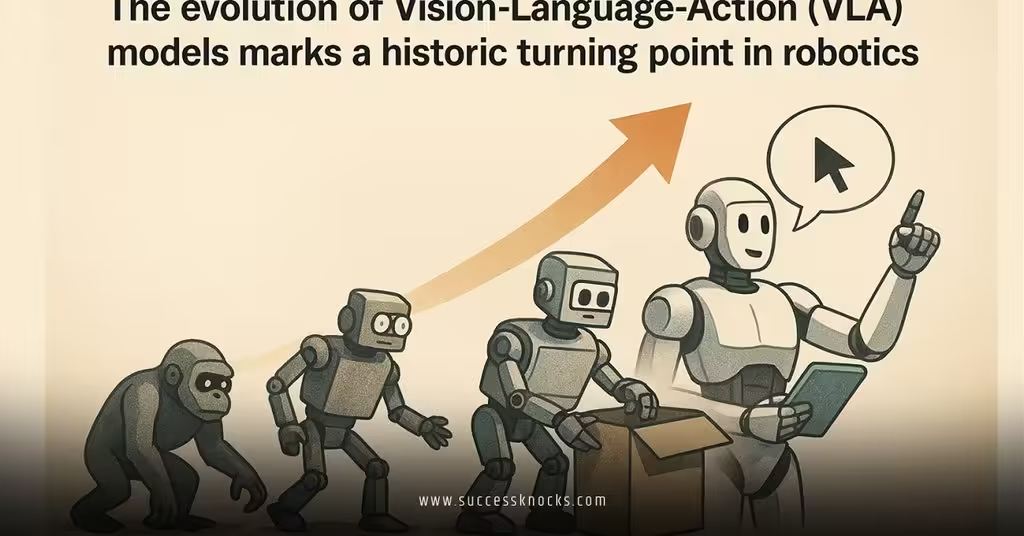
Picture the old way robots worked. Engineers wrote separate modules: one to detect objects, one to plan a path, one to control the arm. Each piece talked to the next through a narrow interface. Change one variable, and the whole chain could break.
VLA models threw that playbook out. A single neural network takes in a camera feed and a text instruction, then outputs motor commands directly. No hand-built pipeline in between.
The term itself was coined with Google DeepMind’s RT-2 paper, which showed that co-training a vision-language model on both web data and robot demonstrations produced emergent generalization — the robot could handle objects and phrasings it had never explicitly seen [1]. That was the “aha” moment for the field.
The Three Ingredients, Broken Down
Every modern VLA architecture, whether it’s OpenVLA, Octo, or Physical Intelligence’s π-series, leans on the same three components [2]:
- Visual encoder — extracts structured features from raw pixels (think DINOv2 or SigLIP).
- Language backbone — a large pretrained language or vision-language model that handles instructions and reasoning (Llama-2 and PaliGemma are common picks).
- Action decoder — converts the backbone’s output into executable commands, either as discretized tokens or through diffusion/flow-matching methods.
Swap out any one piece, and you get a different flavor of VLA. That’s why the field looks crowded but is really just remixing the same three building blocks.
Why Vision-Language-Action Models Matter for Everyday Robotics
Here’s the thing — most robots you’ve interacted with, even industrial ones, are narrow specialists. Teach them one task, and they’re brilliant at it. Ask for anything slightly different, and they choke.
VLA models chip away at that brittleness. Because the language backbone is pretrained on internet-scale text and image data, the robot inherits a rough understanding of the world before it ever sees a single robotics demonstration. That’s a shortcut nobody had access to a decade ago.
VLA Models Compared: What’s Actually Different Between Them
Not all VLAs are built the same, and picking one without understanding the trade-offs is a rookie mistake. Here’s how the major players stack up as of 2026.
| Model | Parameters | License | Action Method | Best Fit |
|---|---|---|---|---|
| OpenVLA | 7B | MIT (open) | Discretized tokens | Language-grounded manipulation, research |
| Octo | 27M–93M | MIT (open) | Diffusion policy | Consumer-GPU deployment, cross-embodiment |
| RT-2-X | 55B | Not publicly released | Discretized tokens | Reference benchmark only |
| Physical Intelligence π0 / π0.7 | Multi-billion | Partial open weights | Flow matching | Dexterous, long-horizon, cross-embodiment tasks |
Notice something? The biggest model isn’t automatically the best fit. OpenVLA, at 7B parameters, actually outperforms the 55B RT-2-X on several manipulation benchmarks while being far cheaper to run [3]. Size isn’t destiny in this field — training data diversity and action representation matter just as much.
Where Physical Intelligence’s π0.7 Fits Into the VLA Story
This is where things get interesting for anyone tracking the frontier. Standard VLAs like OpenVLA and Octo generalize reasonably well to new objects and phrasing. But cross-embodiment transfer — controlling a completely different robot body with zero retraining — has historically been the harder problem.
Physical Intelligence’s π0.7 compositional generalization zero-shot cross-embodiment approach tackles exactly that gap. Instead of training on one robot type, it deliberately trains on varied prompting formats and multiple embodiments simultaneously, so the model learns transferable skill “building blocks” rather than memorized motion sequences.
In practical terms: it’s the difference between a robot that knows how to fold shirts on Robot A, and one that can improvise folding shirts on Robot B it’s never touched. That second capability is what most of the industry is racing toward right now.
Step-by-Step: Getting Started With VLA Models as a Beginner
If you’re new to this and want to actually experiment rather than just read about it, here’s the path I’d walk someone through.
- Learn the core loop first. Understand that a VLA takes image + text in, and outputs an action vector out. Everything else is refinement.
- Pick an open-weight model to study. OpenVLA is the most beginner-friendly entry point — it’s MIT-licensed, hosted on Hugging Face, and well documented.
- Get familiar with Open X-Embodiment. This shared dataset, spanning dozens of robot types, underpins most modern VLA training and is publicly documented on arXiv [4].
- Run a small fine-tuning experiment. Use LoRA adapters on OpenVLA rather than full fine-tuning — it’s dramatically cheaper on consumer-class GPUs.
- Study cross-embodiment benchmarks. Compare how models like Octo and π0.7 perform on unfamiliar robots versus familiar ones — that gap tells you how “generalist” a model really is.
- Set realistic hardware expectations. A 7B-parameter VLA typically needs an A100-class GPU; lighter diffusion policies like Octo run fine on an RTX 4090.
Common Mistakes & How to Fix Them
Mistake: Assuming bigger models always generalize better.
Fix: Check benchmark data first. OpenVLA’s 7B model beats RT-2-X’s 55B on several tasks — parameter count isn’t the whole story [3].
Mistake: Treating VLA output as production-ready without a safety layer.
Fix: Pair the VLA “brain” with a narrower, well-tested action-execution policy, and keep human oversight active during early deployment. Most production teams already run this two-model setup.
Mistake: Ignoring licensing before building on a model.
Fix: RT-2-X weights were never publicly released. If you need something deployable and open, OpenVLA (MIT) or Octo (MIT) are the realistic starting points.
Mistake: Expecting zero-shot cross-embodiment to work flawlessly out of the box.
Fix: Even Physical Intelligence’s own benchmarks show performance dips on genuinely novel robot-task combinations compared to in-distribution tasks. Budget for that gap rather than being surprised by it.
Key Takeaways
- Vision-language-action (VLA) models merge perception, language understanding, and motor control into one trained network, replacing older modular robotics pipelines.
- RT-2 introduced the core idea; OpenVLA made it open-source and practical; Octo made it lightweight; Physical Intelligence pushed it toward dexterous, cross-embodiment control.
- The three universal components are a visual encoder, a language backbone, and an action decoder.
- Bigger isn’t automatically better — OpenVLA’s 7B model outperforms the 55B RT-2-X on key benchmarks.
- Cross-embodiment transfer, demonstrated by Physical Intelligence’s π0.7 compositional generalization zero-shot cross-embodiment work, is the current frontier problem in the field.
- Most real deployments combine a general VLA with a narrower, precise action-execution model.
- Beginners should start with OpenVLA and the Open X-Embodiment dataset before attempting custom training.
Robots that understand plain language and act on it aren’t science fiction anymore — they’re a licensing decision and a GPU budget away. If you’re evaluating this space, start small with an open-weight model, benchmark it honestly against your actual use case, and watch how the cross-embodiment work coming out of labs like Physical Intelligence trickles down into the tools you’ll eventually use.
FAQs
What’s the difference between a vision-language-action model and a standard computer vision model?
A computer vision model only identifies or classifies what’s in an image. A vision-language-action model goes further — it interprets a language instruction alongside the image and directly outputs robot motor commands, closing the loop from perception to physical action.
Can vision-language-action models run without expensive GPUs?
Yes, to a degree. Lightweight VLAs like Octo (27M–93M parameters) run on consumer GPUs such as an RTX 4090. Larger models, including 7B-parameter OpenVLA or Physical Intelligence’s multi-billion-parameter π-series, typically need A100-class or multi-GPU hardware.
How does Physical Intelligence’s π0.7 relate to general vision-language-action models?
π0.7 is a specific, advanced VLA model. Its compositional generalization zero-shot cross-embodiment capabilities represent one of the more advanced frontiers within the broader VLA field — showing that a single trained model can control robot bodies it’s never encountered before.