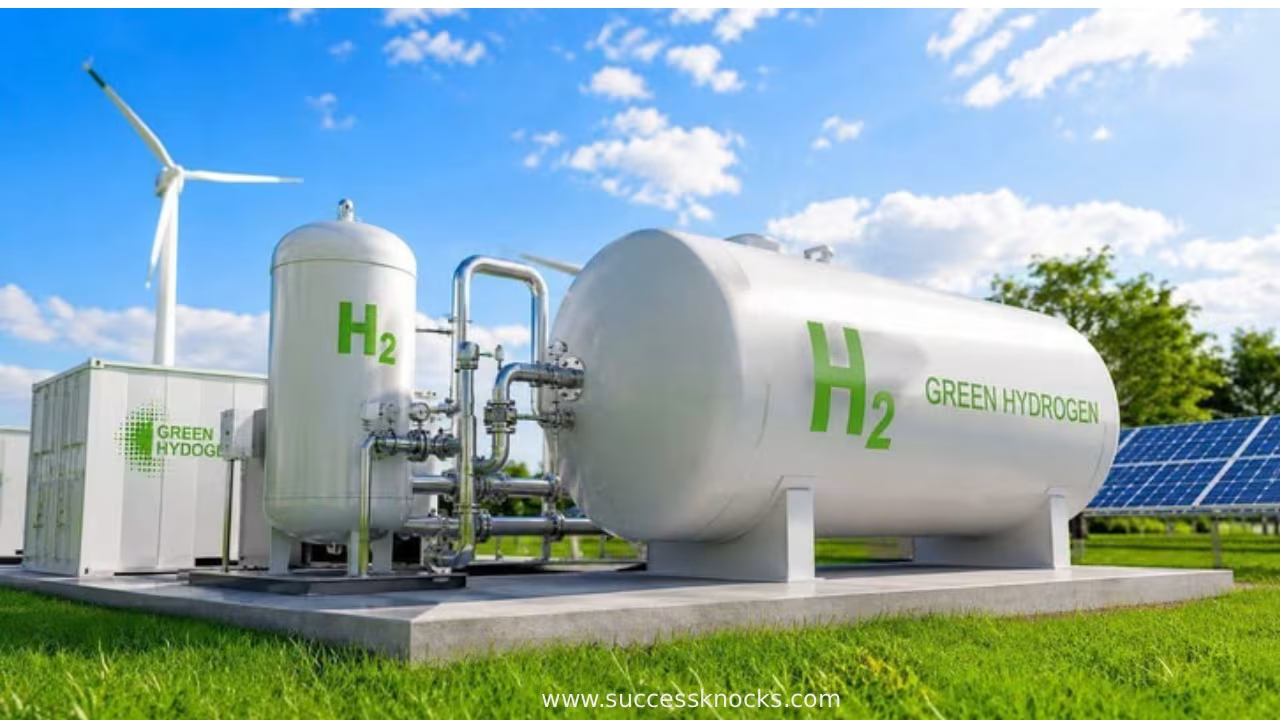
Green hydrogen supply chain business roles explained isn’t just a phrase for industry insiders — it’s the starting point for anyone trying to figure out where they fit in one of the most aggressively funded energy transitions of this decade.
Quick Overview: What You’re About to Learn
- The green hydrogen supply chain spans six distinct layers — from renewable power generation all the way to end-user delivery
- Each layer carries its own business model, capital requirement, and risk profile
- You don’t need to own an electrolyzer to profit from this market
- Non-production roles (logistics, software, compliance, maintenance) are the most accessible entry points for SMBs and investors
- Understanding where you sit in the chain determines your timeline to revenue and your exposure to regulatory risk
If you’re still mapping the full landscape of opportunity, the complete guide to green hydrogen business opportunities covers every major monetization angle in one place — worth reading before you specialize.
Green Hydrogen Supply Chain Business Roles Explained: The Six-Layer Framework
Think of the green hydrogen supply chain like a highway system. Somebody builds the road, somebody manufactures the vehicles, somebody runs the gas stations, somebody moves the freight, somebody manages traffic flow — and somebody insures all of it. None of those roles are the same job. None of them require the same skills or startup capital.
Here’s how those layers break down in practical terms:
Layer 1: Renewable Energy Generation (The Engine Room)
Before a single molecule of green hydrogen exists, you need clean electricity. Electrolysis — the process that splits water into hydrogen and oxygen — only earns the “green” label when powered by renewable sources like wind, solar, or hydropower.
Business roles in this layer include:
- Renewable energy developers who site, permit, and build solar or wind assets specifically for hydrogen production
- Power purchase agreement (PPA) brokers who connect electrolyzer operators with clean energy suppliers
- Grid integration consultants who manage the intermittency problem (because electrolyzers don’t love unstable power input)
Green Hydrogen Supply Chain Business Roles Explained Capital intensity here is high. This layer isn’t for bootstrappers — utility-scale solar or wind builds run into tens or hundreds of millions. But the service roles around it (brokering, consulting, permitting) are wide open.
Layer 2: Hydrogen Production (The Electrolyzer Operators)
This is the layer everyone talks about — and also the one with the highest barrier to entry. Electrolyzer systems, which range from small modular units to industrial-scale plants, are capital-intensive assets.
The U.S. Department of Energy’s Hydrogen Shot initiative targets green hydrogen production costs at $1 per kilogram by 2031, down from roughly $4–$6/kg today. That gap matters enormously for business planning.
Business roles here include:
- Electrolyzer plant operators (asset-heavy, high capex)
- Electrolyzer manufacturers and OEM suppliers — companies like Plug Power, Nel ASA, and ITM Power operate in this space
- Engineering, Procurement & Construction (EPC) contractors who build hydrogen production facilities for third-party owners
- Operations & Maintenance (O&M) service providers — lower capital, recurring revenue model
The kicker is this: O&M providers often lock in long-term service contracts before a facility even comes online. If you have industrial maintenance expertise, this is a lane worth examining seriously.
Layer 3: Hydrogen Storage (The Pressure Cooker Problem)
Hydrogen is notoriously difficult to store. It’s the lightest element in the universe — it wants to escape everything. Storing it at scale requires either extreme compression (700 bar for vehicles), cryogenic liquefaction (−253°C), or conversion to a hydrogen carrier like ammonia or liquid organic hydrogen carriers (LOHCs).
Green hydrogen supply chain business roles explained at the storage layer look like this:
| Role | Description | Capital Level | Entry Barrier |
|---|---|---|---|
| Compressed H₂ storage operator | Manages high-pressure tank infrastructure | High | Regulatory + Engineering |
| Cryogenic storage facility operator | Handles liquid hydrogen tanks | Very High | Specialized expertise |
| LOHC technology provider | Converts H₂ to/from carrier molecules | Medium-High | IP and licensing |
| Storage system integrator | Designs and installs modular storage for end users | Medium | Engineering background |
| Safety compliance consultant | Ensures storage assets meet DOT/OSHA/NFPA standards | Low-Medium | Certification + experience |
Safety compliance consulting and system integration are the sleeper roles here — fragmented, underserved, and increasingly mandated as more storage facilities come online across the U.S.
Layer 4: Transportation & Logistics (Moving the Molecule)
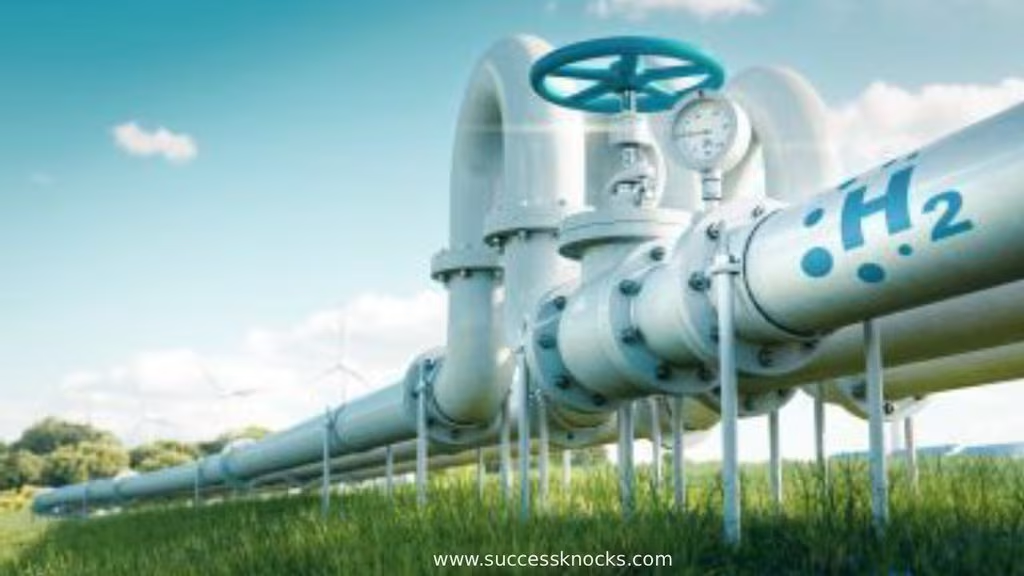
Green Hydrogen Supply Chain Business Roles Explained Getting hydrogen from a production site to a customer is, frankly, a solved problem in some contexts and a nightmare in others. The U.S. pipeline network carries about 1,600 miles of dedicated hydrogen pipelines today — compared to 3+ million miles of natural gas infrastructure. That gap is a business opportunity hiding in plain sight.
Business roles:
- Tube trailer logistics operators — compressed hydrogen transported by road in high-pressure cylinders
- Hydrogen tanker fleet operators — liquid hydrogen transport, similar to LNG logistics
- Pipeline developers and operators — large-scale, long-horizon infrastructure plays
- Port and terminal operators — import/export of hydrogen or ammonia for international supply chains
- Route optimization and fleet software developers — lighter capital, high scalability
One analogy that works well here: the early LNG (liquefied natural gas) industry had the same “last mile” problem 30 years ago. The businesses that solved the logistics layer — not just the production layer — built durable, defensible revenue streams. Green hydrogen is following that exact pattern.
Layer 5: Distribution & Dispensing (The Last Mile)
Green Hydrogen Supply Chain Business Roles Explained Distribution is the bridge between bulk transport and the end customer. Whether that’s a hydrogen fueling station for fuel cell electric vehicles (FCEVs), an industrial offtake point, or a utility blending facility, someone has to own and operate that final touchpoint.
Green hydrogen supply chain business roles explained at this layer include:
- Hydrogen fueling station developers and operators — H2 station infrastructure is expanding rapidly across California, Texas, and the Northeast
- Hydrogen dispensing equipment suppliers — nozzles, meters, dispensers, compressors
- Industrial hydrogen distributors — B2B supply agreements with refineries, chemical plants, steel manufacturers
- Utility blending operators — entities that blend hydrogen into existing natural gas grids (subject to evolving state and federal regulation)
This is also the layer most visible to end consumers. If you’ve seen an H2 fueling station branded by Shell, BP, or a startup like True Zero, that’s this layer in action.
Layer 6: End-Use Applications (Where Demand Drives Everything)
No supply chain survives without a customer at the end of it. Green hydrogen’s end-use markets are diverse — and the diversity of demand is exactly why the supply chain supports so many different business models.
Key demand segments driving U.S. market growth in 2026:
- Heavy transport: Long-haul trucking and commercial fleets running on fuel cells
- Industrial decarbonization: Steel, cement, and chemicals — sectors where electrification alone won’t cut it
- Power generation: Hydrogen-to-power for grid balancing and backup
- Aviation and maritime: Sustainable aviation fuel (SAF) pathways and green ammonia for shipping
Business roles here aren’t just energy companies. Technology integrators, procurement specialists, sustainability consultants, and fleet transition advisors all operate at this layer — often with minimal direct exposure to hydrogen infrastructure itself.
Action Plan for Beginners: How to Find Your Place in the Chain
Not sure where to start? Here’s how I’d approach it if I were entering this space fresh in 2026.
Step 1: Map your existing expertise to a supply chain layer.
Are you in logistics? Look at Layer 4. Industrial maintenance? Layer 2 O&M. Compliance or regulatory work? Layers 3 and 5 are calling your name.
Step 2: Identify your capital ceiling.
Be honest. Production and storage assets require serious capital or institutional backing. Service, software, and consulting roles can often be launched lean.
Step 3: Get the credentials that actually matter.
The U.S. Department of Energy’s Hydrogen and Fuel Cell Technologies Office maintains a free resource library including workforce development pathways.
Step 4: Target markets with active hydrogen infrastructure build-out.
California’s CARB mandates, Texas’s industrial hydrogen corridor, and the DOE’s seven Regional Clean Hydrogen Hubs (H2Hubs) are where near-term contracts are forming. The Hydrogen Forward coalition tracks policy and market development updates worth bookmarking.
Step 5: Pilot small, then scale.
A single service contract, a small consulting engagement, or a distribution agreement in one geography tells you more about real market dynamics than six months of desk research.
Step 6: Watch the certification and regulatory layer closely.
The NFPA 2: Hydrogen Technologies Code governs safety standards for hydrogen facilities in the U.S. Knowing this standard — truly knowing it — is a competitive differentiator.
Common Mistakes and How to Fix Them
Mistake 1: Treating “green hydrogen” as one monolithic business.
The supply chain has six distinct layers. Each has different margins, timelines, and risk profiles. Fix it: pick a layer, understand its economics deeply, and specialize.
Mistake 2: Waiting for production costs to drop before moving.
The businesses profiting today aren’t mostly producers — they’re service providers, system integrators, and logistics operators supporting the infrastructure buildout that will eventually make cheap green hydrogen viable. Don’t wait for perfect unit economics to find your role.
Mistake 3: Ignoring the regulatory environment.
This sector is heavily shaped by the Inflation Reduction Act’s Section 45V hydrogen production tax credit, state-level incentives, and evolving safety codes. Compliance ignorance is a business risk, full stop.
Mistake 4: Overestimating the capital required for entry.
What usually happens is that newcomers look at electrolyzer price tags and walk away. But roles like safety consulting, route optimization software, workforce training, and O&M services require far less upfront capital than most people assume. If you’re unsure what entry into this space actually costs by role, this breakdown of low-capital green hydrogen entry points will reframe the conversation.
Mistake 5: Forgetting that the supply chain is international.
U.S. companies importing hydrogen or hydrogen derivatives (like green ammonia) interact with global supply chains. Understanding which countries are building export capacity matters for sourcing strategy and competitive positioning.
Key Takeaways
- Green hydrogen supply chain business roles span six layers: renewable energy generation, hydrogen production, storage, transportation, distribution, and end-use application
- Not every profitable role is capital-intensive — O&M services, safety compliance, logistics software, and consulting can all be bootstrapped or launched lean
- The DOE’s Hydrogen Shot targets $1/kg production cost, but near-term business opportunities don’t require that milestone to arrive first
- U.S. Regional Clean Hydrogen Hubs are active procurement and partnership magnets right now
- Regulatory fluency (45V tax credit rules, NFPA 2, DOT transport regulations) is a genuine competitive advantage
- The most underserved roles are in storage safety, logistics optimization, and workforce training
- Picking the wrong layer for your capital position and skill set is the most common strategic error new entrants make
The green hydrogen supply chain isn’t waiting for anyone to figure it out slowly. Infrastructure is being built, contracts are being signed, and the businesses that understand the structure of this chain — layer by layer — are the ones writing the proposals that win. Know your layer. Know your role. Move with specificity.
FAQs
Q: How are green hydrogen supply chain business roles explained differently from traditional hydrogen roles?
Green hydrogen supply chain business roles are explained best through the lens of decarbonization intent and power sourcing. Traditional hydrogen (“grey” or “blue”) production relies on fossil fuels, meaning the supply chain is dominated by oil and gas incumbents. Green hydrogen introduces entirely new layers — renewable energy integration, electrolyzer O&M, sustainable logistics — that create fresh entry points for businesses outside the fossil fuel ecosystem.
Q: Which supply chain layer offers the fastest path to revenue for a small business?
In my experience, Layer 2 O&M services, Layer 3 safety compliance consulting, and Layer 4 logistics optimization consistently offer the fastest revenue timelines for small businesses. These roles plug into existing hydrogen projects under construction rather than requiring you to build assets from scratch. The bidding cycles are shorter and the capital requirements are dramatically lower.
Q: Do I need specialized certifications to enter any of these roles?
It depends on the layer. Storage and dispensing roles require familiarity with NFPA 2 and relevant DOT/OSHA standards — formal certification training is widely available. Production-side O&M often requires industrial maintenance credentials. Consulting and software roles are less regulated but demand demonstrated technical fluency to win serious clients. Credentials matter most in the safety-adjacent roles; expertise and track record matter most everywhere else.