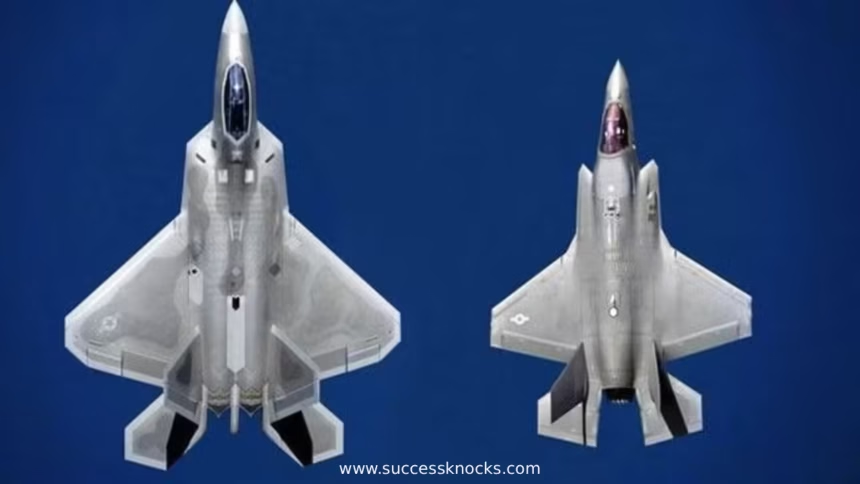
F-22 vs F-35 represents the most significant shift in air combat philosophy since the introduction of jet fighters, pitting two revolutionary stealth aircraft against each other in a comparison that defines modern air warfare. While both jets share fifth-generation technology, they embody radically different strategic visions—one prioritizing unmatched air superiority, the other emphasizing global interoperability and cost-effective multirole capability.
Here’s what separates the F-22 vs F-35 debate:
- F-22 Raptor: Twin-engine air dominance fighter optimized for stealth and supercruise capability
- F-35 Lightning II: Single-engine multirole platform designed for international cooperation and versatility
- Key distinction: F-22 maximizes air superiority performance; F-35 balances capability with affordability and alliance integration
- Production status: F-22 production ended in 2012; F-35 continues with 3,000+ aircraft planned
- Strategic impact: F-22 maintains American air dominance; F-35 strengthens allied air power globally
Why the F-22 vs F-35 Comparison Matters More Than Ever
Unlike the F15 vs F16 debate that focused on fourth-generation design philosophies, the F-22 vs F-35 discussion represents competing visions for twenty-first century air power. These aren’t just upgraded versions of existing fighters—they’re fundamental reimaginings of what air combat means in an era of advanced radar systems, integrated air defenses, and network-centric warfare.
The F-22 Raptor emerged from the Advanced Tactical Fighter program with one mandate: achieve and maintain air superiority against any conceivable threat. No compromises. No cost considerations. Pure technological supremacy.
The F-35 Lightning II followed a different path entirely.
What if stealth technology could be democratized? What if allied nations could operate advanced fighters without breaking their defense budgets? What if one platform could serve air forces, navies, and marine corps simultaneously?
The F-35 program answered those questions with the largest military procurement program in history.
F-22 vs F-35: Technical Specifications Breakdown
| Feature | F-22 Raptor | F-35 Lightning II |
|---|---|---|
| First Flight | 1997 | 2006 |
| Engines | Twin Pratt & Whitney F119 | Single Pratt & Whitney F135 |
| Max Speed | Mach 2.25 (supercruise Mach 1.8) | Mach 1.6 |
| Combat Radius | 590 miles | 670 miles (A variant) |
| Stealth Focus | Air-to-air optimized | Multirole optimized |
| Unit Cost | ~$150 million | ~$80-100 million |
| Production Total | 187 aircraft | 3,000+ planned |
| Export Status | U.S. only | 15+ partner nations |
The F-22 Raptor: Redefining Air Superiority
When Lockheed Martin designed the F-22, they created something unprecedented: a fighter that could remain invisible to enemy radar while engaging targets at beyond-visual-range with impunity.
F-22 Revolutionary Capabilities
Supercruise changes everything in air combat. While other fighters achieve supersonic speeds using fuel-hungry afterburners, the F-22 cruises at Mach 1.8+ without afterburner. That’s not just about speed—it’s about energy management, fuel efficiency, and tactical flexibility that no other operational fighter can match.
The stealth characteristics aren’t just radar cross-section reduction—they represent a holistic approach to signature management. Infrared suppression, acoustic dampening, and electromagnetic emissions control create what pilots describe as “tactical invisibility.”
Vector thrust capability enables maneuvers that defy conventional aerodynamics. When F-22 pilots talk about “impossible” angles of attack and instantaneous direction changes, they’re describing capability gaps that remain unmatched in 2026.
The U.S. Air Force credits the F-22 with maintaining American air superiority against increasingly sophisticated threats from near-peer adversaries.
F-22 Strategic Limitations
But perfection comes with costs that extend beyond mere dollars.
Production limitations mean only 187 F-22s exist globally. That’s barely enough to maintain deterrent capability across multiple theaters, let alone sustain intensive combat operations.
Export restrictions prevent allied nations from acquiring F-22 technology, limiting interoperability and burden-sharing opportunities that define modern coalition warfare.
Maintenance complexity requires specialized facilities and highly trained technicians. The F-22’s stealth coatings and advanced systems demand care that smaller air forces simply cannot provide.
The F-35 Lightning II: Democratizing Fifth-Generation Technology
The F-35 took stealth fighter technology in a completely different direction, prioritizing accessibility, interoperability, and multirole effectiveness over absolute performance.
F-35 Game-Changing Advantages
Sensor fusion represents the F-35’s most significant advancement. The Distributed Aperture System and advanced radar create situational awareness that transforms air combat from reactive engagement to proactive battlefield management.
Three variants serve different service requirements without losing commonality. The F-35A conventional takeoff variant, F-35B short takeoff/vertical landing model, and F-35C carrier-capable version share 80%+ parts commonality while meeting distinct operational needs.
International cooperation isn’t just a sales strategy—it’s fundamental to the F-35’s design philosophy. Partner nations contributed to development costs while gaining access to technology that would otherwise remain exclusively American.
The multirole capability spans air-to-air combat, precision strike, close air support, reconnaissance, and electronic warfare missions. One platform. Multiple mission sets. Simplified logistics.
F-35 Performance Trade-offs
Single-engine configuration limits redundancy compared to twin-engine designs like the F-22. While the F135 engine is exceptionally reliable, that backup powerplant isn’t there when operating over hostile territory.
Speed limitations become apparent when compared directly to the F-22’s supercruise capability. The F-35 simply cannot match the Raptor’s sustained supersonic performance without afterburner.
Stealth optimization for multirole missions means compromises in pure air-to-air stealth characteristics. The F-35’s radar cross-section, while still minimal, doesn’t match the F-22’s air superiority-focused signature reduction.
Combat Doctrine: How F-22 vs F-35 Shapes Modern Air Warfare
The operational employment of both aircraft reveals fundamentally different approaches to air power projection.
F-22 Air Superiority Doctrine
The F-22 operates as the tip of the spear in contested airspace. Its mission: clear the skies of enemy fighters and create safe operating environments for other coalition aircraft.
Typical F-22 operations involve:
- First-day-of-war air superiority missions
- Counter-air operations against advanced threats
- High-value target protection
- Deterrent patrols in sensitive areas
The Department of Defense employs F-22s strategically, positioning small numbers to maximum psychological and tactical effect.
F-35 Multirole Integration
The F-35 serves as a multirole force multiplier, combining stealth penetration with comprehensive mission capability. Its sensor systems often provide situational awareness for entire strike packages.
F-35 mission profiles include:
- Suppression of enemy air defenses
- Precision strike against high-value targets
- Close air support in contested environments
- Intelligence, surveillance, and reconnaissance
- Electronic warfare support
International Impact: F-22 vs F-35 Global Strategies
The export policies surrounding both aircraft reflect broader strategic considerations about technology sharing and alliance management.
F-22 Export Restrictions
Congressional limitations prevent F-22 exports, maintaining exclusive American access to the world’s most advanced air superiority fighter. This policy preserves technological advantages while limiting cost-sharing opportunities.
The restriction means allied nations must rely on alternative platforms or wait for future American willingness to share F-22 technology—creating capability gaps in coalition operations.
F-35 Partnership Model
The F-35 program pioneered international defense cooperation on unprecedented scales. Partner nations including the United Kingdom, Italy, Netherlands, Australia, Canada, Denmark, and Norway contributed development funding in exchange for technology access and production participation.
This approach created a global F-35 community with shared training, logistics, and operational procedures that strengthen alliance capabilities while reducing individual nation costs.
Additional foreign military sales to countries like Israel, Japan, and South Korea further expand the F-35’s global footprint and interoperability advantages.
Technology Evolution: Advanced Systems in F-22 vs F-35 Platforms
Both aircraft incorporate cutting-edge technology, though their focus areas reflect different design priorities.
F-22 Advanced Technologies
The F-22’s technology suite prioritizes air-to-air combat excellence:
- AN/APG-77 AESA radar with exceptional range and low probability of intercept
- Advanced electronic warfare systems for self-protection and offensive operations
- Integrated communications systems enabling beyond-line-of-sight coordination
- Sophisticated flight control systems managing inherently unstable aerodynamics
F-35 Technological Integration
The F-35 emphasizes sensor fusion and multirole adaptability:
- AN/APG-81 AESA radar optimized for both air-to-air and air-to-ground missions
- Electro-optical targeting systems providing 360-degree coverage
- Advanced electronic warfare capabilities integrated with mission systems
- Helmet-mounted display systems projecting critical information directly to pilot vision
Cost Analysis: Economic Realities of F-22 vs F-35 Programs
Military procurement decisions increasingly focus on cost-effectiveness over absolute capability, making economic analysis crucial to F-22 vs F-35 comparisons.
F-22 Program Economics
The F-22’s total program cost exceeded $67 billion for 187 aircraft, creating per-unit costs approaching $150 million. These figures reflect development amortization across a limited production run.
Operating costs compound the economic challenge. The F-22’s maintenance requirements, specialized facilities, and limited global logistics network create ongoing expenses that limit deployment frequency.
F-35 Cost Structure
The F-35 program’s scale enables cost efficiencies impossible with smaller production runs. Current unit costs range from $80-100 million depending on variant, with further reductions expected as production scales increase.
International cost-sharing through partner nation participation reduces American financial burden while creating sustainable long-term economics for global operators.
The larger production base enables economies of scale in spare parts, training systems, and support equipment that benefit all operators.
Step-by-Step Guide: Understanding F-22 vs F-35 Mission Applications
When analyzing F-22 vs F-35 applications, consider these operational factors:
- Assess Threat Environment Complexity
- Near-peer adversaries with advanced air defenses = F-22 advantages critical
- Mixed threat scenarios = F-35 versatility valuable
- Limited air opposition = F-35 cost-effectiveness optimal
- Evaluate Mission Requirements
- Air superiority focus = F-22 unmatched capability
- Multirole flexibility needed = F-35 comprehensive solution
- Alliance integration priority = F-35 interoperability essential
- Consider Resource Availability
- Unlimited budget = F-22 performance advantages clear
- Cost constraints = F-35 provides better value proposition
- International cooperation desired = F-35 enables partnership
- Analyze Long-term Strategic Goals
- Technology advantage maintenance = F-22 preserves edge
- Alliance strengthening = F-35 builds coalition capability
- Global presence projection = F-35 numbers enable coverage
Common Mistakes in F-22 vs F-35 Analysis
Mistake 1: Assuming Direct Competition
The F-22 vs F-35 comparison often incorrectly treats them as competing for identical roles. They serve complementary functions in modern air power structures.
Fix: Evaluate each aircraft’s mission-specific advantages rather than head-to-head comparisons.
Mistake 2: Ignoring Production Economics
Focusing on per-unit costs while ignoring program-wide economics leads to incomplete analysis.
Fix: Consider total program costs, international partnerships, and long-term sustainability factors.
Mistake 3: Overlooking Strategic Implications
Technical specifications don’t capture the broader strategic impacts of export policies and alliance relationships.
Fix: Include diplomatic, alliance, and technology-sharing considerations in platform evaluation.
Mistake 4: Underestimating Operational Complexity
Both platforms require sophisticated support infrastructures that significantly impact deployment capability.
Fix: Assess maintenance requirements, pilot training needs, and logistics complexity in realistic operational contexts.
Mistake 5: Discounting Legacy Platform Integration
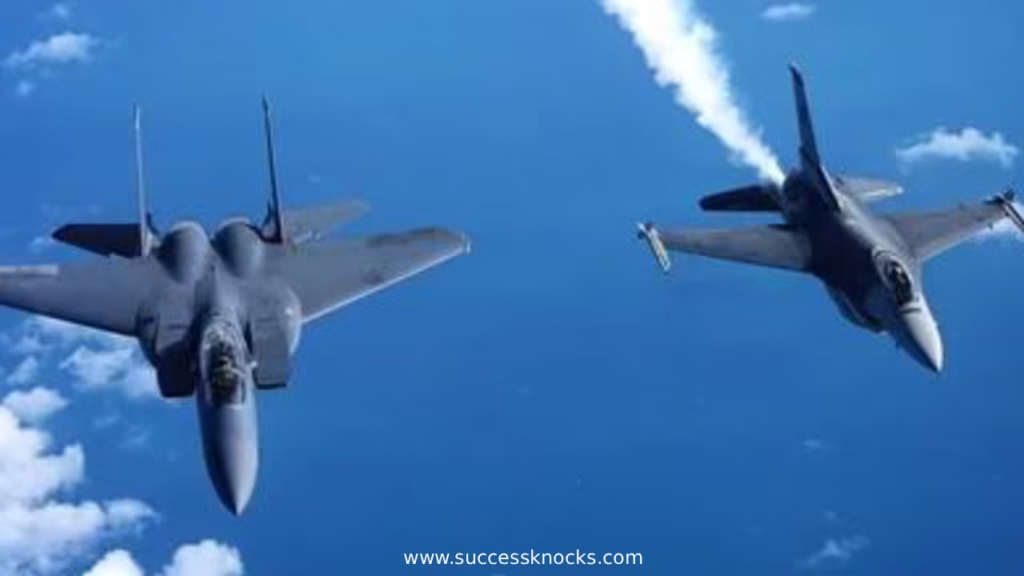
Modern air operations require integration with existing fourth-generation fighters like those analyzed in F15 vs F16 discussions.
Fix: Consider how fifth-generation platforms complement rather than replace existing capabilities.
Future Development: F-22 vs F-35 Evolution Paths
Both programs continue evolving to meet emerging threats and incorporate advancing technology.
F-22 Modernization Efforts
Despite production conclusion, the Air Force continues investing in F-22 capability upgrades:
- Advanced radar modes and processing capability
- Enhanced electronic warfare systems
- Improved weapons integration including hypersonic missiles
- Updated communications and networking systems
These improvements maintain the F-22’s technological edge while extending operational relevance through the 2040s.
F-35 Continuous Development
The F-35 program’s ongoing nature enables regular capability additions:
- Block 4 upgrades expanding weapons compatibility and sensor capability
- Enhanced electronic warfare systems
- Improved maintenance procedures reducing operating costs
- Advanced pilot training systems leveraging virtual reality technology
Continuous improvement processes ensure the F-35 remains competitive throughout its planned service life.
Operational Integration: F-22 vs F-35 in Combined Operations
Modern air campaigns increasingly rely on coordinated operations between different platform types, making integration capability crucial.
F-22 Integration Advantages
The F-22’s air superiority focus enables other aircraft to operate more effectively:
- Clearing contested airspace for follow-on strikes
- Providing overwatch for multirole fighters
- Establishing air superiority bubbles for non-stealthy platforms
F-35 Network Integration
The F-35’s sensor fusion capability provides battlefield awareness for entire strike packages:
- Sharing targeting data with other coalition aircraft
- Coordinating suppression of enemy air defense missions
- Enabling precision strikes in complex threat environments
Key Takeaways: What Matters Most in F-22 vs F-35 Decisions
- Mission focus determines choice: F-22 for air dominance, F-35 for multirole flexibility and alliance integration
- Production numbers affect strategy: F-22’s limited quantity vs F-35’s mass production creates different operational implications
- Cost considerations are paramount: Economic sustainability increasingly drives procurement decisions
- Export policies shape alliances: F-35’s international availability strengthens coalition warfare capability
- Technology advancement continues: Both platforms receive ongoing upgrades maintaining competitive advantages
- Integration capability matters: How platforms work together often more important than individual specifications
- Strategic implications extend beyond military: Technology sharing and alliance relationships influence platform value
- Legacy platform integration remains crucial: Fifth-generation fighters complement rather than replace fourth-generation capabilities
Conclusion
The F-22 vs F-35 comparison illuminates two competing visions for air power’s future that both succeeded at their intended objectives.
The F-22 Raptor represents the pinnacle of air superiority technology, maintaining American dominance in contested airspace through unmatched performance and capability. When absolute air superiority is non-negotiable, the F-22 remains without peer.
The F-35 Lightning II demonstrates how advanced technology can be democratized without compromising effectiveness, enabling allied nations to operate fifth-generation capabilities while strengthening coalition warfare capacity.
In 2026’s complex security environment, the most successful air forces don’t choose between these platforms—they understand how each contributes to comprehensive air power projection.
The F-22 clears the skies. The F-35 owns the battlespace. Together, they create layered capability that no adversary can match.
The real victory isn’t in picking sides in the F-22 vs F-35 debate—it’s in recognizing how both platforms advance air power into the next generation of warfare.
Choose based on mission. Integrate based on capability. Dominate based on understanding the synergy.
Frequently Asked Questions
Q: Which is more advanced, the F-22 or F-35 in terms of technology?
A: Both incorporate cutting-edge technology optimized for different missions. The F-22 features more advanced air-to-air systems and supercruise capability, while the F-35 offers superior sensor fusion and multirole integration. Neither is universally “more advanced”—they excel in different technological areas.
Q: Why can’t other countries buy the F-22 like they can the F-35?
A: Congressional legislation prohibits F-22 exports to protect sensitive stealth and supercruise technologies. The F-35 was designed from the beginning as an international program with partner nation participation, making export both legally permissible and strategically beneficial for alliance relationships.
Q: How does the F-22 vs F-35 comparison relate to older fighters like the F-15 and F-16?
A: While F15 vs F16 represented fourth-generation design philosophy differences, F-22 vs F-35 shows how fifth-generation technology addresses different strategic needs. Both newer platforms would outperform older fighters, but they serve complementary rather than replacement roles in comprehensive air forces.
Q: Which aircraft is more cost-effective for smaller air forces?
A: The F-35 offers better cost-effectiveness for most operators due to lower unit costs, international support networks, and multirole capability. The F-22’s performance advantages typically justify costs only for nations facing the most sophisticated air threats requiring absolute air superiority.
Q: Will there be a replacement for either the F-22 or F-35?
A: The U.S. Air Force is developing the Next Generation Air Dominance (NGAD) program as a potential F-22 successor, while the F-35 will likely receive continuous upgrades extending its service life through the 2070s. Both platforms represent long-term investments in air superiority and multirole capability.