Russian military expansion at six Libyan airbases 2026 has become one of the most consequential geopolitical stories nobody’s talking about at the dinner table. And that’s a problem, because this quietly reshapes power along NATO’s southern flank.
Here’s the fast version before we dig in.
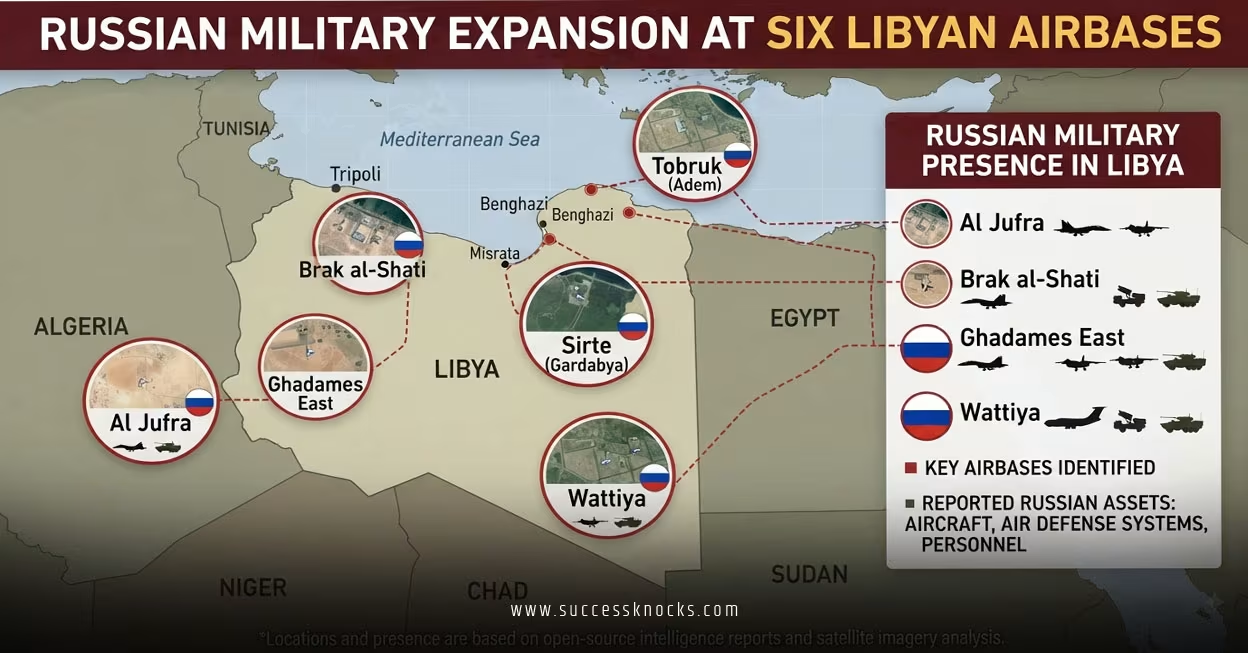
- Russia is building, funding, and staffing infrastructure at six Libyan air bases — Al-Jufra, Al-Khadim, Al-Qardabiyah, Brak al-Shati, Maaten al-Sarra, and Tamanhint.
- The work is tracked through satellite imagery by the National Geospatial-Intelligence Agency’s Tearline Project.
- Africa Corps, the Kremlin-run successor to Wagner Group, runs personnel and logistics at these sites.
- New hangars, barracks, and even a possible communications tower have gone up since 2024.
- Personnel numbers at some bases have grown fast — one site jumped from roughly 300 to 450 troops in a matter of months.
That’s the skeleton. Now let’s put some meat on it.
What Is Driving Russian Military Expansion at Six Libyan Airbases in 2026?
Simple answer: Wagner’s collapse created a vacuum, and the Kremlin filled it fast.
After Yevgeny Prigozhin died in August 2023, Moscow didn’t walk away from Africa. It rebranded. Africa Corps absorbed most of Wagner’s old personnel and hardware, but this time it reports directly up through Russia’s GRU and a deputy defense minister [1].
That’s not a mercenary outfit freelancing anymore. That’s state policy with a paint job.
By April 2024, flights carrying between 1,000 and 1,500 Africa Corps troops started landing in southern Libya. Within four months, deployed personnel across various Libyan sites reportedly reached 2,000 to 2,500 [1].
The kicker? This isn’t random troop movement. It’s infrastructure-first strategy — runways, hangars, housing — built to last, not to bug out next spring.
Why Libya, Specifically?
Location, location, location. Libya sits on the Mediterranean, a short hop from NATO’s soft underbelly in southern Europe, and it’s the gateway into the Sahel — Mali, Niger, Sudan, Chad.
Control a handful of Libyan air bases and you control a logistics corridor stretching from the Med to central Africa. That’s the whole game.
The Six Bases Driving Russian Military Expansion at Six Libyan Airbases 2026
Let’s get specific, because vague talk about “Russian activity in Libya” doesn’t tell you much. The six confirmed sites, according to Tearline’s satellite analysis, are scattered across central, eastern, and southern Libya [1][2].
| Air Base | Location | Notable 2024–2026 Developments | Strategic Role |
|---|---|---|---|
| Al-Jufra | Central Libya | Major logistics hub, long-standing Russian presence | Central staging point for Sahel operations |
| Al-Khadim | ~100 km east of Benghazi | 3 new hangars, recreation center, communications tower, barracks added in 2026 | Transit hub between Libya and Sudan/Sahel, arms trafficking route |
| Al-Qardabiyah | Near Sirte | Runway and facility upgrades | Coastal access point |
| Brak al-Shati | Central-southwest Libya | Personnel grew from ~300 to 450 since Dec. 2024; new hangar and maintenance buildings | Troop concentration and staging |
| Maaten al-Sarra | Near Chad/Sudan border | Reactivated after sitting abandoned since 2011; Libyan personnel led work with Russian/Syrian support | Sahel operations launchpad |
| Tamanhint (Sabha) | Southern Libya | New housing quarters, resurfaced roads, runway modifications | Arms shipment route to Sudan’s RSF |
A seventh site worth watching: Tobruk Port and Tobruk Air Base. Reports say Russia wants to invest there too, though satellite imagery hasn’t confirmed construction yet [2].
Common Mistakes People Make Analyzing This Story (And How to Fix Them)
I’ve read a dozen breathless takes on this topic. Most of them stumble in predictable ways.
Mistake #1: Confusing “Wagner” with “Africa Corps.” Wagner is dead as an organizational entity. Africa Corps replaced it and answers directly to Russia’s military chain of command. Treating them as interchangeable muddies who’s actually accountable.
Mistake #2: Assuming the Libyan government invited all this. Not quite. At Maaten al-Sarra specifically, Libyan personnel led the implementation while Russian and Syrian elements supported — the Kremlin doesn’t fund every project outright [2]. Independent Libyan initiatives can’t be ruled out at every site.
Mistake #3: Treating satellite imagery as proof of troop numbers. Imagery shows construction — hangars, barracks, fences. It doesn’t hand you an exact headcount. Estimates on personnel come from a mix of imagery analysis and open-source reporting, not hard census data.
Mistake #4: Ignoring the Sahel angle entirely. Most coverage fixates on “Russia vs. NATO.” But the bigger prize might be Sudan, Mali, and Niger — resource access and influence that dwarfs anything happening on Libya’s coast.
Step-by-Step: How to Track Russian Military Expansion at Six Libyan Airbases 2026 Yourself
If you want to follow this beyond headlines, here’s what I’d do.
- Bookmark Tearline’s public reports. The NGA-backed project publishes satellite-based analysis directly and updates as new construction appears [2].
- Check reputable defense-focused outlets regularly, particularly ones citing named intelligence sources rather than anonymous “officials say” language.
- Cross-reference dates. Construction claims tied to specific months (say, “barracks added in 2026”) are far more credible than vague “recently” language.
- Watch for Sudan and Sahel spillover stories. Arms shipments through Tamanhint and Al-Khadim toward Sudan’s Rapid Support Forces are a useful leading indicator of what Russia’s actually using these bases for [1].
- Read Libyan political reactions too. Local forums have flagged that continued foreign military presence complicates unifying Libya’s fractured institutions — that’s a domestic political story, not just a geopolitical one.
What This Means for the U.S. and NATO
In my experience covering foreign military footholds, the pattern is always the same: infrastructure first, ambiguity second, leverage third.
Russia isn’t announcing a permanent Mediterranean base with a press conference. It’s pouring concrete for hangars and calling it “infrastructure cooperation.” That’s the playbook.
Should Americans be alarmed? Somewhat — but panic isn’t the right response either. What matters is that a persistent Russian air and logistics presence 300 miles from Sicily changes calculations for NATO’s southern flank, full stop.
Think of it like a neighbor slowly building a shed that keeps growing new rooms. No permit filed, no loud announcement — just steady expansion until one day it’s bigger than your house.
Is Washington watching closely? Reports suggest yes, with U.S. intelligence assessments feeding directly into public tracking projects like Tearline [2].
Key Takeaways
- Russian military expansion at six Libyan airbases 2026 centers on Al-Jufra, Al-Khadim, Al-Qardabiyah, Brak al-Shati, Maaten al-Sarra, and Tamanhint.
- Africa Corps, not Wagner, now runs day-to-day operations, reporting directly to Russia’s GRU.
- Personnel counts have grown quickly at some sites — Brak al-Shati went from roughly 300 to 450 troops since December 2024.
- New construction includes hangars, barracks, recreation centers, and possibly a communications tower.
- Libya functions as a launchpad into the Sahel, with arms reportedly moving toward Sudan’s RSF through these bases.
- Tobruk Port and Tobruk Air Base are reportedly next on Russia’s investment list, though construction hasn’t been confirmed yet.
- Not every project ties directly to Kremlin funding — some involve Libyan-led implementation with Russian and Syrian support.
- The expansion places a persistent Russian presence uncomfortably close to NATO’s southern flank.
Bottom line: this isn’t a fringe story anymore. Russian military expansion at six Libyan airbases 2026 is reshaping the Mediterranean-Sahel corridor in real time, and it deserves more mainstream attention than it’s getting. Keep an eye on Tearline’s updates and credible defense reporting — that’s where the next chapter of this story gets written first.
FAQs
What triggered the current phase of Russian military expansion at six Libyan airbases 2026?
The collapse of Wagner Group after Prigozhin’s death and its replacement by the state-run Africa Corps in 2024 accelerated construction and troop deployment across these six sites.
Which Libyan air base has seen the fastest troop growth?
Brak al-Shati stands out — personnel there jumped from around 300 to 450 between December 2024 and mid-2026, according to satellite-based tracking.
Is the Russian military expansion at six Libyan airbases 2026 backed entirely by the Kremlin?
Mostly, but not entirely. At Maaten al-Sarra, Libyan personnel reportedly led construction with Russian and Syrian support rather than direct Kremlin funding for every project.