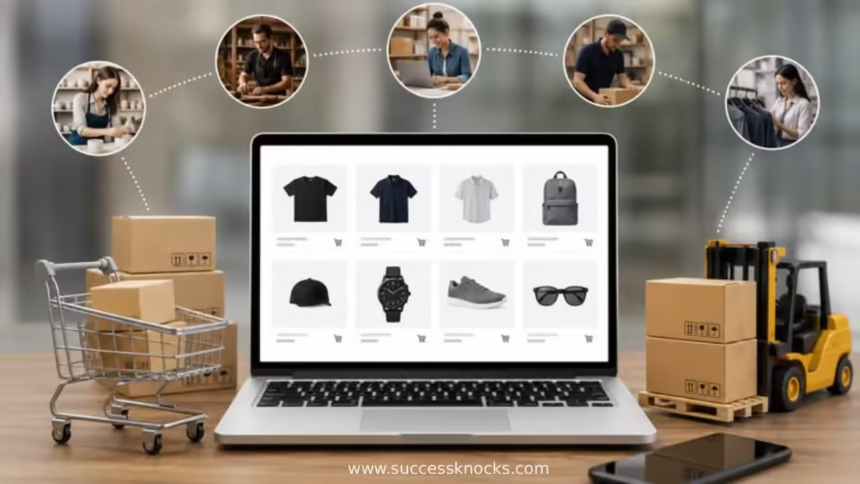
Best 3PL providers for small ecommerce brands don’t look anything like the mega-warehouse operations built for sellers shipping a million units a month — and treating them the same is how founders quietly bleed margin in year one.
Here’s the thing: most “top 10 3PL” lists are written for enterprise buyers, then slapped with a small-business headline. That’s not what you need. You need partners who’ll actually pick up your call when order volume spikes during a flash sale.
Quick answer, before we dig in:
- A 3PL (third-party logistics provider) stores your inventory, picks and packs orders, and ships them — so you’re not doing it from your garage.
- Small ecommerce brands need 3PLs with low minimums, fast onboarding, and integrations with Shopify, WooCommerce, or Amazon.
- Pricing usually breaks into receiving, storage, pick/pack, and shipping fees — rarely a flat rate.
- The best 3PL providers for small ecommerce brands specialize in agility, not just scale.
- Picking the wrong partner too early is one of the fastest ways to sink cash flow.
If you want the full landscape — trends, pricing shifts, and where outsourcing is headed — I laid that out in the bigger picture on 3PL outsourcing trends. This piece is the tactical, “just tell me who to call” version.
What a 3PL Actually Does (No Jargon, Promise)
Strip away the buzzwords and a 3PL is simple: it’s a warehouse, a team, and software that handles the physical side of your ecommerce business. Inventory sits on their shelves. Orders route through their system. Boxes leave from their dock, not yours.
For a solo founder or a five-person team, that’s the difference between fulfilling orders at midnight and actually sleeping. It’s outsourcing the boring-but-critical stuff so you can focus on product and marketing.
The catch? Not every 3PL is built for brands doing 200 orders a day instead of 20,000. That’s exactly where this list earns its keep.
How I Evaluated the Best 3PL Providers for Small Ecommerce Brands
I didn’t rank these on brand size or funding rounds. Small brands care about different things than enterprise shippers do, so the criteria shifted accordingly.
Here’s what actually moved the needle:
- Low or no minimum order volume — you shouldn’t need 10,000 units a month to get a contract.
- Fast, guided onboarding — weeks, not quarters.
- Native integrations with Shopify, BigCommerce, and major marketplaces.
- Transparent pricing with no mystery fees buried in the fine print.
- Real customer support, not a ticket queue that vanishes into a void.
If pricing structures are still fuzzy for you, I walked through every fee type — receiving, pick/pack, dim weight, the works — in this breakdown on choosing a 3PL provider. Worth a read before you sign anything.
The Best 3PL Providers for Small Ecommerce Brands, Compared
Here’s the shortlist I’d actually hand a friend launching a store this year. Pricing ranges are general — always request a current quote, since fuel surcharges and warehouse labor costs shift.
| Provider | Best For | Pricing Model | Standout Feature | Small-Brand Fit |
|---|---|---|---|---|
| ShipBob | Multi-channel DTC brands | Usage-based (receiving, storage, pick/pack) | Strong Shopify/BigCommerce integrations, multiple warehouse nodes | High |
| ShipMonk | Subscription boxes, growing SKUs | Tiered based on order volume | Kitting, bundling, and returns automation | High |
| Red Stag Fulfillment | Heavy, bulky, or high-value items | Custom quotes, volume-based | Inventory accuracy guarantee | Medium-High |
| Rakuten Super Logistics (Ware2Go) | Brands wanting 1-2 day delivery zones | Zone-based shipping + storage fees | Distributed warehouse network | Medium |
| Fulfillment by Amazon (FBA) | Amazon-first sellers | Per-unit fulfillment + storage fees | Prime eligibility, built-in traffic | Medium (Amazon-centric) |
Best 3PL Providers for Small Ecommerce Brands With Fast, Small-Batch Fulfillment
ShipBob and ShipMonk consistently show up as the go-to picks here. Both were built with startup and small-brand workflows in mind — not retrofitted from enterprise contracts.
What I’d do in your shoes: start with whichever one has a warehouse closest to your customer base. Proximity beats brand name every time when you’re optimizing shipping speed.
Best 3PL Providers for Small Ecommerce Brands Shipping Oversized or Fragile Goods
If you’re moving furniture, appliances, or anything with “handle with care” stamped on the box, Red Stag Fulfillment is worth a serious look. Standard 3PLs often mishandle bulky freight, and that shows up fast in your return rate.
Rakuten Super Logistics fits a similar niche — especially if fast, zone-skipping delivery matters more to your customers than the absolute lowest cost per unit.

Step-by-Step: How to Choose Yours
Beginners tend to overthink the research phase and underthink the trial phase. Flip that.
- Map your order volume for the next 6-12 months. Guess high, not low — growth breaks under-provisioned contracts fast.
- List your top 3 non-negotiables. Speed? Cost? Returns handling? Rank them honestly.
- Request quotes from 3-4 providers, not one. Pricing varies more than you’d expect.
- Run a small test batch before migrating your full catalog over.
- Check integration depth, not just “compatible with Shopify” — ask specifically about inventory sync speed.
- Read the contract’s exit clause before you read anything else. Seriously.
Skipping step 6 is how brands get stuck in twelve-month agreements that no longer fit six months in.
Common Mistakes & How to Fix Them
Small brands make the same handful of errors, over and over. None of them are fatal if you catch them early.
| Mistake | Why It Hurts | The Fix |
|---|---|---|
| Picking based on price alone | Cheap 3PLs often skimp on accuracy, causing costly returns | Weigh accuracy rate and support quality alongside cost |
| Skipping the trial shipment | You won’t catch packaging or labeling issues until customers complain | Always run a small test batch first |
| Ignoring seasonal capacity limits | Some 3PLs cap volume during Q4, stranding you mid-holiday rush | Ask directly about peak-season caps before signing |
| Not auditing inventory reports | Discrepancies compound silently over months | Reconcile stock counts weekly, not quarterly |
Is switching 3PLs ever worth the hassle mid-year? Sometimes, yes — but only after you’ve genuinely tried fixing the relationship first. Migrations are expensive and disruptive, so they shouldn’t be your first move.
Choosing a 3PL is a bit like picking a running shoe — the “best” one on paper might still leave you limping if it doesn’t match how you actually move.
Key Takeaways
- The best 3PL providers for small ecommerce brands prioritize low minimums and fast onboarding over sheer scale.
- ShipBob and ShipMonk lead the pack for agile, multi-channel small brands.
- Red Stag Fulfillment and Rakuten Super Logistics fit niche needs — bulky goods and speed zones, respectively.
- Pricing transparency matters more than the lowest sticker price.
- Always run a trial shipment before fully migrating inventory.
- Read exit clauses before signing anything — flexibility protects you as you scale.
- Weekly inventory reconciliation catches problems before they become expensive.
At the end of the day, the right 3PL should feel like an extension of your team, not a vendor you’re constantly chasing for answers. Start with the provider that matches your current order volume and growth trajectory, run a small test batch, and scale the relationship from there — don’t marry the contract before the first date goes well.
FAQs
What makes a 3PL “best” for a small ecommerce brand specifically?
Low order minimums, fast onboarding, and genuine support responsiveness matter more for small brands than sheer warehouse square footage. The best 3PL providers for small ecommerce brands treat a 50-order month with the same care as a 5,000-order month.
How much do 3PLs typically cost for a small ecommerce brand?
Costs vary by receiving fees, storage, and pick/pack rates, so there’s no universal number — request itemized quotes from multiple providers. The U.S. Small Business Administration offers general guidance on budgeting for outsourced operational costs, which is a useful sanity check when comparing quotes.[1]
Can a small ecommerce brand switch 3PLs without major disruption?
It’s possible, but plan for a transition window of several weeks to move inventory and re-sync systems. Migrations go smoother when you keep a buffer stock on hand during the switch rather than cutting over all at once.