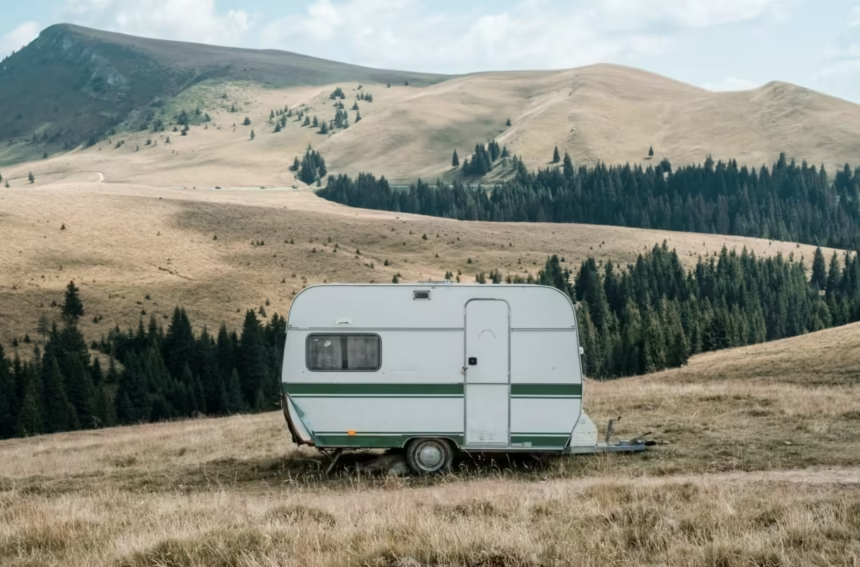
Caravan ownership is fairly common, and there are various types of caravans available, whether you have a static caravan that doesn’t move unless towed, or a moving caravan that doubles up as a vehicle you can drive.
Manually maneuvering a heavy touring caravan can prove quite the challenge, especially when navigating a tight driveway or trying to pitch it. However, it’s physically exhausting and can be hard to do for most.
A single misstep can lead to serious back strains, dented bodywork, or a vehicle that becomes completely stuck. Understanding the common pitfalls of manual moving, as well as implementing simple mechanical solutions, can ensure a stress-free, towing transition.
The Caravan Feels Incredibly Heavy and Refuses to Budge
One of the main problems that occurs when moving a caravan manually is when it feels incredibly heavy and refuses to budge. Attempting to push against the handbrake, doing so on unlevel ground or with slightly sunken tyres, is the mistake many people tend to make.
It’s therefore helpful to double-check that the handbrake is fully released and that you are rocking the caravan gently back and forth to break that initial tyre resistance. You’ll want to ensure the corner steadies are completely wound up before you attempt any physical push.
This will help improve the success of getting it moving, rather than getting it stuck even more.
The Jockey Wheel Sinks into Soft Ground or Grass
Moving a heavy caravan over wet turf, mud, or gravel can often be problematic. The standard nylon jockey wheel that’s often used is what will ultimately lead to it getting stuck or lead to further sinking.
It’s best to upgrade to a wide, heavy-duty rubber jockey wheel or a pneumatic tire that floats over the soft terrain, rather than sinking into it and causing the problem above.
It’s also good to lay down some heavy-duty plastic grip mats or solid wooden tracks over any muddy patches. This is useful to do before moving the chassis.
Back Strain and Physical Fatigue
When it comes to your own personal health and wellbeing, moving a caravan manually can come with a fair bit of physical work.
A lot of those moving a caravan will make the mistake of pushing with their lower back arched or bending over the A-frame incorrectly. You’re therefore relying on upper-body strength to do all the work, and you might not have that available.
Instead, look at repositioning by keeping your spine straight, bending at your knees, and relying on your core and legs instead. This can help to push from the solid structural handles.
The help of spotters is worthwhile to enlist in order to distribute the weight evenly and to share the physical load of moving such a large object.
Loss of Control and Runaway Caravans on Slopes
When you’re ready to move a caravan, it’s good to look at the gradient of a driveway or pitch, as letting gravity take control of the uncoupled weight is a mistake you don’t want to make.
With that being said, moving a caravan should be a two-person job where possible. One person should be permanently stationed right next to the handbrake lever so that they can pull it instantly to keep control of the moving caravan.
Rubber wheel chocks positioned just behind the tyres are great to stop the vehicle if it ends up slipping. Loss of control and runaway caravans can very quickly lead to damage to the caravan and to the surrounding vehicles and obstructions in the way.
Dented Bodywork and Blind-Spot Collisions
Caravans aren’t made from materials like brick, where you can push and lean on them without damage. If you’re pushing the caravan, then you’re likely going to contribute to dented bodywork.
You also want to be well aware of low-level brick walls or gateposts that you might end up hitting as a result of blind spots.
Only apply physical force directly to the dedicated grab handles or the structural steel A-frame at the front. A dedicated spotter at the rear corner can help shout directions in order to clear the blind spots and potential obstacles with ease.
Jackknifing and Sudden Directional Lockups
If you’re forcing a caravan into a tight turn too quickly, then this can cause the tyres to drag or the hitch to bind. That can cause damage to the caravan and the surface it’s on. You’ll need to take wide, gradual paths and use a secondary lever tool that’s attached to the hitch to achieve a more precise steering control.
If the wheels are dragging sideways, then it’s best to pull the caravan straight for a meter in order for the tyre alignment to reset.
Scraped Hitch Assemblies and Low Clearance
If you’re winding the jockey wheel too low, this can cause the expensive hitch head to either break or the breakaway cable to scrape on any curbs.
Instead, adjust the height of the jockey wheel clamp beforehand to keep the A-frame level with the horizon. You’ll also want to keep the hitch cover on during any manual moves to help protect the electrical plugs from any ground impact.
The Ultimate Fix: Investing in a Motor Mover
To help save you time and effort, you can eliminate the need for manual labor on your part entirely and have a caravan mover help with the move itself.
These are great to provide precision parking on steep inclines, tight gravel driveways, and wet grass without any of the physical effort that would have been needed otherwise.
Avoid Common Problems When Moving a Caravan
Moving a caravan manually is one that provides a lot of patience, combined with the correct technique. It’s also essential to have a solid understanding of basic physics to maneuver it correctly from one location to another.
With the use of smart leverage tools or mechanical movers, you’ll be able to park your unit safely without doing any injury to your back as a result. While it’s a stressful effort, moving a caravan manually is achievable, but it may be worth using equipment to move it for you.