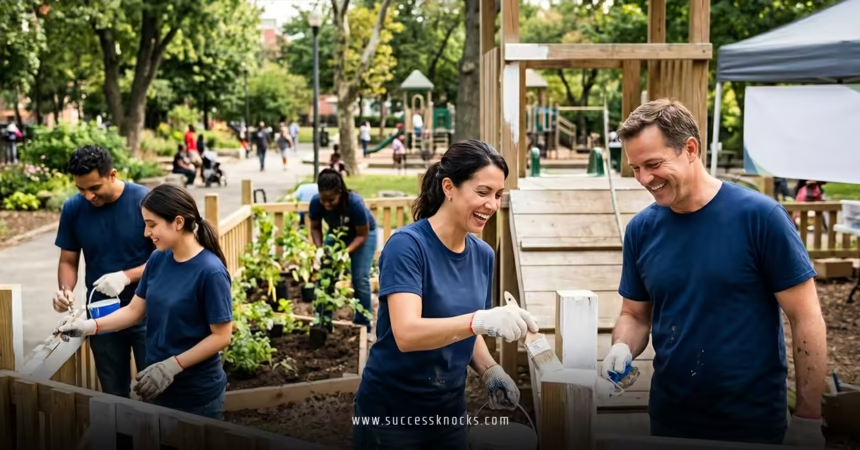
corporate volunteer programs work best when they do three things at once: help a real community need, give employees a reason to show up, and make the company look like it knows how to do more than talk.
- They turn CSR from a slide deck into visible action.
- They help employees build connection, purpose, and team trust.
- They can be designed around local needs, like education, food security, and disaster relief.
- They scale from a one-day event to a full-year engagement strategy.
- They become easier to justify when you track participation, hours, and outcomes.
Here’s the thing: most companies say they value impact, then bury volunteerism under clunky sign-up forms and vague goals. That’s not a program. That’s a missed opportunity.
What corporate volunteer programs actually are
Corporate volunteer programs are structured company-led or company-supported initiatives that let employees give time, skills, or labor to community causes. That can mean:
- team volunteer days
- skilled-based volunteering
- ongoing service partnerships
- paid volunteer time off
- donation drives with hands-on support
- employee-led community projects
The best programs are not random acts of kindness. They’re built around a real strategy. They match business culture, employee interests, and local community needs.
If you’re building around education, a smart place to start is organizing local back to school drive for corporate csr, because it gives volunteer efforts a concrete, seasonal focus and a simple win employees can see fast.
Why corporate volunteer programs matter
A strong volunteer program does more than fill a calendar.
It can:
- improve employee engagement
- strengthen retention
- create cross-team relationships
- deepen local community trust
- support ESG and CSR reporting
- make recruitment messages more credible
That last part matters. Candidates can spot fake purpose talk in seconds. A real volunteer program gives them proof.
And the kicker is this: people remember doing something useful together far more than they remember a motivational email from leadership.
Types of corporate volunteer programs
Not every company needs the same model. Different goals call for different setups.
| Program Type | Best For | What Employees Do | Pros | Watch Outs |
|---|---|---|---|---|
| Team Volunteer Days | Culture-building and entry-level CSR | Serve meals, sort donations, pack kits | Easy to launch, highly visible | Needs tight logistics and good partner coordination |
| Skills-Based Volunteering | Professional services, tech, marketing, finance | Offer expertise to nonprofits | High value, strong employee pride | Requires clear scope and nonprofit readiness |
| Paid Volunteer Time Off | Companies wanting flexible participation | Volunteer independently or in groups | Employee-friendly, scalable | Needs tracking and manager support |
| Cause Campaigns | Seasonal or local impact goals | Collect supplies, fundraise, mentor | Great for awareness and engagement | Can feel thin if not tied to a real need |
How to build corporate volunteer programs that people actually use
Start with a clear business reason
Don’t begin with “we should do something good.”
Begin with:
- employee engagement
- local community impact
- leadership visibility
- recruitment and retention
- ESG reporting
That gives the program a spine. Without that, it turns into a one-off event nobody owns.
Choose causes that fit your people and your footprint
The best programs feel local. Relevant. Close to home.
Ask:
- Where do our employees live and work?
- What needs are visible in those communities?
- Which nonprofits already have trust and infrastructure?
- What causes fit our company culture?
If your company has branches across the U.S., a decentralized model can work well. Let each office choose a local partner, then keep a shared framework for approval and reporting.
Make participation ridiculously easy
If employees need five logins, a committee meeting, and a spreadsheet to volunteer, you’ve already lost them.
Keep it simple:
- one sign-up link
- clear dates and time windows
- short descriptions of the work
- transportation details if needed
- calendar holds for managers
- reminders before each event
Simple beats clever.
Where organizing local back to school drive for corporate csr fits in
This is where corporate volunteer programs get practical fast.
A local back-to-school drive is one of the strongest examples of a volunteer program with a real outcome. Employees are not just donating. They’re helping assemble backpacks, organize supply kits, coordinate pickup, and support local students in a visible, useful way.
That makes organizing local back to school drive for corporate csr a smart campaign inside a broader employee volunteer strategy.
Why it works:
- it has a clear seasonal deadline
- the need is easy to explain
- employees can participate at different levels
- schools and nonprofits know how to handle distribution
- results are easy to measure
If you want a volunteer initiative that feels grounded instead of generic, this is a solid one.
Step-by-step plan for launching a corporate volunteer program
Define the goal
Pick one primary goal.
Examples:
- increase employee participation
- build local community trust
- support one signature nonprofit
- create a year-round CSR platform
Trying to do everything at once usually muddies the program.
Secure leadership support
You do not need a giant speech. You need a sponsor who will back the time, budget, and communications.
Leadership should support:
- volunteer time off
- event scheduling
- internal promotion
- budget for supplies or transportation
Find partner organizations
Look for nonprofits or schools that already know how to work with volunteers.
Good partners will tell you:
- what help they actually need
- how many volunteers they can manage
- what training or background checks are required
- what dates fit their calendar
Build the employee experience
Think like an employee, not an administrator.
Ask:
- What would make this easy to join?
- What would make it worth showing up?
- What kind of work feels meaningful, not forced?
That might mean packing backpacks for a local school drive, sorting donations at a food bank, or helping with a clean-up event on a Friday afternoon.
Measure what matters
Track more than attendance.
Useful metrics include:
- volunteer hours
- participation rate
- number of employees involved
- number of nonprofit partners supported
- supplies packed or services delivered
- post-event feedback from employees and partners
If you want the program to grow, measurement is not optional.

Common mistakes in corporate volunteer programs
Mistake 1: Choosing the wrong activity
Not every cause fits every workforce.
Fix it by matching the volunteer work to the team’s energy, location, and skill set. Office teams often do well with packing events, mentoring, or admin support. Field teams may prefer hands-on local projects.
Mistake 2: Making it too complicated
If the signup process feels like tax filing, people will bail.
Fix it by stripping the process down to the essentials. One page. One date. One clear call to action.
Mistake 3: Treating it like a one-day PR stunt
Employees can tell when a program exists for optics only.
Fix it by building continuity. A few recurring volunteer moments beat one flashy event with no follow-through.
Mistake 4: Ignoring local relevance
National campaigns are fine. But local wins create stronger loyalty.
Fix it by tying the program to real neighborhood needs. That’s one reason organizing local back to school drive for corporate csr gets traction so quickly. It solves a local problem in a way people can see.
How to keep the program fresh year after year
Volunteer fatigue is real.
To keep interest up:
- rotate cause areas
- vary in-person and remote options
- feature employee stories
- let teams nominate local partners
- offer family-friendly events when appropriate
- refresh communications with real impact, not slogans
Think of the program like a good gym routine. Same muscle groups, different angles. If every event feels identical, participation will flatten.
Best practices for leaders and CSR teams
- Start small, then scale.
- Choose one clear owner.
- Use local partners, not assumptions.
- Make participation easy on employees.
- Tie the program to actual community need.
- Report results in plain language.
- Keep the tone human. No one wants to volunteer for a spreadsheet.
Key Takeaways
- corporate volunteer programs work when they solve a real need and fit company culture.
- The best programs are easy to join, easy to explain, and easy to measure.
- Employee participation rises when the work feels local, practical, and visible.
- Skills-based volunteering, team service days, and paid volunteer time off each serve different goals.
- organizing local back to school drive for corporate csr is a strong example of a simple, high-impact volunteer initiative.
- Tracking hours, participation, and outcomes makes the program easier to defend and scale.
- Strong nonprofit partnerships keep the work focused and respectful.
- A good volunteer program should feel like part of the company, not a side project.
If you want employees to care, give them something real to do. Start with one cause, one partner, and one clean execution. That’s how a volunteer program stops being a perk and starts becoming part of the culture.
FAQs
What makes corporate volunteer programs successful?
Corporate volunteer programs succeed when the cause is relevant, the process is simple, and employees can see the impact. Clear planning and reliable community partners matter just as much as enthusiasm.
How do corporate volunteer programs support CSR goals?
They turn social responsibility into action. Instead of only donating money, the company contributes time, skills, and team energy to local causes, which helps with employee engagement and community trust.
Can organizing local back to school drive for corporate csr be part of a volunteer program?
Yes. It’s one of the easiest ways to launch a practical volunteer initiative because employees can pack supplies, sort donations, and help deliver support to local students in a direct, visible way.